
Rivastigmine transdermal patch,
does it really help with Symptomatic attenuation of cognitive and daily-function decline in mild-to-moderate Alzheimer's disease?
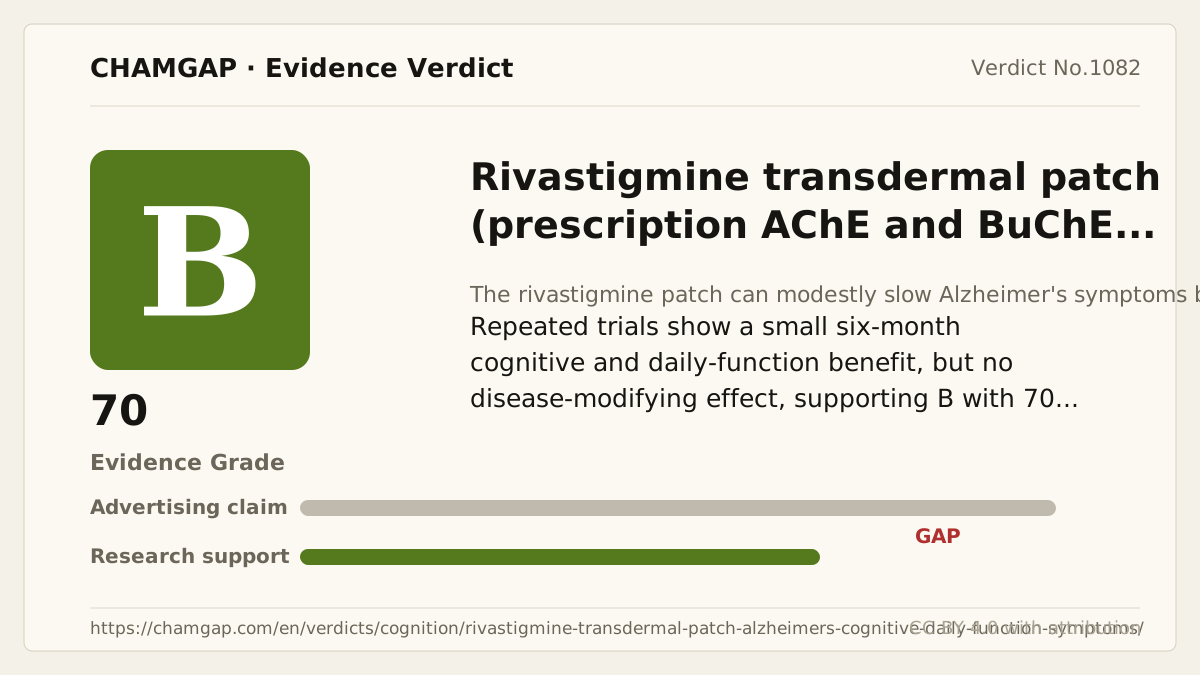
research showsThe rivastigmine patch is rated B because it modestly slows cognitive and daily-function decline for about six months in mild-to-moderate Alzheimer's disease. A 2015 Cochrane review found that oral rivastigmine 6 to 12 mg/day or the 9.5-mg/day patch improved 26-week ADAS-Cog by a mean 1.79 points versus placebo (95% CI 1.37 to 2.21) and activities of daily living by SMD 0.20 (95% CI 0.13 to 0.27) across seven trials with 3,450 participants. In the IDEAL trial, the 9.5-mg/24-hour patch was 1.6 ADAS-Cog points better than placebo, was noninferior to high-dose capsules, and caused less nausea and vomiting. The benefit is consistent but small and symptomatic, with no evidence that it changes pathology or the long-term disease course, supporting B with 70 points in parity with galantamine.
ads claimDescriptions can inflate an average one-to-two-point short-term scale difference into restored memory, guaranteed independence, or halted Alzheimer's progression. The evidence instead shows a modest symptomatic slowing over roughly six months, with substantial variation in response and tolerability.
Useful facts when choosing a product
- Rivastigmine is a prescription symptomatic treatment that inhibits acetylcholinesterase and butyrylcholinesterase; it does not remove Alzheimer's pathology or cure the disease.
- The patch is applied once daily to intact, relatively hairless skin with rotation of the site, and the previous patch must be removed before a new one is applied to avoid duplicate dosing.
- The patch can cause less nausea and vomiting than capsules with similar exposure, but appetite loss, weight loss, dizziness, bradycardia or syncope, and application-site erythema or pruritus still require monitoring.
- Restarting after several missed days or increasing the dose requires prescriber reassessment and retitration, with regular review of real cognitive or functional benefit alongside adverse effects.
Chamgap Semantic Classification Code
Candidate index · review held
M.rivastigmine-transdermal-patch.transdermal.symptomatic-attenuation-of-cognitive-and-daily-function-decline-in-mild-to-moderate-alzheimers-disease.reduce.MULTIMedicinal interventions > Rivastigmine transdermal patch > Transdermal > Symptomatic attenuation of cognitive and daily-function decline in mild-to-moderate Alzheimer's disease > Reduction claim > Multiple: primary unresolved
An automated migration candidate, not an issued permanent code; exact claim scope remains under review. This machine-generated migration candidate helps retrieval but is not a permanent assignment. The original verdict ID and URL remain authoritative.
What the research actually shows
The 2015 Cochrane review by Birks, Chong, and Grimley Evans included 13 trials lasting 12 to 52 weeks; seven trials with 3,450 participants contributed to the main comparison of oral 6 to 12 mg/day or transdermal 9.5 mg/day rivastigmine versus placebo. At 26 weeks, ADAS-Cog MD was -1.79 (95% CI -2.21 to -1.37; 3,232 participants in six trials), MMSE MD was 0.74 (95% CI 0.52 to 0.97; 3,205 participants in six trials), and activities-of-daily-living SMD was 0.20 (95% CI 0.13 to 0.27; 3,230 participants in six trials). IDEAL randomized 1,195 people across 21 countries for 24 weeks; the 9.5-mg/24-hour patch differed from placebo by 1.6 ADAS-Cog points (p=0.005) and 0.3 ADCS-CGIC points (p=0.01). It was noninferior to capsules, while nausea occurred in 7.2% versus 23.1% and vomiting in 6.2% versus 17.0%.
Why this is classified as B (70)
Cochrane's 3,450-participant main analysis and the 1,195-participant IDEAL trial consistently support 24-to-26-week benefits in cognition, daily function, and global assessment. However, an ADAS-Cog MD of -1.79 is small and of uncertain clinical importance, all usable trials were industry supported, and disease modification is unproven. Parity with galantamine yields B with 70 points.
Counterpoint. Because the average benefit is small, treatment goals should be explicitly symptomatic and continuation should be reconsidered with the prescriber when no functional benefit emerges or when weight loss, bradycardia, or skin reactions become problematic.
Rejudgment record. New verdict — Credited the 2015 Cochrane estimates of ADAS-Cog MD -1.79 and daily-function SMD 0.20 plus IDEAL's placebo-controlled patch benefit and noninferiority to capsules, but applied B in parity with galantamine because effects were modest, clinical importance was uncertain, trials were industry concentrated, and disease modification was unproven
Sub-claim grades by effect
This ingredient is marketed for several effects. A single overall grade blends strong and weak claims together, so each effect is graded separately here. The overall grade reflects the strongest disconfirming or core claim.
| Effect (sub-claim) | Grade | Basis |
|---|---|---|
| Attenuation of cognitive decline in mild-to-moderate Alzheimer's disease | B | Repeated randomized evidence showed a consistent small benefit, with a 26-week ADAS-Cog MD of -1.79 points. |
| Attenuation of daily-function decline in mild-to-moderate Alzheimer's disease | B | Cochrane found a daily-function SMD of 0.20, and the IDEAL patch analyses supported benefit versus placebo. |
| Modification of Alzheimer's pathology and the long-term disease course | ? | Demonstrated effects are symptomatic scale changes; no human efficacy literature shows alteration of the underlying pathology. |
Cross-check — AI research and Codex final gate
Evidence Table
| Study | Design | Sample | Funding | Endpoint | Result | Weight |
|---|---|---|---|---|---|---|
| Birks JS, Chong LY, and Grimley Evans J. 2015 Cochrane review | Systematic review and meta-analysis of double-blind placebo-controlled randomized trials | Thirteen included trials; seven trials with 3,450 participants in the main analysis | All trials with usable data were industry funded or sponsored; the Cochrane review itself was noncommercial | Twenty-six-week ADAS-Cog, MMSE, activities of daily living, and clinician-rated global change | ADAS-Cog MD was -1.79 (95% CI -2.21 to -1.37), MMSE MD 0.74 (0.52 to 0.97), daily-function SMD 0.20 (0.13 to 0.27), and the OR for no global improvement or deterioration was 0.68 (0.58 to 0.80). | Key repeated synthesis; modest effects and attrition-bias concerns |
| Winblad B et al. 2007 IDEAL | Twenty-four-week multinational randomized double-blind double-dummy placebo- and active-controlled trial | 1,195 participants with Alzheimer's disease from 21 countries | Novartis development trial | ADAS-Cog, ADCS-CGIC, and patch-versus-capsule tolerability | The 9.5-mg/24-hour patch was better than placebo by 1.6 ADAS-Cog points (p=0.005) and 0.3 ADCS-CGIC points (p=0.01), and was noninferior to capsules. Nausea was 7.2% versus 23.1% and vomiting 6.2% versus 17.0%. | Pivotal direct patch trial; manufacturer supported |
Receipt — 2 References
All 2 cited sources were verified for existence at the original page (as of 2026-07-22).
Final verification and publication gate: Codex · Evidence date: 2026-07-22 · Corrections: none
Cite this verdict
[Chamgap] Rivastigmine transdermal patch x symptomatic attenuation of cognitive and daily-function decline in Alzheimer's disease — Evidence Grade B·70. 2 cited sources checked. Source: https://chamgap.com/en/verdicts/cognition/rivastigmine-transdermal-patch-alzheimers-cognitive-daily-function-symptoms/ · CC BY 4.0CC BY 4.0 — free to use with attribution; do not distort grades, numbers, or verdict meaning.
What this document does and does not do
Chamgap is an information source. It reports what research has and has not confirmed; it does not tell readers what to take or buy. That decision belongs to readers and, when needed, medical or legal professionals. This verdict reflects literature available up to the search date and may change as new research appears. Nothing here is medical advice.