
Rimegepant every other day,
does it really help with Reduction in monthly migraine days for adult migraine prevention?
research showsRimegepant every other day is rated C. Two manufacturer-led placebo-controlled trials reduced monthly migraine days by about 0.8 to 1.1 additional days, but this small effect lacks an established minimal clinically important difference and the decisive evidence comes only from the Biohaven and Pfizer program.
ads claimMarketing can expand a statistically significant average difference into the impression that migraine is largely prevented. The additional average reduction was about one day per month, with variable individual response.
Useful facts when choosing a product
- The confirmatory regimen was rimegepant 75 mg every other day for 12 weeks.
- The United States trial randomized 747 and analyzed 695 for primary efficacy; the Japanese trial treated 496 and analyzed 484 for efficacy.
Chamgap Semantic Classification Code
Candidate index · review held
UNK.rimegepant.oral.monthly-migraine-days-migraine-prevention.prevent.placeboUnknown > Rimegepant > Oral > monthly migraine days migraine prevention > Occurrence-prevention claim > Placebo
An automated migration candidate, not an issued permanent code; exact claim scope remains under review. This machine-generated migration candidate helps retrieval but is not a permanent assignment. The original verdict ID and URL remain authoritative.
What the research actually shows
Croop 2021 randomized 747 participants, while the prespecified primary efficacy analysis included 695: 348 assigned rimegepant and 347 placebo. Monthly migraine days during weeks 9 to 12 changed by -4.3 versus -3.5, a between-group difference of -0.8 days (95% CI -1.46 to -0.20), P=0.0099, so the primary endpoint succeeded. The Kitamura 2025 Japanese trial treated 496 participants and analyzed 484 for efficacy; its difference was -1.1 days (95% CI -1.73 to -0.38), P=0.002, also a successful primary endpoint. Both trials were sponsored by Biohaven or Pfizer, with company employees involved in design, analysis, and writing. The boundary between fact and unsupported extension is clear: a statistically significant reduction in monthly migraine days is factual, but an established MCID-level effect or independently funded replication is not demonstrated. Verdict 1042, which is B with 75 points, concerns two-hour pain and associated-symptom freedom in acute migraine; acute treatment and prevention are separate and its evidence was not transferred. In the preventive landscape, verdict 1091, which is B with 74 points, for topiramate and verdict 129, which is B with 66 points, for riboflavin are higher. Verdict 1675, which is C with 45 points, for oral magnesium, verdict 1826, which is C with 54 points, for melatonin, and verdict 1696, which is C with 50 points, for acupuncture occupy the same grade band. Verdict 1850, which is F with 12 points, for episodic botulinum toxin differs because it has repeated null results and C1 precision, whereas both rimegepant primary endpoints were positive.
Why this is classified as C (50)
P, R1, I0, E~, and B0 derive C with 50 points because the two trials are not independent replications outside the Biohaven-Pfizer development program.
Counterpoint. Preventive selection should consider monthly migraine days, acute-medication use, comorbidity, cost, and preference. Evidence for acute rimegepant use is a separate verdict.
Rejudgment record. Cross-check applied — Accepted two successful placebo-controlled trials while applying ceilings for an unestablished clinically important effect of 0.8 to 1.1 monthly days and manufacturer-only evidence
| Endpoint | P | Symptom or function itself is the target - including patient reports and performance tests |
| Replication | R1 | Single confirmatory trial |
| Independence | I0 | Evidence comes only from manufacturer studies |
| Effect size | E~ | Statistically positive but below the threshold |
Stored derived and displayed grades match; this is not a current recalculation or validity check (C).
Sub-claim grades by effect
This ingredient is marketed for several effects. A single overall grade blends strong and weak claims together, so each effect is graded separately here. The overall grade reflects the strongest disconfirming or core claim.
| Effect (sub-claim) | Grade | Basis |
|---|---|---|
| Reduction in monthly migraine days | C | Two trials found 0.8 to 1.1 additional days of reduction, without an established clinically important threshold. |
| At least 50% monthly-migraine-day response | C | Positive responder signals do not overcome the manufacturer-only program and small average effect. |
| Sustained reduction in monthly migraine days over 12 weeks | C | Reduction persisted through the final four weeks, but the placebo-adjusted average difference was about one day. |
Cross-check — AI research and Codex final gate
Evidence Table
| Study | Design | Sample | Funding | Endpoint | Result | Weight |
|---|---|---|---|---|---|---|
| Croop R et al. 2021 | Phase 2/3 multicenter randomized double-blind placebo-controlled trial | 747 randomized; 695 in the primary efficacy analysis, 348 versus 347 | Manufacturer sponsorship by Biohaven Pharmaceuticals with employee coauthors | Change from observation in monthly migraine days during weeks 9 to 12 | -4.3 versus -3.5 days; difference -0.8 (95% CI -1.46 to -0.20), P=0.0099; primary endpoint succeeded | Key direct positive trial |
| Kitamura S et al. 2025 | Japanese phase 3 multicenter randomized double-blind placebo-controlled trial | 496 treated and analyzed for safety; 484 in the primary efficacy analysis | Sponsored by Biohaven Pharmaceuticals, later acquired by Pfizer, with multiple Pfizer employee coauthors | Change in monthly migraine days during the final four weeks of 12-week treatment | Difference -1.1 days (95% CI -1.73 to -0.38), P=0.002; primary endpoint succeeded | Geographic replication within the same manufacturer program |
Receipt — 2 References
All 2 cited sources were verified for existence at the original page (as of 2026-07-24).
Final verification and publication gate: Codex · Evidence date: 2026-07-24 · Corrections: none
Cite this verdict
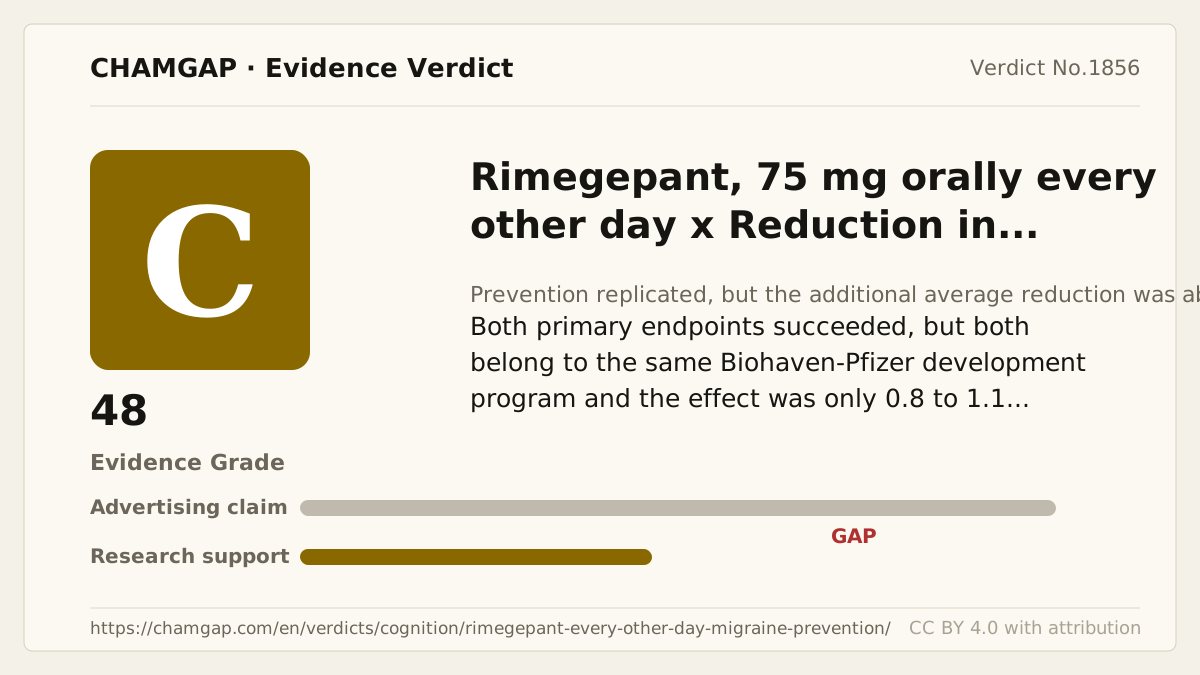
[Chamgap] Rimegepant every other day x migraine prevention — Evidence Grade C·50. 2 cited sources checked. Source: https://chamgap.com/en/verdicts/cognition/rimegepant-every-other-day-migraine-prevention/ · CC BY 4.0CC BY 4.0 — free to use with attribution; do not distort grades, numbers, or verdict meaning.
What this document does and does not do
Chamgap is an information source. It reports what research has and has not confirmed; it does not tell readers what to take or buy. That decision belongs to readers and, when needed, medical or legal professionals. This verdict reflects literature available up to the search date and may change as new research appears. Nothing here is medical advice.