
Blocking phone notifications,
does it really help with Fewer sustained-attention task errors?
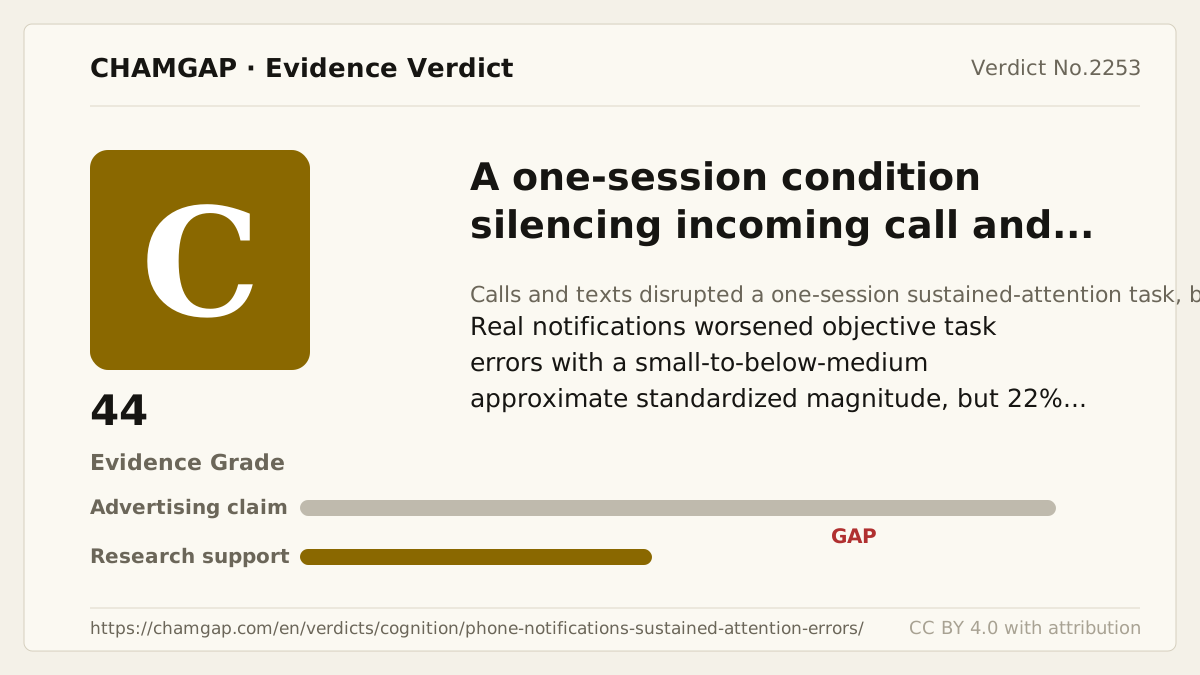
research showsThe grade is C. A one-session experiment randomized 212 students to call, text, or no-study-notification conditions. In the primary analysis of 166 after 46 exclusions, SART commission errors increased more in the notification conditions. The approximate between-group standardized magnitude was 0.292 in the primary analysis and 0.213 in the all-randomized sensitivity analysis. The reported d-z values of 0.72 and 0.54 were within-group block changes, not between-group effects versus no notification. A brief laboratory task cannot establish durable everyday concentration or ADHD benefit.
ads claimThis experiment shows that an unanswered call or text can disrupt a single numerical response task. It did not test durable work performance or treatment of ADHD. Verdict 2200 is C with 54 points for pre-bed phone cessation and sleep, a different intervention and endpoint.
Useful facts when choosing a product
- The study program sent four real call or text notifications to participants' own phones during the second SART block.
- SART was a one-session laboratory task requiring keypresses for digits other than three.
- Forty-six of 212 randomized participants were excluded; the analysis included 50 call, 57 text, and 59 no-notification participants.
- Within-notification-group block changes were d-z 0.72 for calls and 0.54 for texts, not standardized between-group effects versus control.
Chamgap Semantic Classification Code
Candidate index · review held
UNK.one-session-condition-silencing-incoming-call-and-text-notifications-and-putting-the-phone-away.UNK.fewer-sustained-attention-task-errors.assess.UNKUnknown > one-session condition silencing incoming call and text notifications and putting the phone away > Unknown > Fewer sustained-attention task errors > Association or change assessment > Unknown
An automated migration candidate, not an issued permanent code; exact claim scope remains under review. This machine-generated migration candidate helps retrieval but is not a permanent assignment. The original verdict ID and URL remain authoritative.
What the research actually shows
Florida State psychology students were randomized into three conditions, leaving 50 call, 57 text, and 59 no-notification participants in the primary analysis. Twenty were excluded for looking at or handling the phone, 13 because the phone was off, nine for missing data, and four for other reasons: 46 of 212, or 21.7%. The program sent four notifications to participants' own phones during the second SART block, after trials 1, 91, 181, and 271; control received no study notification. No registration or prespecified primary endpoint was identified. The public manuscript did not provide a funding or industry-conflict statement, so funding independence could not be established.
Why this is classified as C (46)
Real notification delivery, randomization, an objective task, and an all-randomized sensitivity analysis are strengths. One session, 21.7% primary-analysis exclusion, and an approximate rather than precise between-group magnitude give C with 46 points.
Counterpoint. C does not mean notifications are irrelevant. It means laboratory disruption was detected while its durable real-world or clinical magnitude remains uncertain.
Rejudgment record. Cross-check applied — Objective SART effects after randomized real-notification delivery, with correction for misuse of within-group effect sizes and consideration of exclusions and one-session design
| Endpoint | P | Symptom or function itself is the target - including patient reports and performance tests |
| Replication | R1 | Single confirmatory trial |
| Independence | I1 | Mixed funding sources |
| Effect size | E~ | Statistically positive but below the threshold |
Stored derived and displayed grades match; this is not a current recalculation or validity check (C).
Sub-claim grades by effect
This ingredient is marketed for several effects. A single overall grade blends strong and weak claims together, so each effect is graded separately here. The overall grade reflects the strongest disconfirming or core claim.
| Effect (sub-claim) | Grade | Basis |
|---|---|---|
| Fewer commission errors on a one-session SART | C | The notification-versus-control interaction was significant, with an approximate between-group standardized magnitude of 0.292. |
| Fewer very fast responses after blocking text notifications | D | Block change did not differ between text and no-notification conditions. |
| Durable improvement in everyday concentration | ? | Everyday functioning and long-term follow-up were not measured. |
Cross-check — AI research and Codex final gate
Evidence Table
| Study | Design | Sample | Funding | Endpoint | Result | Weight |
|---|---|---|---|---|---|---|
| Stothart et al. 2015 | Three-arm randomized one-session laboratory experiment | 212 randomized; 166 in primary analysis, 50 call, 57 text, and 59 no notification | No funding statement identified in the public manuscript | SART commission errors and very fast responses | Commission-error block-by-condition chi-square(2)=14.15, P<0.001; notification-versus-control interaction b=0.047, 95% CI 0.021-0.073 | Real notifications and objective task, but 46 exclusions and one session |
Receipt — 2 References
All 2 cited sources were verified for existence at the original page (as of 2026-08-05).
Final verification and publication gate: Codex · Evidence date: 2026-08-05 · Corrections: none
Cite this verdict
[Chamgap] Blocking phone notifications x sustained-attention errors — Evidence Grade C·46. 2 cited sources checked. Source: https://chamgap.com/en/verdicts/cognition/phone-notifications-sustained-attention-errors/ · CC BY 4.0CC BY 4.0 — free to use with attribution; do not distort grades, numbers, or verdict meaning.
What this document does and does not do
Chamgap is an information source. It reports what research has and has not confirmed; it does not tell readers what to take or buy. That decision belongs to readers and, when needed, medical or legal professionals. This verdict reflects literature available up to the search date and may change as new research appears. Nothing here is medical advice.