
Patent foramen ovale closure,
does it really help with Reduced or eliminated migraine attacks in medication-refractory migraine?
research showsThe grade is D. In PREMIUM, a 50% or greater attack reduction occurred in 45/117 (38.5%) after closure versus 33/103 (32.0%) after sham, difference 6.4 points, 95% CI -6.2 to 19.0, P=0.32, missing the primary endpoint. MIST found complete cessation in 3/74 versus 3/73, P=0.51, and PRIMA also missed its monthly migraine-day primary endpoint.
ads claimAura or a large PFO does not by itself establish migraine-treatment efficacy. Marketing should disclose both secondary signals and the three failed primary endpoints.
Useful facts when choosing a product
- PFO closure is an invasive catheter procedure that places an occluder across the atrial communication.
- PREMIUM and MIST were double-blind sham-controlled trials; PRIMA compared closure with medical therapy without sham.
- No existing verdict for the same PFO-closure and migraine combination was identified.
Chamgap Semantic Classification Code
Candidate index · review held
UNK.percutaneous-patent-foramen-ovale-closure.transdermal.or-eliminated-migraine-attacks-in-medication-refractory-migraine.reduce.shamUnknown > Percutaneous patent foramen ovale closure > Transdermal > or eliminated migraine attacks in medication-refractory migraine > Reduction claim > Sham procedure or device
An automated migration candidate, not an issued permanent code; exact claim scope remains under review. This machine-generated migration candidate helps retrieval but is not a permanent assignment. The original verdict ID and URL remain authoritative.
What the research actually shows
PREMIUM was supported by AGA Medical and St Jude Medical. MIST, supported by NMT Medical, randomized 147, 74 versus 73, and found complete migraine cessation during days 91-180 in 3/74 versus 3/73, P=0.51. PRIMA, supported by St Jude Medical, randomized 107, 53 versus 54, and found a change of -2.9 versus -1.7 monthly migraine days during months 9-12, P=0.17. Confidence intervals for MIST and PRIMA were not reported in the original articles. All three trials had device-manufacturer support.
Why this is classified as D (30)
Even excluding smaller limitation-prone trials, the null 230-participant sham-controlled PREMIUM trial supports D; its interval still permits limited benefit, giving D with 30 points.
Counterpoint. This verdict addresses closure for migraine and does not grade PFO closure for recurrent-stroke prevention.
Rejudgment record. Cross-check applied — The 230-participant sham-controlled PREMIUM trial missed its primary endpoint, sustaining the null conclusion without smaller flawed trials, while its upper confidence limit permits limited meaningful benefit
| Endpoint | P | Symptom or function itself is the target - including patient reports and performance tests |
| Replication | RX | Repeatedly refuted in the same indication |
| Independence | I0 | Evidence comes only from manufacturer studies |
| Effect size | E0 | Null |
| Precision | C0 | The confidence interval leaves room for benefit |
Stored derived and displayed grades match; this is not a current recalculation or validity check (D).
Sub-claim grades by effect
This ingredient is marketed for several effects. A single overall grade blends strong and weak claims together, so each effect is graded separately here. The overall grade reflects the strongest disconfirming or core claim.
| Effect (sub-claim) | Grade | Basis |
|---|---|---|
| At least 50% reduction in attacks | D | PREMIUM's prespecified primary result was 38.5% versus 32.0%, P=0.32. |
| Complete migraine remission | D | MIST's primary result was three versus three; PREMIUM's positive finding was secondary. |
Cross-check — AI research and Codex final gate
Evidence Table
| Study | Design | Sample | Funding | Endpoint | Result | Weight |
|---|---|---|---|---|---|---|
| Tobis et al. 2017 PREMIUM | Multicenter randomized double-blind sham-controlled trial | 230 randomized; 220 in the primary efficacy analysis, 117 versus 103 | AGA Medical and St Jude Medical device program | Responder rate with at least 50% reduction in migraine attacks, the primary efficacy endpoint | 45/117 (38.5%) versus 33/103 (32.0%), difference 6.4 points, 95% CI -6.2 to 19.0, P=0.32. | Largest sham-controlled primary-endpoint failure |
| Dowson et al. 2008 MIST | Multicenter randomized double-blind sham-controlled trial | 147 randomized and analyzed, 74 versus 73 | NMT Medical STARFlex device program | Complete migraine cessation during days 91 to 180, the primary endpoint | 3/74 versus 3/73, P=0.51; prespecified secondary endpoints also were not met. | Repeated primary failure in a separate device program |
| Mattle et al. 2016 PRIMA | Multicenter randomized open-label medical-therapy-controlled trial | 107 randomized, 53 versus 54 | Supported through the Amplatzer device program | Change in monthly migraine days during months 9 to 12, the primary endpoint | -2.9 versus -1.7 days, P=0.17, not significant. | Third prespecified primary-endpoint failure |
Receipt — 3 References
All 3 cited sources were verified for existence at the original page (as of 2026-08-01).
Final verification and publication gate: Codex · Evidence date: 2026-08-01 · Corrections: none
Cite this verdict
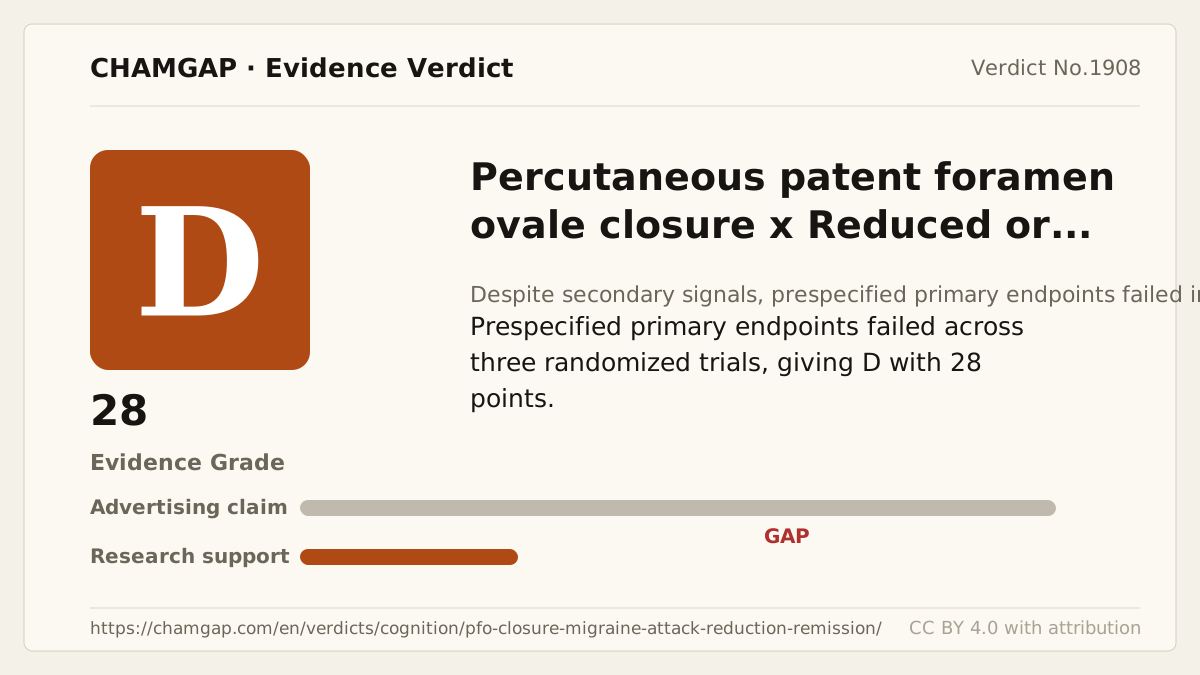
[Chamgap] Patent foramen ovale closure x migraine reduction or remission — Evidence Grade D·30. 3 cited sources checked. Source: https://chamgap.com/en/verdicts/cognition/pfo-closure-migraine-attack-reduction-remission/ · CC BY 4.0CC BY 4.0 — free to use with attribution; do not distort grades, numbers, or verdict meaning.
What this document does and does not do
Chamgap is an information source. It reports what research has and has not confirmed; it does not tell readers what to take or buy. That decision belongs to readers and, when needed, medical or legal professionals. This verdict reflects literature available up to the search date and may change as new research appears. Nothing here is medical advice.