
Periodontitis,
does it really help with Increased incidence of Parkinson disease?
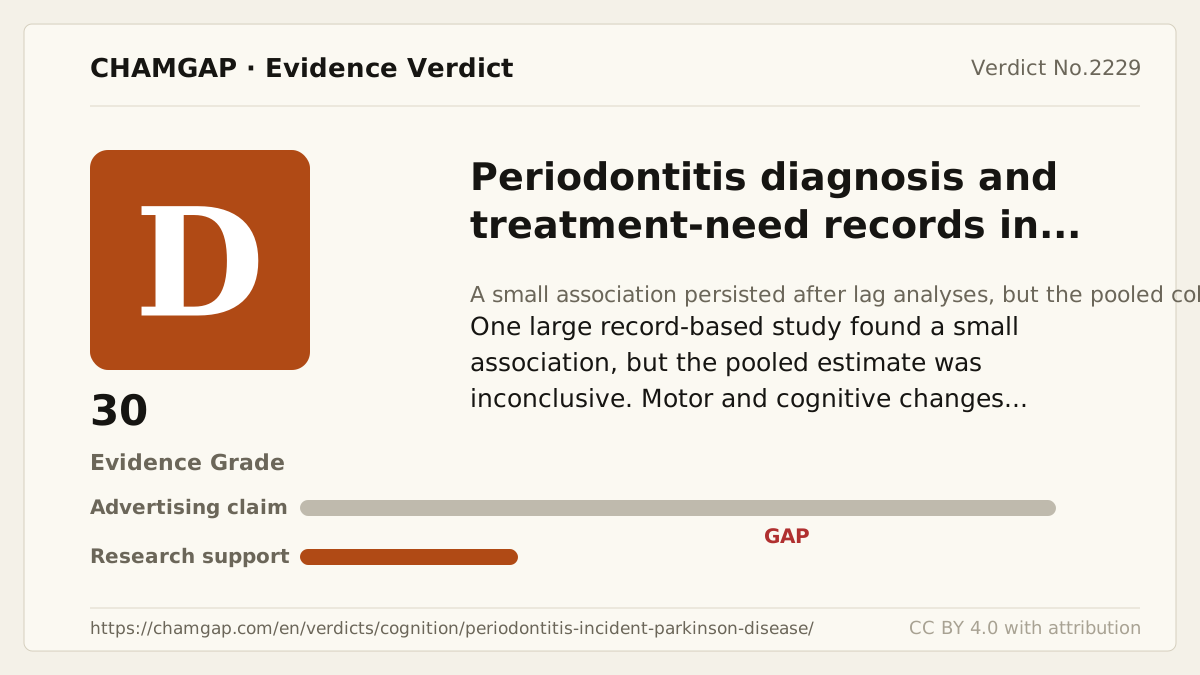
research showsThe grade is D. A Korean insurance cohort found a small association, but the pooled HR across three cohorts and 7,298,955 people was 1.13 (95% CI 0.88 to 1.45), which was null. Misclassification from care codes, differences in health-care use, and residual reverse causation create substantial bias concerns. The score is 30.
ads claimA record-based association cannot be converted into a claim that gum disease causes Parkinson disease or that scaling prevents it. Lag analyses reduce one bias but do not create randomized intervention evidence.
Useful facts when choosing a product
- Exposure used K05.3 and treatment procedures rather than measured pocket depth.
- After excluding the first three and five years, overall HRs were 1.103 and 1.109.
- The severe-periodontitis HR was 0.987 (0.820 to 1.188), showing no consistent severity gradient.
Chamgap Semantic Classification Code
Candidate index · review held
UNK.periodontitis-diagnosis-and-treatment-need-records-in-national-health-insurance-data.UNK.incidence-of-parkinson-disease.increase.UNKUnknown > Periodontitis diagnosis and treatment-need records in national health insurance data > Unknown > incidence of Parkinson disease > Increase claim > Unknown
An automated migration candidate, not an issued permanent code; exact claim scope remains under review. This machine-generated migration candidate helps retrieval but is not a permanent assignment. The original verdict ID and URL remain authoritative.
What the research actually shows
The study followed 6,825,684 final participants from a 2009 health-checkup cohort through 2017. Periodontitis severity was based on K05.3 diagnosis and procedures such as scaling, subgingival curettage, and surgery, not full clinical probing. Parkinson disease required G20 plus the rare-disease registration code. Models adjusted for age, sex, smoking, alcohol, exercise, income, BMI, diabetes, hypertension, dyslipidemia, stroke, and depression. Excluding the first three and five years left overall periodontitis HRs of 1.103 (1.069 to 1.138) and 1.109 (1.068 to 1.151). This reduces but cannot eliminate reverse causation because prodromal disease may precede diagnosis and exposure severity was procedure-coded.
Why this is classified as D (30)
A small association in one large cohort contrasted with a null pooled HR of 1.13 (0.88 to 1.45). Care-code misclassification, differences in health-care use, and residual reverse causation prevent a causal claim, while the wide interval prevents exclusion, giving D with 30 points.
Counterpoint. Incident dementia is a different endpoint and was not pooled with Parkinson disease merely because both are neurodegenerative disorders.
Rejudgment record. Cross-check applied — Small association in a large cohort, null pooled cohort estimate, care-code misclassification, health-care-use differences, and residual reverse causation
| Endpoint | H | Hard endpoint - actual events such as death |
| Replication | R1 | Single confirmatory trial |
| Independence | I1 | Mixed funding sources |
| Effect size | E0 | Null |
| Precision | C0 | The confidence interval leaves room for benefit |
Stored derived and displayed grades match; this is not a current recalculation or validity check (D).
Sub-claim grades by effect
This ingredient is marketed for several effects. A single overall grade blends strong and weak claims together, so each effect is graded separately here. The overall grade reflects the strongest disconfirming or core claim.
| Effect (sub-claim) | Grade | Basis |
|---|---|---|
| Increased Parkinson disease incidence after periodontitis | D | Despite a small individual association, the pooled HR included one. |
Cross-check — AI research and Codex final gate
Evidence Table
| Study | Design | Sample | Funding | Endpoint | Result | Weight |
|---|---|---|---|---|---|---|
| Jeong et al. 2021 Korean NHIS cohort | Nationwide retrospective observational cohort | 6,825,684 final participants; 28,279 Parkinson disease events | The article reported no external funding | Incident Parkinson disease diagnosis | Overall HR 1.090 (1.060 to 1.121); three-year lag 1.103 (1.069 to 1.138); five-year lag 1.109 (1.068 to 1.151) | Key large individual cohort |
| Chen et al. 2023 systematic review and meta-analysis | Meta-analysis of three cohorts | 7,298,955 people | Funding across included studies was mixed or incompletely verified | Incident Parkinson disease | Pooled HR 1.13 (95% CI 0.88 to 1.45), I-squared 96% | Decisive null pooled evidence |
Receipt — 2 References
All 2 cited sources were verified for existence at the original page (as of 2026-08-04).
Final verification and publication gate: Codex · Evidence date: 2026-08-04 · Corrections: none
Cite this verdict
[Chamgap] Periodontitis x incident Parkinson disease — Evidence Grade D·30. 2 cited sources checked. Source: https://chamgap.com/en/verdicts/cognition/periodontitis-incident-parkinson-disease/ · CC BY 4.0CC BY 4.0 — free to use with attribution; do not distort grades, numbers, or verdict meaning.
What this document does and does not do
Chamgap is an information source. It reports what research has and has not confirmed; it does not tell readers what to take or buy. That decision belongs to readers and, when needed, medical or legal professionals. This verdict reflects literature available up to the search date and may change as new research appears. Nothing here is medical advice.