
Periodontitis,
does it really help with Increased incidence of dementia?
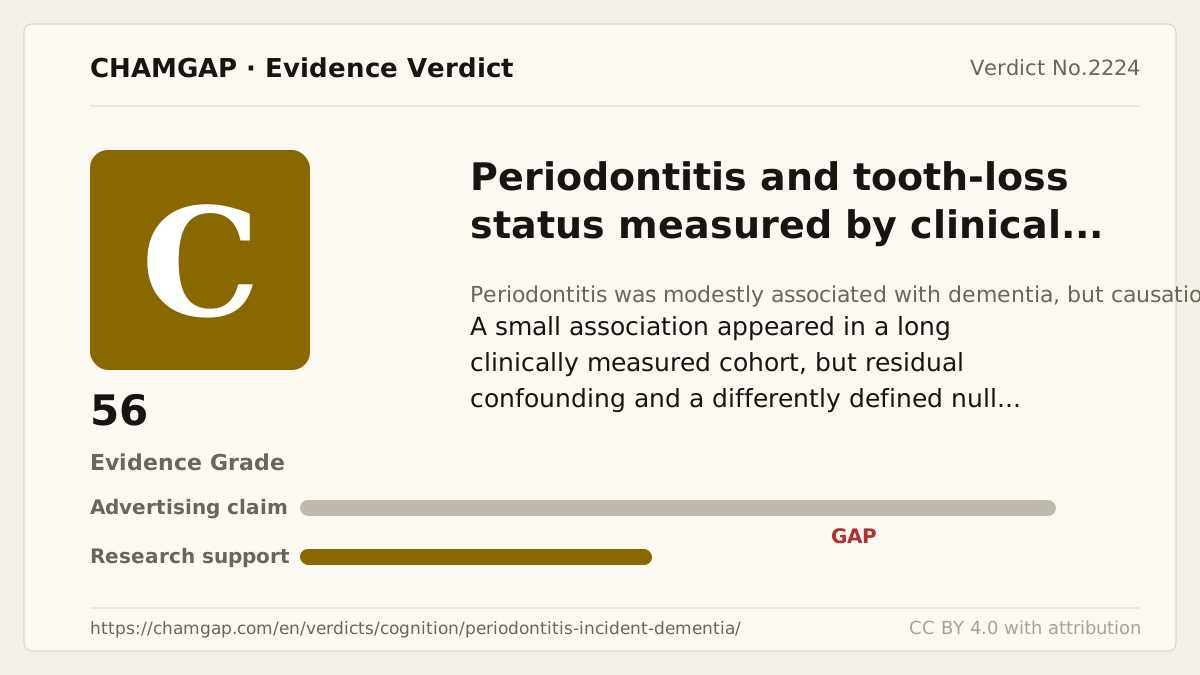
research showsThe grade is C with 56 points. ARIC followed 8,275 clinically examined participants for a median 18.4 years and identified 1,569 dementia cases. Severe periodontal profile versus health had adjusted HR 1.22 (95% CI 1.01 to 1.47), while a Swedish cohort of 7,992 people with deep pockets and 29,182 comparators found 1.7% versus 1.6% dementia. This grades an association, not proof that periodontitis causes dementia or that treatment prevents it.
ads claimAn association does not justify saying gum disease causes dementia or that treatment prevents it. Smoking, diabetes, education, income, and healthcare use may influence both.
Useful facts when choosing a product
- ARIC exposure came from a full-mouth clinical periodontal examination, not self-report.
- Adjusted HR was 1.22 (95% CI 1.01 to 1.47) for severe profile and 1.21 (0.99 to 1.48) for edentulism.
- Verdict 2229 is D with 30 points and concerns incident Parkinson disease, a different outcome not pooled here.
Chamgap Semantic Classification Code
Candidate index · review held
UNK.periodontitis-and-tooth-loss-status-measured-by-clinical-periodontal-examination.UNK.incidence-of-dementia.increase.UNKUnknown > Periodontitis and tooth-loss status measured by clinical periodontal examination > Unknown > incidence of dementia > Increase claim > Unknown
An automated migration candidate, not an issued permanent code; exact claim scope remains under review. This machine-generated migration candidate helps retrieval but is not a permanent assignment. The original verdict ID and URL remain authoritative.
What the research actually shows
Of 11,656 people at ARIC visit 4, 3,381 were excluded mainly for missing dental information, leaving 8,275. Dementia adjudication combined cognitive testing, neurological assessment, informant interviews, and hospital and death codes. The fully adjusted model included age, sex, education, race-center, income, insurance, BMI, physical activity, smoking, high- and low-density lipoprotein cholesterol, heart failure, apolipoprotein E genotype, hypertension medication, systolic blood pressure, coronary heart disease, stroke, and dental-visit frequency. Baseline cognition informed selection models. When events were restricted to more than ten years after baseline, HR was 1.12 (95% CI 0.92 to 1.36) for severe tooth loss and disease and 1.11 (0.89 to 1.37) for edentulism, both null. Preclinical cognitive decline and changes in periodontal status still remain. The Swedish study used registry-classified deep pockets and mean 7.6-year follow-up. ARIC had public NIH/NHLBI support.
Why this is classified as C (56)
A small long-term event association is limited by observational design, multiple comparisons, selection and residual confounding, plus an external null cohort, giving C with 56 points.
Counterpoint. C grades the evidence for the risk claim; it does not mean the risk itself is of medium severity.
Rejudgment record. Cross-check applied — Verified temporal clinical periodontal measurement, dementia adjudication, adjustment and reverse-causation checks, while accounting for residual confounding and a differently defined null cohort
| Endpoint | H | Hard endpoint - actual events such as death |
| Replication | R1 | Single confirmatory trial |
| Independence | I2 | Decisive evidence is publicly or non-profit funded |
| Effect size | E+ | Meets the clinically important threshold |
Stored derived and displayed grades match; this is not a current recalculation or validity check (C).
Sub-claim grades by effect
This ingredient is marketed for several effects. A single overall grade blends strong and weak claims together, so each effect is graded separately here. The overall grade reflects the strongest disconfirming or core claim.
| Effect (sub-claim) | Grade | Basis |
|---|---|---|
| Association between severe periodontal profile and incident dementia | C | Adjusted HR was 1.22, but observation cannot establish causation. |
| Dementia prevention through periodontal treatment | ? | The cohorts did not randomize periodontal treatment. |
Cross-check — AI research and Codex final gate
Evidence Table
| Study | Design | Sample | Funding | Endpoint | Result | Weight |
|---|---|---|---|---|---|---|
| Demmer et al. ARIC 2020 | Prospective observational cohort | 8,275 participants and 1,569 dementia cases | Public US NHLBI and NIH support | Incident dementia over median 18.4 years | Severe periodontal profile HR 1.22 (1.01 to 1.47); edentulism 1.21 (0.99 to 1.48). | Pivotal long-term clinically measured cohort |
| Holmer et al. 2022 | Nationwide registry cohort | 7,992 with deep pockets and 29,182 matched comparators | Public and nonprofit institutional support reported in the full paper | Incident dementia over mean 7.6 years | 137/7,992 (1.7%) versus 470/29,182 (1.6%). | External null evidence using a different exposure definition |
Receipt — 2 References
All 2 cited sources were verified for existence at the original page (as of 2026-08-04).
Final verification and publication gate: Codex · Evidence date: 2026-08-04 · Corrections: none
Cite this verdict
[Chamgap] Periodontitis x increased dementia incidence — Evidence Grade C·56. 2 cited sources checked. Source: https://chamgap.com/en/verdicts/cognition/periodontitis-incident-dementia/ · CC BY 4.0CC BY 4.0 — free to use with attribution; do not distort grades, numbers, or verdict meaning.
What this document does and does not do
Chamgap is an information source. It reports what research has and has not confirmed; it does not tell readers what to take or buy. That decision belongs to readers and, when needed, medical or legal professionals. This verdict reflects literature available up to the search date and may change as new research appears. Nothing here is medical advice.