
Organised inpatient stroke-unit care,
does it really help with Reduced death, dependency, and institutional care after acute stroke?
research showsOrganised inpatient stroke-unit care is graded B because multiple randomized trials show reductions in death, dependency, and institutional care after acute stroke, but the intervention could not be blinded and certainty was generally moderate. The 2020 Cochrane network meta-analysis included 29 trials and 5,902 participants and reported odds ratios of 0.76 (95% CI 0.66 to 0.88) for death, 0.76 (95% CI 0.67 to 0.85) for death or institutional care, and 0.75 (95% CI 0.66 to 0.85) for death or dependency at the end of follow-up. At about one year, the absolute effects corresponded to about two additional survivors, six additional independent people, and six additional people living at home per 100 treated. This is a verdict on an organized multidisciplinary delivery system, not a single drug.
ads claimHospital promotion can reduce the stroke-unit label to imaging equipment or bed location. The tested intervention combined specialist stroke nursing, medical and rehabilitation teams, regular multidisciplinary meetings, standardized assessment, and early rehabilitation.
Useful facts when choosing a product
- Organised stroke-unit care concentrates patients with stroke in a ward where specialist nurses, physicians, and rehabilitation therapists collaborate.
- Trial components included systematic neurologic, swallowing, and functional assessment, complication prevention, early rehabilitation, and discharge planning.
- Discrete stroke wards, mixed rehabilitation wards, and mobile teams were studied, with the clearest effects in discrete stroke wards.
- The intervention has no drug-like toxicity, but it requires concentrated specialist staffing, beds, protocols, and resources, and the exact care package varies.
Chamgap Semantic Classification Code
Candidate index · review held
UNK.organised-inpatient-stroke-unit-care.UNK.death-dependency-and-institutional-care-after-acute-stroke.reduce.UNKUnknown > Organised inpatient stroke-unit care > Unknown > death, dependency, and institutional care after acute stroke > Reduction claim > Unknown
An automated migration candidate, not an issued permanent code; exact claim scope remains under review. This machine-generated migration candidate helps retrieval but is not a permanent assignment. The original verdict ID and URL remain authoritative.
What the research actually shows
The 2020 Cochrane review by Langhorne, Ramachandra, and the Stroke Unit Trialists' Collaboration included 29 randomized trials and 5,902 participants. At final follow-up, the odds ratio was 0.76 (95% CI 0.66 to 0.88) for death, 0.76 (95% CI 0.67 to 0.85) for death or institutional care, and 0.75 (95% CI 0.66 to 0.85) for death or dependency. Absolute effects were about two additional survivors, six additional people living at home, and six additional independent people per 100 compared with general-ward care. The 2013 review of 28 trials and 5,855 participants found the same direction: OR 0.81 for death, 0.78 for death or institutional care, and 0.79 for death or dependency.
Why this is classified as B (79)
Across 29 randomized trials and 5,902 participants, organized care produced large, consistent reductions in death, OR 0.76 (95% CI 0.66 to 0.88), death or institutional care, OR 0.76 (95% CI 0.67 to 0.85), and death or dependency, OR 0.75 (95% CI 0.66 to 0.85), and is a standard model of care in major guidelines; however, inability to blind the intervention left certainty generally moderate and capped the grade at B with 79 points.
Counterpoint. The effects are large and consistent, but inability to blind the care system left certainty generally moderate and imposed the grade ceiling; evidence for mobile teams alone is less secure than for a discrete stroke ward.
Rejudgment record. Cross-check applied — Across 29 randomized trials and 5,902 participants, the direct hard endpoints of death, death or dependency, and death or institutional care showed large, consistent reductions versus general wards or alternative services, but inability to blind the intervention left certainty generally moderate, so the boundary rule capping the grade at B was applied
Sub-claim grades by effect
This ingredient is marketed for several effects. A single overall grade blends strong and weak claims together, so each effect is graded separately here. The overall grade reflects the strongest disconfirming or core claim.
| Effect (sub-claim) | Grade | Basis |
|---|---|---|
| Reduction in death after acute stroke | B | Across 29 trials and 5,902 participants, the final-follow-up death OR was 0.76 (95% CI 0.66 to 0.88), but inability to blind the intervention left certainty generally moderate. |
| Reduction in death or dependency | B | The pooled OR was 0.75 (95% CI 0.66 to 0.85), corresponding to about six additional independent people per 100, but inability to blind the intervention left certainty generally moderate. |
| Reduction in death or institutional care | B | The pooled OR was 0.76 (95% CI 0.67 to 0.85), corresponding to about six additional people living at home per 100, but inability to blind the intervention left certainty generally moderate. |
Cross-check — AI research and Codex final gate
Evidence Table
| Study | Design | Sample | Funding | Endpoint | Result | Weight |
|---|---|---|---|---|---|---|
| Langhorne P, Ramachandra S; Stroke Unit Trialists' Collaboration. 2020 | Systematic review with pairwise and network meta-analysis of randomized trials | 29 trials and 5,902 participants | Academic and public research infrastructure through the Cochrane Stroke Group | Death, death or dependency, and death or institutional care at final follow-up | Death OR 0.76 (95% CI 0.66 to 0.88), death or institutional care OR 0.76 (0.67 to 0.85), death or dependency OR 0.75 (0.66 to 0.85). | Key multiple-trial hard-endpoint synthesis |
| Stroke Unit Trialists' Collaboration. 2013 | Cochrane systematic review and meta-analysis of randomized trials | 28 trials and 5,855 participants | Academic research through the Cochrane Stroke Group | Death, death or dependency, and death or institutional care | Death OR 0.81, death or institutional care OR 0.78, and death or dependency OR 0.79 were all significant. | Consistency across an earlier update |
Receipt — 3 References
All 3 cited sources were verified for existence at the original page (as of 2026-07-23).
Final verification and publication gate: Codex · Evidence date: 2026-07-23 · Corrections: none
Cite this verdict
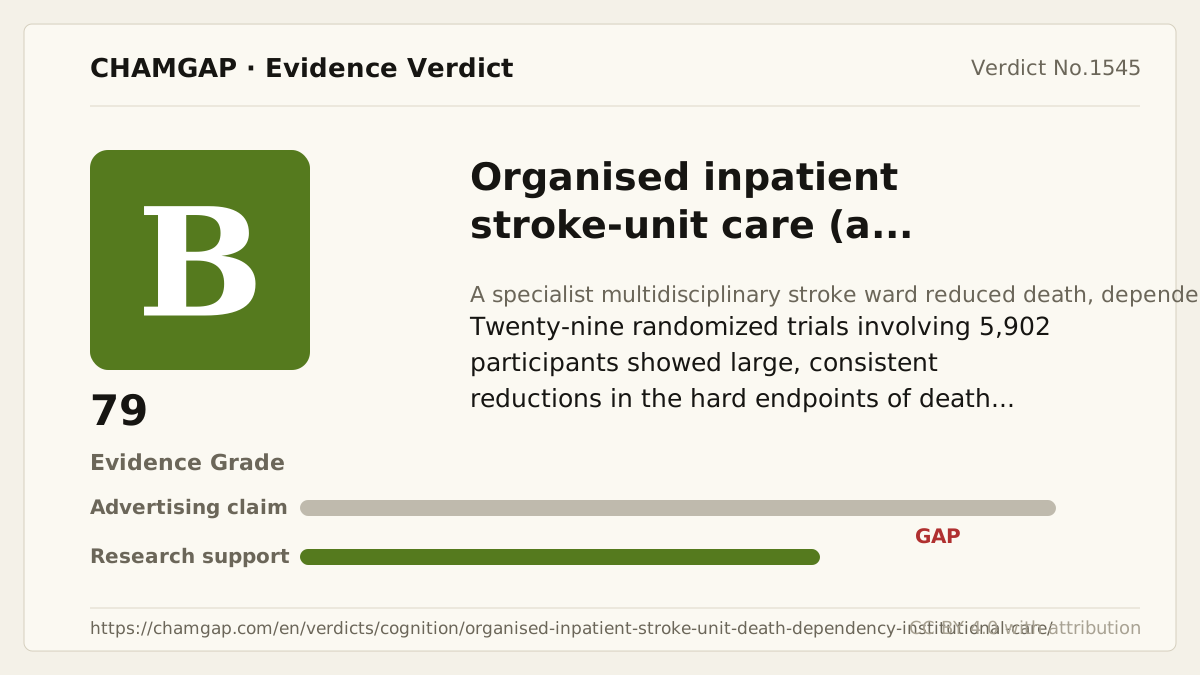
[Chamgap] Organised inpatient stroke-unit care x reduced death, dependency, and institutional care — Evidence Grade B·79. 3 cited sources checked. Source: https://chamgap.com/en/verdicts/cognition/organised-inpatient-stroke-unit-death-dependency-institutional-care/ · CC BY 4.0CC BY 4.0 — free to use with attribution; do not distort grades, numbers, or verdict meaning.
What this document does and does not do
Chamgap is an information source. It reports what research has and has not confirmed; it does not tell readers what to take or buy. That decision belongs to readers and, when needed, medical or legal professionals. This verdict reflects literature available up to the search date and may change as new research appears. Nothing here is medical advice.