
Oral vitamin B12 as the sole added active ingredient,
does it really help with Improvement in global cognition in adults with clinically defined MCI?
research showsWithin the search and access scope documented through 2026-09-16, no directly eligible between-group B12-only result on a prespecified main-timepoint global cognition scale in clinically defined adult MCI was confirmed. The current value is ? with a null score. This is not a no-effect judgment or a claim that no human research exists. A human trial with a B12-alone arm was identified. [S01][S03]
ads claimThese data do not establish that B12 improves cognition, prevents dementia, or benefits people regardless of deficiency status. Changes in homocysteine, blood B12 or brain volume do not replace this page’s global cognition result.
Four separate assessment dimensions
| Effect direction and size | Within the search and access scope documented through 2026-09-16, no directly eligible between-group B12-only result on a prespecified main-timepoint global cognition scale in clinically defined adult MCI was confirmed. The current value is ? with a null score. This is not a no-effect judgment or a claim that no human research exists. A human trial with a B12-alone arm was identified. [S01][S03] |
|---|---|
| Evidence certainty | Stage zero before confirmation of a directly eligible estimate; no evidence is not no effect. |
| Applicability | Ma2019 full text, registry/SAP, detailed MCI diagnosis, matching folate background, single-arm chemical form/dose/route, baseline B12 status, arm-specific analysis and safety denominators, primary hierarchy, between-group estimate/CI/MCID, funding/product supply. The mismatch between the legacy stage label and this task’s policy is preserved through an explicit technical mapping. |
| Safety | Caution. Arm-specific adverse-event, serious-event and discontinuation denominators, long-term safety and special-population safety were not verified for the central candidate. No established UL is not unlimited-safety assurance. Cobalt sensitivity warnings retain the hydroxocobalamin/cyanocobalamin scope; Leber and intensive severe-megaloblastic-anemia hypokalemia warnings are separately attributed to the accessed injectable cyanocobalamin label. No event rate is transferred to another form. Trial doses are not instructions for personal supplementation, stopping medicines or treating cognitive impairment. [S14][S15][S16] |
This is a clinical-efficacy type B question with a stage-zero current value of ? and score null. Endpoint, replication, independence, effect, bias and precision remain null. The empirical no_human_study flag remains false; the unchanged legacy calculator was run only on a separately declared stage-gate projection. Direct raw-profile validation is unsupported and its diagnostics are disclosed. No zero effect, C/D point score or high-independence assumption was invented.
Useful facts when choosing a product
- Cyanocobalamin, methylcobalamin/mecobalamin, hydroxocobalamin and adenosylcobalamin are not treated as one formulation. The Ma2019 B12-only arm’s chemical form, tablet/capsule, release type, product, batch and purity remain unverified. [S01]
- The review-reported 25 µg/day B12 and 800 µg/day folic acid are leads for original-report verification, not verified single-arm doses or personal dosing advice. [S11][S13]
- Dietary, fortified-food and concurrent supplemental B12 exposure, adherence, malabsorption, metformin/PPI use and baseline deficient/replete status are unverified for the central candidate. Missing information is not normal status. [S01]
Chamgap Semantic Classification Code
Permanent code issued
S.vitamin-b12-single-active.oral-form-dose-unverified-6months.clinically-defined-mci-wais-rc-fsiq.improve.no-added-b12-same-backgroundSubstances > Vitamin B12 as the sole added active > Oral with form/dose unverified for a reported 6 months > WAIS-RC Full Scale IQ in clinically defined MCI > Improve > No added B12 on the same background
Human research exists, but a directly eligible B12-only main-outcome between-group result was not verified. Folic-acid-plus-B12 results are not attributed to B12 alone. The code identifies the intervention and claim; it never contains the evidence grade, score, or safety result.
Exact Claim Classification
These independent facets prevent evidence from different forms, routes, populations, effects, and comparators from being mixed.
| Intervention class | S · Supplement or nutraceutical |
|---|---|
| Canonical ingredient or intervention | Vitamin B12 as the sole randomized added active ingredient |
| Source or part used | Manufacturing source, batch and purity unverified; plant part not applicable |
| Formulation or processing | Oral single-agent question; chemical form, tablet/capsule and release type of the Ma2019 single-agent arm unverified |
| Route | Oral only; sublingual, intramuscular and intravenous evidence not pooled |
| Dose | No directly verified per-dose or daily dose; 25 µg/day is a secondary-review lead only |
| Duration | Six-month page assessment point, reported in Ma2019; prespecified primary timing unverified |
| Population | Adults with clinically defined MCI; deficiency replacement separated from replete/unknown-status supplementation; detailed Ma2019 criteria and baseline status unverified |
| Effect or condition | Improvement in global cognition score, not prevention of dementia conversion |
| Primary endpoint | Six-month WAIS-RC Full Scale IQ between-group change/adjusted endpoint difference selected for assessment; registered primary status and eligible single-agent estimate unverified |
| Comparator | Matched placebo, no added B12 or usual care on the same background; untreated control reported in Ma2019; folate-background add-on contrast unresolved until background matching is verified |
| Duplicate-detection key | proposed|S|vitamin-b12-single-added-active|source-UNVERIFIED|form-UNVERIFIED|oral-only|dose-UNVERIFIED|6-month-reported-endpoint|clinically-defined-adult-MCI-B12-status-UNVERIFIED|global-cognition-improvement|WAIS-RC-FSIQ-primary-hierarchy-UNVERIFIED|matched-no-B12-background |
What the research actually shows
Ma2019, the central candidate, assigned 240 participants described as having MCI to four groups for 6 months. This page selects its reported WAIS-RC Full Scale IQ as the global measure to inspect, but registered primary status, primary analysis timing and an eligible single-agent estimate remain unverified. MoCA or MMSE results were not substituted. [S01][S03] The abstract reports d=0.169 and P=0.024 for folic acid plus B12 versus untreated control. These are not the B12-alone versus control global difference, CI or P value. The reported d calculation and an applicable clinically important between-group threshold are also unverified. [S01] Other trials with B12-only arms were separated by population and endpoint. Whole-cohort diabetic-elderly results and biochemically deficient cohorts with mixed cognition were not counted as independent clinical-MCI replications. MCI B-complex trials and follow-up imaging analyses do not provide isolated B12 effects; reports from the same trial family were not counted twice. [S04][S05][S07][S10]
Why this is classified as ?
This is a clinical-efficacy type B question with a stage-zero current value of ? and score null. Endpoint, replication, independence, effect, bias and precision remain null. The empirical no_human_study flag remains false; the unchanged legacy calculator was run only on a separately declared stage-gate projection. Direct raw-profile validation is unsupported and its diagnostics are disclosed. No zero effect, C/D point score or high-independence assumption was invented.
Counterpoint. Cognitive performance can itself be a patient-centred functional target, but an FSIQ difference cannot be promoted to improved daily functioning or reduced dementia conversion. An MCID and scale range applicable to this MCI population, scale and between-group estimand were not confirmed. Neither another scale’s MCID nor a generic d=0.2 convention was substituted.
Rejudgment record. Scoped current value for unverified direct eligibility, not a no-effect judgment — Task-specific stage zero and supplied null-score rule; legacy stage mapping disclosed
Review performed and remaining limitations
The page inspects six-month WAIS-RC Full Scale IQ reported in the central candidate. Registered primary status and actual primary analysis status are unverified; it is not presented as the confirmed primary outcome of a fully qualified trial.
Preliminary RoB 2-informed review — not a complete formal assessment
| Randomization | Randomization reported; sequence and concealment unverified |
|---|---|
| Deviations from assigned interventions | Single-blind roles and matched background unverified |
| Missing outcome data | Denominators and handling unverified |
| Outcome measurement | WAIS-RC reported; administration, education and practice effects unverified |
| Selection of the reported result | Abstract emphasizes combination and posthoc comparisons; registry hierarchy unverified |
Reasons for the certainty judgment — not formal GRADE
| Risk of bias | unresolved |
|---|---|
| Inconsistency | No verified same-claim repeat estimates |
| Indirectness | Additional actives, population and route separated |
| Imprecision | Direct effect and CI unverified |
| Publication bias | not assessable |
Search scope and limitations. audit/search_log.json and audit/access_log.json
Evidence Table
| Study | Design | Sample | Funding | Endpoint | Result | Weight |
|---|---|---|---|---|---|---|
| Ma F et al. Effects of Folic Acid and Vitamin B12, Alone and in Combination… Curr Alzheimer Res. 2019;16(7):622–632. | candidate_direct_contrasts_unresolved | 240 | Central single-agent funding unverified; see family/appraisal audit | WAIS-RC Full Scale IQ | The B12-alone arm exists, but its global between-group estimate is absent from the accessed primary abstract. The favorable combination-versus-folate statement remains a conditional candidate pending matched-background and outcome-hierarchy verification. | Not included as verified direct efficacy evidence |
| Kwok T et al. A randomized placebo controlled trial of vitamin B12 supplementation to prevent cognitive decline in older diabetic people with borderline low serum vitamin B12. Clin Nutr. 2017;36(6):1509–1515. | excluded_mixed_population_no_verified_separable_MCI_global_result | 271 | Funding for this adjacent study was not used to assign a single-agent independence axis; see the trial-family audit for verification scope. | Increase in global CDR; NTB z scores separate | No qualified MCI stratum-specific primary effect retrieved; whole-cohort non-significance not a negative MCI monotherapy trial. | Not included as verified direct efficacy evidence |
| Kwok T et al. A randomized placebo-controlled trial of using B vitamins to prevent cognitive decline in older mild cognitive impairment patients. Clin Nutr. 2020;39(8):2399–2405. | excluded_multiple_randomized_actives | 279 | Funding for this adjacent study was not used to assign a single-agent independence axis; see the trial-family audit for verification scope. | CDR sum of boxes at 24 months | Both folic acid and B12 differ versus placebo. | Not included as verified direct efficacy evidence |
| Eussen SJ et al. Effect of oral vitamin B-12 with or without folic acid on cognitive function in older people with mild vitamin B-12 deficiency. Am J Clin Nutr. 2006;84:361–370. | excluded_mixed_population_no_separable_target_estimate | 195 | Funding for this adjacent study was not used to assign a single-agent independence axis; see the trial-family audit for verification scope. | Neuropsychological domains; no verified separate clinical-MCI global primary result | B12-only arm is real. Do not exclude merely for also having a combination arm; exclude this page for population/endpoint non-separability. | Not included as verified direct efficacy evidence |
| Zhou et al. Vitamin B12 supplementation improves cognitive function in middle aged and elderly patients with cognitive impairment. Nutr Hosp. 2023;40(4). | excluded_route_form_population_boundary | 115 | Funding for this adjacent study was not used to assign a single-agent independence axis; see the trial-family audit for verification scope. | See selection boundary | Do not silently repair printed IM unit; do not turn mixed-route two-form regimen into oral single-form MCI treatment. | Not included as verified direct efficacy evidence |
| Jatoi S et al. Low Vitamin B12 Levels: An Underestimated Cause Of Minimal Cognitive Impairment And Dementia. Cureus. 2020;12(2):e6976. | excluded_no_randomized_matched_comparator | 202 | Funding for this adjacent study was not used to assign a single-agent independence axis; see the trial-family audit for verification scope. | See selection boundary | All deficient patients received replacement; uncontrolled MMSE response cannot estimate placebo-relative efficacy. | Not included as verified direct efficacy evidence |
| Smith AD et al. Homocysteine-Lowering by B Vitamins Slows the Rate of Accelerated Brain Atrophy in Mild Cognitive Impairment: A Randomized Controlled Trial. PLoS One. 2010;5:e12244. | excluded_multiple_randomized_actives | 271 | Public/charitable and Meda AB/Recip AB-related support disclosed in the primary text. The source reports no sponsor role; this is not an independent B12-only replication. | See selection boundary | Primary brain atrophy article and later cognition/MRI/omega-3/PON1 reports belong to one family. They are not independent B12-only replications. | Not included as verified direct efficacy evidence |
| Chen et al. Effects of Folic Acid and Vitamin B12 Supplementation on Cognitive Impairment and Inflammation in Patients with Alzheimer’s Disease: A Randomized, Single-Blinded, Placebo-Controlled Trial. | excluded_AD_and_combination | Original count unverified | Funding for this adjacent study was not used to assign a single-agent independence axis; see the trial-family audit for verification scope. | See selection boundary | Alzheimer disease, not separable MCI; folic acid and B12 both differ. | Not included as verified direct efficacy evidence |
| Dangour AD et al. Effects of vitamin B-12 supplementation on neurologic and cognitive function in older people: a randomized controlled trial. Am J Clin Nutr. 2015;102(3):639–647. | adjacent_lead_primary_details_not_verified | Original count unverified | Funding for this adjacent study was not used to assign a single-agent independence axis; see the trial-family audit for verification scope. | See selection boundary | Identified RCT title and bibliographic record; full primary text access failed. No MCI result inferred or scored. | Not included as verified direct efficacy evidence |
| Martínez-Noguera et al. Short-Term Methylcobalamin Supplementation Is Associated with Changes in Anaerobic and Cognitive Performance in Amateur Cyclists: A Randomized Crossover Trial. Nutraceuticals. 2026;6(2):35. | excluded_population_from_primary_title | Original count unverified | Funding for this adjacent study was not used to assign a single-agent independence axis; see the trial-family audit for verification scope. | See selection boundary | Amateur cyclists, not clinical MCI. No extrapolation from a recent cognitive-performance study. | Not included as verified direct efficacy evidence |
Receipt — 21 References
Evidence access cutoff: 2026-09-16. Each citation states its actual access level (full-text transcription, abstract, index, or other) and remaining limitations. Bibliographic checking does not certify the study results or treatment efficacy.
Technical integration by: Codex · Evidence date: 2026-09-16 · Corrections: none
Cite this verdict
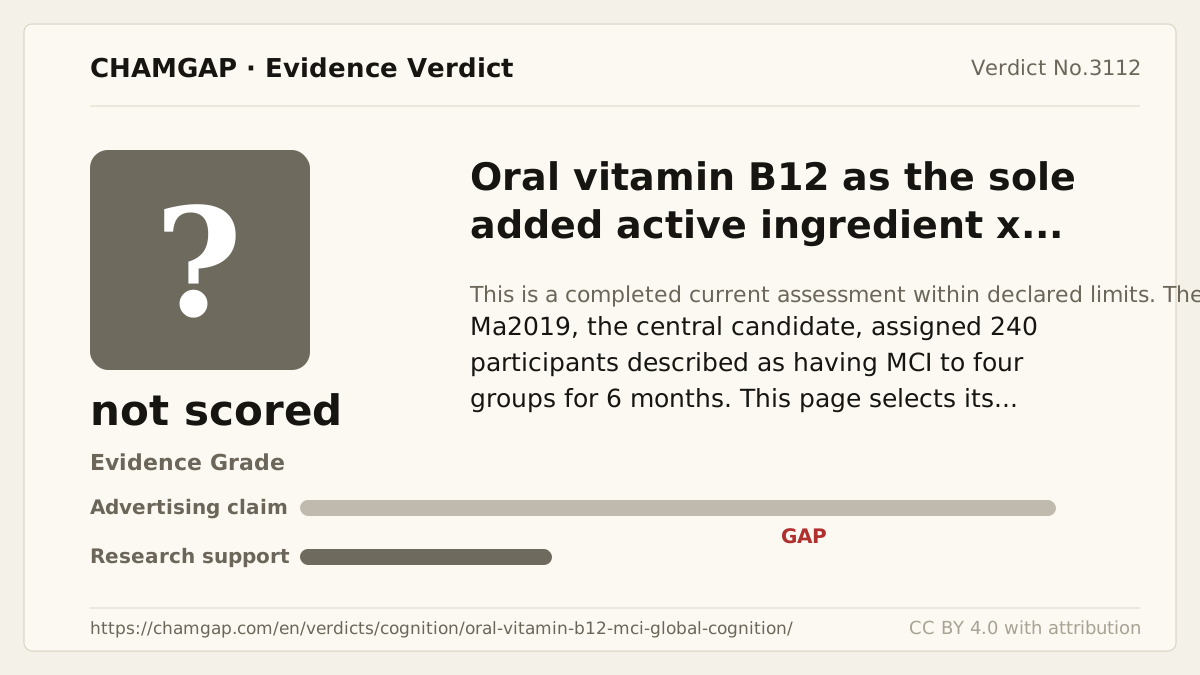
[Chamgap] Does oral vitamin B12 monotherapy improve global cognition in mild cognitive impairment? — Evidence Grade ?. 21 cited sources checked. Source: https://chamgap.com/en/verdicts/cognition/oral-vitamin-b12-mci-global-cognition/ · CC BY 4.0CC BY 4.0 — free to use with attribution; do not distort grades, numbers, or verdict meaning.
What this document does and does not do
Chamgap is an information source. It reports what research has and has not confirmed; it does not tell readers what to take or buy. That decision belongs to readers and, when needed, medical or legal professionals. This verdict reflects literature available up to the search date and may change as new research appears. Nothing here is medical advice.