
Ordinary thiamine,
does it really help with Improvement of cognition in mild cognitive impairment?
research showsThe documented search did not identify an eligible result isolating ordinary oral thiamine’s effect in an MCI population. The current judgment is ? with no numerical score, not a finding of no cognitive effect. Results for benfotiamine or established dementia were not used to fill the gap.
ads claimAdvertising and mechanistic claims were not used as grade bonuses or direct clinical evidence.
Four separate assessment dimensions
| Effect direction and size | The documented search did not identify an eligible result isolating ordinary oral thiamine’s effect in an MCI population. The current judgment is ? with no numerical score, not a finding of no cognitive effect. Results for benfotiamine or established dementia were not used to fill the gap. |
|---|---|
| Evidence certainty | The rubric’s ? rule is applied to the bounded search conclusion that no directly eligible result was verified. Score is null. MCI and dementia, or ordinary thiamine and benfotiamine, are not combined into E0, RX or F, and unverified effect sizes or sample sizes are not filled in. |
| Applicability | Adults with mild cognitive impairment (MCI); excluding established Alzheimer dementia and confirmed B1 (thiamine)-deficiency encephalopathy |
| Safety | The actual dose, duration and safety denominator for this exact MCI question remain unconfirmed. Tolerability of another molecular form or a dementia trial is not presented as equivalent. |
Not official GRADE or treatment-success probability; ? has no score.
Useful facts when choosing a product
- Ordinary oral thiamine is the fixed intervention. Benfotiamine is a related search term, not an automatic synonym. Baseline deficiency status, exact formulation and actual comparative MCI results remain unconfirmed.
Chamgap Semantic Classification Code
Permanent code issued
S.thiamine.oral.mild-cognitive-impairment-cognition.improve.placebo-or-no-additionSupplements > Ordinary thiamine > Oral > Cognition in mild cognitive impairment > Improvement claim > Placebo or no addition
Technically bound to the current-value claim boundary fixed by ChatGPT. Unconfirmed dose, duration, study details, and evidence grade remain in verdict fields and revision history rather than the permanent semantic code. The code identifies the intervention and claim; it never contains the evidence grade, score, or safety result.
Exact Claim Classification
These independent facets prevent evidence from different forms, routes, populations, effects, and comparators from being mixed.
| Intervention class | S · Supplement or nutraceutical |
|---|---|
| Canonical ingredient or intervention | Ordinary thiamine (vitamin B1) |
| Source or part used | Synthetic/fermentation/other production origin unconfirmed; plant-part classification not applicable |
| Formulation or processing | Question: single-ingredient ordinary oral thiamine; exact salt/formulation for an eligible MCI result unconfirmed |
| Route | Oral (page question; see observed_evidence for study-route verification) |
| Dose | Dose in an eligible MCI study unconfirmed |
| Duration | Duration in an eligible MCI study unconfirmed |
| Population | Adults with mild cognitive impairment (MCI); excluding established Alzheimer dementia and confirmed B1 (thiamine)-deficiency encephalopathy |
| Effect or condition | Improvement of cognition in mild cognitive impairment |
| Primary endpoint | Change in a validated cognitive measure; specific scale in an eligible MCI study unconfirmed |
| Comparator | Question: placebo/no addition or matched usual care; eligible MCI comparative results unconfirmed |
| Duplicate-detection key | ordinary-thiamine-single|oral|dose-unconfirmed|duration-unconfirmed|mild-cognitive-impairment|validated-cognition-scale-unconfirmed|placebo-or-no-addition-question |
What the research actually shows
Verified related research includes a cognitive trial of benfotiamine and a trial of ordinary thiamine in Alzheimer dementia. The former differs in molecular intervention and the latter in population. Neither is adopted as a direct result for ordinary thiamine and cognition in MCI.
Why this is classified as ?
The rubric’s ? rule is applied to the bounded search conclusion that no directly eligible result was verified. Score is null. MCI and dementia, or ordinary thiamine and benfotiamine, are not combined into E0, RX or F, and unverified effect sizes or sample sizes are not filled in.
Counterpoint. No assertion is made that human cognitive research is entirely absent. The negative ordinary-thiamine dementia result is not transferred to MCI to declare no effect or repeated refutation.
Rejudgment record. The documented search did not identify an eligible result isolating ordinary oral thiamine’s effect in an MCI population. The current judgment is ? with no numerical score, not a finding of no cognitive effect. Results for benfotiamine or established dementia were not used to fill the gap. — The rubric’s ? rule is applied to the bounded search conclusion that no directly eligible result was verified. Score is null. MCI and dementia, or ordinary thiamine and benfotiamine, are not combined into E0, RX or F, and unverified effect sizes or sample sizes are not filled in.
| Endpoint | P | Symptom or function itself is the target - including patient reports and performance tests Case application: Defines the question, not an observed eligible trial; unused scoring axes remain null |
Stored derived and displayed grades match; this is not a current recalculation or validity check (?).
Review performed and remaining limitations
Isolated MCI results and treatment details for ordinary thiamine unconfirmed Native databases worldwide were not exhaustively searched; the current judgment is published with that limitation.
Search scope and limitations. tasks/R01-004/search_log.json
Evidence Table
| Study | Design | Sample | Funding | Endpoint | Result | Weight |
|---|---|---|---|---|---|---|
| Gibson et al. — benfotiamine and cognitive decline in early Alzheimer disease (2020) | Excluded: different or confounded intervention | Only verified denominators are recorded in numeric_evidence.json; assignment totals are not substituted for unknown endpoint analysis counts. | Unconfirmed or not used in this page grade | Cognitive outcomes of benfotiamine in early Alzheimer disease | The cognitive trial used benfotiamine, a different molecular intervention from ordinary thiamine. | Excluded: different or confounded intervention |
| Nolan et al. — a trial of thiamine in Alzheimer disease (1991) | Excluded: different population | Only verified denominators are recorded in numeric_evidence.json; assignment totals are not substituted for unknown endpoint analysis counts. | Unconfirmed or not used in this page grade | Cognition in Alzheimer dementia, not an isolated MCI result | Human cognitive research on ordinary thiamine does exist, but this study involved Alzheimer dementia. It does not provide an isolated MCI result for the present claim. | Excluded: different population |
Receipt — 2 References
Evidence access cutoff: 2026-09-15. Each citation states its actual access level (full-text transcription, abstract, index, or other) and remaining limitations. Bibliographic checking does not certify the study results or treatment efficacy.
Technical integration by: Codex · Evidence date: 2026-09-15 · Corrections: 1
Correction log — 1
Corrections applied to this verdict, in chronological order. Changes are logged, not erased.
- 2026-09-15 · current_value_initial_publication — The benfotiamine paper was identified as PMID 33074237, DOI 10.3233/JAD-200896 rather than adopting a mismatched PMID; its efficacy was not transferred to ordinary thiamine.
Cite this verdict
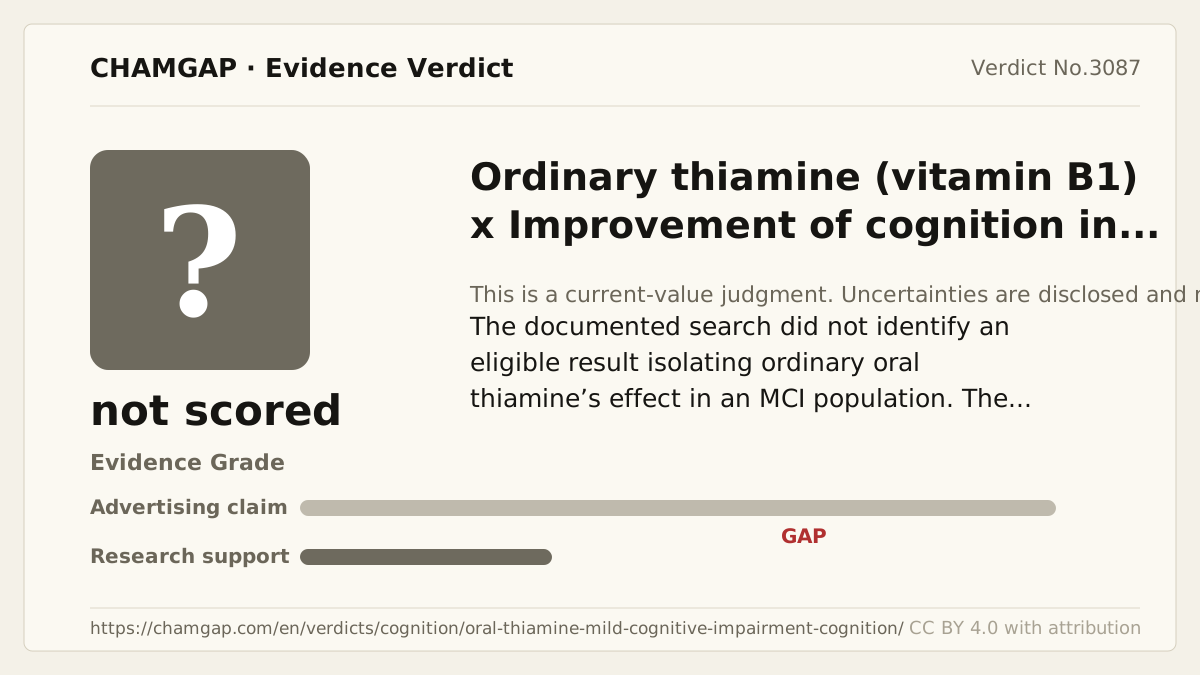
[Chamgap] Ordinary thiamine (vitamin B1) × Improvement of cognition in mild cognitive impairment — Evidence Grade ?. 2 cited sources checked. Source: https://chamgap.com/en/verdicts/cognition/oral-thiamine-mild-cognitive-impairment-cognition/ · CC BY 4.0CC BY 4.0 — free to use with attribution; do not distort grades, numbers, or verdict meaning.
What this document does and does not do
Chamgap is an information source. It reports what research has and has not confirmed; it does not tell readers what to take or buy. That decision belongs to readers and, when needed, medical or legal professionals. This verdict reflects literature available up to the search date and may change as new research appears. Nothing here is medical advice.