
Oral semaglutide 14 mg,
does it really help with Delayed cognitive and functional decline in early Alzheimer disease?
research showsOral semaglutide is rated F for this indication. EVOKE and EVOKE+ were two separate large phase 3 trials of the same drug in the same early Alzheimer disease indication, totaling 3,808 participants. Both failed the week-104 CDR-SB primary endpoint, clinical secondary outcomes were concordantly null, and biomarker changes did not translate into clinical benefit.
ads claimBenefits in diabetes, obesity, or cardiovascular indications cannot be transferred to Alzheimer disease. This verdict is separate from verdicts 615, 1191, 1587, and 1593 in other indications.
Useful facts when choosing a product
- Once-daily oral semaglutide was titrated from 3 mg to a maximum of 14 mg.
- EVOKE and EVOKE+ followed 3,808 people with early symptomatic Alzheimer disease for 104 weeks.
- Neither trial showed clinically slower progression on CDR-SB versus placebo.
- Gastrointestinal adverse effects and loss of weight, lean mass, or muscle warrant attention in older patients.
Chamgap Semantic Classification Code
Candidate index · review held
S.semaglutide-tablet.oral.delayed-cognitive-and-functional-decline-in-early-alzheimer-disease.reduce.MULTISupplements and nutraceuticals > semaglutide tablet > Oral > Delayed cognitive and functional decline in early Alzheimer disease > Reduction claim > Multiple: primary unresolved
An automated migration candidate, not an issued permanent code; exact claim scope remains under review. This machine-generated migration candidate helps retrieval but is not a permanent assignment. The original verdict ID and URL remain authoritative.
What the research actually shows
The two randomized double-blind phase 3 trials added oral semaglutide up to 14 mg or placebo to standard care for 104 weeks. Across 3,808 participants neither trial showed CDR-SB superiority, and confirmatory clinical secondary outcomes did not support efficacy.
Why this is classified as F (10)
Two large trials of the same drug in the same indication each failed, giving F with 10 points. Biomarker-only changes did not raise the grade.
Counterpoint. Efficacy in other metabolic or cardiovascular indications does not alter this Alzheimer verdict.
Rejudgment record. New verdict — Two separate large phase 3 trials of the same drug in the same early Alzheimer disease indication each failed the primary and concordant clinical secondary endpoints
Sub-claim grades by effect
This ingredient is marketed for several effects. A single overall grade blends strong and weak claims together, so each effect is graded separately here. The overall grade reflects the strongest disconfirming or core claim.
| Effect (sub-claim) | Grade | Basis |
|---|---|---|
| Delayed cognitive decline | F | Repeatedly null in two large trials in the same indication. |
| Delayed functional decline | F | CDR-SB and clinical secondary outcomes were null. |
| Delayed clinical progression of Alzheimer disease | F | Biomarker changes did not translate into clinical benefit. |
Cross-check — AI research and Codex final gate
Evidence Table
| Study | Design | Sample | Funding | Endpoint | Result | Weight |
|---|---|---|---|---|---|---|
| EVOKE and EVOKE+ phase 3 trials, 2025 primary results | Two separate randomized double-blind placebo-controlled phase 3 trials | 3,808 total participants | Novo Nordisk | Week-104 CDR-SB | Both failed superiority; clinical secondary outcomes were also null. | Repeated confirmatory failure in the same indication |
| Cummings J et al. 2025 design paper | Design report for both phase 3 trials | 1,855 in EVOKE and 1,953 in EVOKE+ | Novo Nordisk | CDR-SB and cognitive and functional secondary outcomes | Documents two separate confirmatory trials in the same indication. | Design and sample verification |
Receipt — 2 References
All 2 cited sources were verified for existence at the original page (as of 2026-07-24).
Final verification and publication gate: Codex · Evidence date: 2026-07-24 · Corrections: none
Cite this verdict
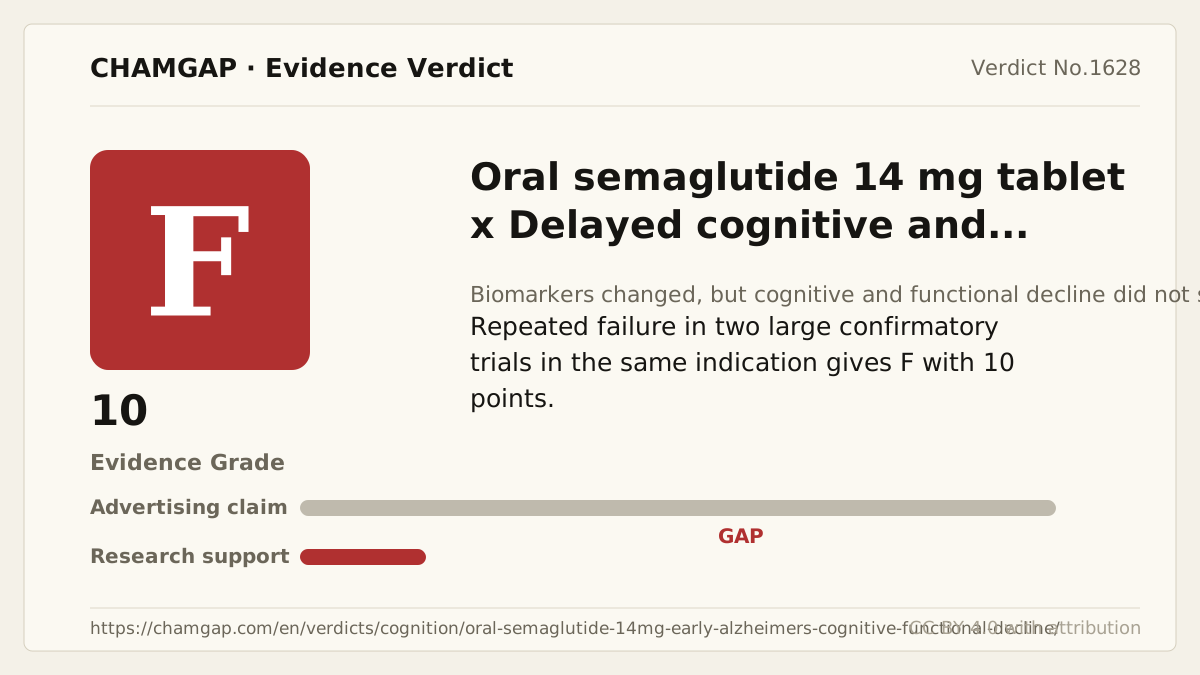
[Chamgap] Oral semaglutide 14 mg x delayed progression of early Alzheimer disease — Evidence Grade F·10. 2 cited sources checked. Source: https://chamgap.com/en/verdicts/cognition/oral-semaglutide-14mg-early-alzheimers-cognitive-functional-decline/ · CC BY 4.0CC BY 4.0 — free to use with attribution; do not distort grades, numbers, or verdict meaning.
What this document does and does not do
Chamgap is an information source. It reports what research has and has not confirmed; it does not tell readers what to take or buy. That decision belongs to readers and, when needed, medical or legal professionals. This verdict reflects literature available up to the search date and may change as new research appears. Nothing here is medical advice.