
Riboflavin,
does it really help with Whether diabetic neuropathic pain is reduced?
research showsWithin the documented search and accessible material, a direct comparative result establishing how much oral vitamin B2 alone reduces pain in this population was not verified. A B2-containing combination improved symptoms and a rat study provides biological plausibility, but neither isolates the effect of B2 alone. This is not a finding of no effect or a declaration that human research is absent; efficacy grade and score remain unassigned and safety of the exact target regimen is Unknown.
ads claimDoes oral vitamin B2 alone reduce pain in diabetic peripheral neuropathy?
Four separate assessment dimensions
| Effect direction and size | Within the documented search and accessible material, a direct comparative result establishing how much oral vitamin B2 alone reduces pain in this population was not verified. A B2-containing combination improved symptoms and a rat study provides biological plausibility, but neither isolates the effect of B2 alone. This is not a finding of no effect or a declaration that human research is absent; efficacy grade and score remain unassigned and safety of the exact target regimen is Unknown. |
|---|---|
| Evidence certainty | Direct clinical certainty unassigned; indirectness and access limits declared |
| Applicability | No direct transfer to the target population and single-active oral formulation |
| Safety | An eligible B2-only dose, duration, and two-arm adverse-event/discontinuation denominators were not verified. NIH ODS explains that no riboflavin upper intake level has been established and no clinically relevant medication interactions are known, but limited adverse-effect evidence does not establish high-dose harmlessness. Long exposure, pregnancy, children, hepatic/renal impairment, co-medication and assay interference remain unverified for this question. Research regimens are not individual dosing or treatment-change instructions. |
Pain is a P endpoint. I1 is the supplied case-29 fallback for unverified independence, not proof of independent funding. Human symptom research containing B2 exists, so no_human_study is false. No verified B2-only identifying result supports a truthful replication, effect or target-trial bias axis. R0 means conflict and RX repeated refutation, not missing evidence. The bare B output on invalid inputs is rejected; no score anchor is applied.
Useful facts when choosing a product
- The population is adults with painful diabetic peripheral neuropathy and the intervention is oral single-active riboflavin. An incremental B2 comparison with other care balanced would also be eligible. This page prioritizes mean pain NRS and does not relabel a study’s registered primary outcome. Composite symptom scores, nerve conduction, vitamin-status markers and dietary associations remain separate evidence types. An eligible actual dose, duration, molecular form, comparator and NRS effect are unverified; proposed fields have not been promoted to study facts.
- CYLINDER tested succinic acid, inosine, nicotinamide and riboflavin together in symptomatic diabetic polyneuropathy. The abstract reports 109 experimental and 107 placebo participants and a sequence of 10 IV days followed by 75 oral days. At 12 weeks, mean TSS changes were −2.65 and −1.73, with reported p<0.0001. Their arithmetic difference is −0.92 TSS points, not an isolated B2 mean pain NRS effect. No CI was reconstructed from the parenthetical 1.46/1.51 values. Employment, advisory and compensation relationships with Polysan are disclosed. Detailed analyzed denominators, attrition, concealment, registry agreement and adverse-event tables were not verified. NCT04649203 is the same study, not a second replication.
- Farvid 2011 was identified through official bibliographic information and indexed fragments. The recent review maps a comparison using multiple vitamins and minerals. Primary arm doses, denominators and pain values were not verified and were not used for reproducible treatment-effect calculations. The 2021 and 2026 B-vitamin reviews are study maps, not pooled B2-only evidence. Details and eligibility of a historical 1945 Diabetic Neuropathy primary-text lead remain unresolved because the original could not be accessed.
- The 2024 experiment placed 25 or 50 mg riboflavin into 600 mL drinking water for two weeks in STZ-diabetic rats. These are preparation concentrations of approximately 0.042/0.083 mg/mL; actual ingested mg per animal per day is unverified. Mechanical responses improved in the lower condition but were not significant in the higher condition, while cold and formalin findings varied by assay. This is not a consistently positive dose-response across tests. Rat behavior or serum metabolite ratios cannot be converted into adult mean NRS effects, an appropriate human dose or comparative safety.
- The 1980 status study covered 119 diabetic participants, 53 with and 66 without neuropathy, and summarized most B1/B2/E status as sufficient. That historical sample does not establish deficiency or treatment response in all current patients. A 2026 cross-sectional study of 300 Romanian adults reported a dietary B2 trend across neuropathy severity with p=0.076; the table’s 0.08 is rounding. This is a non-significant dietary association, not a null or equivalence trial of B2 supplementation. Temporality and dietary-pattern confounding remain unresolved.
- The central limitations are directness and attribution to the ingredient. Without a verified isolating comparison, direction, magnitude, CI and MCID attainment cannot be assigned. Evidence transferring deficiency correction to supplementation in nondeficient adults was not verified. Combination p values, rat findings and dietary associations are not pooled into a score or NNT. Unreported methods are not absence of bias; non-significance is not equivalence; inaccessible text is not absence of research.
Chamgap Semantic Classification Code
Permanent code issued
S.riboflavin.oral-single-active-regimen-unverified.adults-painful-diabetic-neuropathy-pain.reduce.placebo-background-care-unverifiedSubstances > Riboflavin > Oral single-active regimen unverified > Painful diabetic peripheral neuropathy in adults > Reduce > Placebo/background comparison unverified
Published as current display ? with no numerical score and unknown safety. ? represents an unscored report, not no effect or absence of human research. New evidence triggers traceable revision. The code identifies the intervention and claim; it never contains the evidence grade, score, or safety result.
Exact Claim Classification
These independent facets prevent evidence from different forms, routes, populations, effects, and comparators from being mixed.
| Intervention class | S · Supplement or nutraceutical |
|---|---|
| Canonical ingredient or intervention | Single-active riboflavin (vitamin B2) |
| Source or part used | Isolated nutrient; botanical/animal part not applicable; actual manufacturing source unverified |
| Formulation or processing | Question: oral single-active ingredient; eligible formulation/salt/active amount unverified |
| Route | Oral (question boundary) |
| Dose | Unverified: no eligible isolated-B2 regimen verified |
| Duration | Unverified: no eligible isolated-B2 regimen verified |
| Population | Adults with painful diabetic peripheral neuropathy; separate deficient and nondeficient status |
| Effect or condition | Whether diabetic neuropathic pain is reduced |
| Primary endpoint | Page question prioritizes mean pain NRS; distinct from registered trial primary outcome |
| Comparator | Candidates: placebo, usual care or appropriate active comparator; other co-treatment must be balanced |
| Duplicate-detection key | R01|vitamin-B2|oral|NEUROPAIN|adults-painful-diabetic-peripheral-neuropathy |
What the research actually shows
Question boundaries versus established findings — The population is adults with painful diabetic peripheral neuropathy and the intervention is oral single-active riboflavin. An incremental B2 comparison with other care balanced would also be eligible. This page prioritizes mean pain NRS and does not relabel a study’s registered primary outcome. Composite symptom scores, nerve conduction, vitamin-status markers and dietary associations remain separate evidence types. An eligible actual dose, duration, molecular form, comparator and NRS effect are unverified; proposed fields have not been promoted to study facts.
What the human combination trial establishes — CYLINDER tested succinic acid, inosine, nicotinamide and riboflavin together in symptomatic diabetic polyneuropathy. The abstract reports 109 experimental and 107 placebo participants and a sequence of 10 IV days followed by 75 oral days. At 12 weeks, mean TSS changes were −2.65 and −1.73, with reported p<0.0001. Their arithmetic difference is −0.92 TSS points, not an isolated B2 mean pain NRS effect. No CI was reconstructed from the parenthetical 1.46/1.51 values. Employment, advisory and compensation relationships with Polysan are disclosed. Detailed analyzed denominators, attrition, concealment, registry agreement and adverse-event tables were not verified. NCT04649203 is the same study, not a second replication.
Other supplementation studies and literature maps — Farvid 2011 was identified through official bibliographic information and indexed fragments. The recent review maps a comparison using multiple vitamins and minerals. Primary arm doses, denominators and pain values were not verified and were not used for reproducible treatment-effect calculations. The 2021 and 2026 B-vitamin reviews are study maps, not pooled B2-only evidence. Details and eligibility of a historical 1945 Diabetic Neuropathy primary-text lead remain unresolved because the original could not be accessed.
Animal findings support plausibility, not human efficacy — The 2024 experiment placed 25 or 50 mg riboflavin into 600 mL drinking water for two weeks in STZ-diabetic rats. These are preparation concentrations of approximately 0.042/0.083 mg/mL; actual ingested mg per animal per day is unverified. Mechanical responses improved in the lower condition but were not significant in the higher condition, while cold and formalin findings varied by assay. This is not a consistently positive dose-response across tests. Rat behavior or serum metabolite ratios cannot be converted into adult mean NRS effects, an appropriate human dose or comparative safety.
Observational and non-significant evidence — The 1980 status study covered 119 diabetic participants, 53 with and 66 without neuropathy, and summarized most B1/B2/E status as sufficient. That historical sample does not establish deficiency or treatment response in all current patients. A 2026 cross-sectional study of 300 Romanian adults reported a dietary B2 trend across neuropathy severity with p=0.076; the table’s 0.08 is rounding. This is a non-significant dietary association, not a null or equivalence trial of B2 supplementation. Temporality and dietary-pattern confounding remain unresolved.
Certainty and clinical applicability — The central limitations are directness and attribution to the ingredient. Without a verified isolating comparison, direction, magnitude, CI and MCID attainment cannot be assigned. Evidence transferring deficiency correction to supplementation in nondeficient adults was not verified. Combination p values, rat findings and dietary associations are not pooled into a score or NNT. Unreported methods are not absence of bias; non-significance is not equivalence; inaccessible text is not absence of research.
Search and verification scope — Forty-three general-web indexed searches on 2026-09-16 used English, Korean and molecular-form candidate terms, including negative, terminated, withdrawn, unpublished-registry and correction leads. The adopted evidence is limited to inspected abstracts/article text, official nutrition information and registry indexing. No exhaustive native MEDLINE, Embase, CENTRAL, ICTRP or Korean database search or author contact was performed. Failed PDF downloads, some inaccessible full texts, and unavailable native registry results/history are recorded. No specific correction/retraction notice was verified, but absence is not certified.
Current grading and publication status — Pain is a P endpoint. I1 is the supplied case-29 fallback for unverified independence, not proof of independent funding. Human symptom research containing B2 exists, so no_human_study is false. No verified B2-only identifying result supports a truthful replication, effect or target-trial bias axis. R0 means conflict and RX repeated refutation, not missing evidence. The bare B output on invalid inputs is rejected; no score anchor is applied. Downstream ? displays in supplied 3126/3127 are publication-history precedents, not a change to the supplied calculator. The bilingual content is completed_with_uncertainty and handed off as reports/TASK-1012.json. Publication status is needs_format_mapping, with permanent ID/URLs unassigned. Document quality A denotes the same author’s editorial self-check of sources, boundaries, numbers and language consistency; it is not efficacy certainty or external certification.
Classification and revision triggers — Kind S is retained. Because the endpoint is peripheral neuropathic pain rather than blood glucose, category cognition—whose supplied definition includes nerve health—is selected; the change from proposed blood-sugar is documented. No new semantic code or site ID is created. Newly obtained isolating B2 results, inaccessible primary material or registry history, a correction/retraction, or a numerical error would trigger a traceable revision. first_published_at remains null until actual technical publication.
Why this is classified as ?
Pain is a P endpoint. I1 is the supplied case-29 fallback for unverified independence, not proof of independent funding. Human symptom research containing B2 exists, so no_human_study is false. No verified B2-only identifying result supports a truthful replication, effect or target-trial bias axis. R0 means conflict and RX repeated refutation, not missing evidence. The bare B output on invalid inputs is rejected; no score anchor is applied.
Review performed and remaining limitations
No verified oral B2-only mean pain NRS comparison in the documented accessible set; Some full texts/PDFs/supplements and native registry results/history inaccessible; Details of a historical 1945 Diabetic Neuropathy candidate remain unverified; Target-specific baseline B2 deficiency, intake, molecular form and comparative safety unverified; No exhaustive native-database search or author contact; Downstream ? display precedent differs from the supplied calculator’s supported inputs; Permanent site ID/URL/semantic code issuance and deployment not performed
Preliminary RoB 2-informed review — not a complete formal assessment
| Randomization | S01 abstract describes randomization/double blinding; procedures and concealment unverified. This is not a bias grade for an eligible isolated-B2 trial. |
|---|---|
| Deviations from assigned interventions | Details of adherence and departures from the sequential multicomponent regimen were incompletely accessible. |
| Missing outcome data | S01 final analyzed/completed/attrition denominators and missing-data handling unverified. |
| Outcome measurement | TSS, animal behavior, vitamin status and severity categories are not mean pain NRS. |
| Selection of the reported result | Incomplete registry results/history access prevents certification of prospective registration or absence of selective reporting. |
Reasons for the certainty judgment — not formal GRADE
| Risk of bias | No formal target-study bias grade; unverified methods are not absence of flaws. |
|---|---|
| Inconsistency | No eligible isolated-B2 estimates to classify replication or conflict. |
| Indirectness | Major ingredient, sequence, species, dietary-design and endpoint differences. |
| Imprecision | Isolated-B2 pain effect/CI unverified; meaningful benefit neither excluded nor established. |
| Publication bias | Small-study/access/unpublished-result uncertainties remain; no funnel test performed. |
Search scope and limitations. Q01–Q43 in search_log.json; not exhaustive native-database searching
Evidence Table
| Study | Design | Sample | Funding | Endpoint | Result | Weight |
|---|---|---|---|---|---|---|
| CYLINDER 2022 | Human randomized double-blind combination trial | 109/107: abstract-reported group counts; final analysis denominators unverified | Polysan employment, advisory and compensation relationships disclosed | 12-week TSS change | −2.65 versus −1.73; p<0.0001. Recomputed arithmetic contrast −0.92 TSS points. | Indirect: ingredient, route and endpoint mismatch |
| Farvid 2011 | Mapped multinutrient trial | Arm analysis counts unverified | Primary funding/conflicts unverified | Neuropathy scores; primary detail unverified | No primary numerical or isolated-B2 estimate adopted | Indirect candidate with primary-access limitations |
| Hristov 2024 | STZ-diabetic rats, B2 drinking water | Eight animals per group | Bulgarian National Science Fund; no competing interests declared | Mechanical, cold and formalin behavior | Some improvement; not significant across all conditions/tests | Nonhuman; excluded from clinical estimate |
| Rieder 1980 | Observational vitamin-status comparison | 119 = 53 + 66 people | Unverified in abstract | Vitamin status | Most B1/B2/E supply sufficient; not an analgesic intervention result | Historical baseline-status context |
| Cobuz 2026 | Cross-sectional dietary study in Romanian adults with T2DM | 300 people | University APC/CNFIS support disclosed; no conflicts declared | Neuropathy severity categories | B2 trend p=0.076, table 0.08; not a supplementation effect | Non-significant observational association; no causal treatment estimate |
| NCT04649203 | Registry companion to S01 | Not counted as a new sample | Unverified beyond S01 disclosures | Native outcomes/results/history unavailable | Indexed oral-phase description only | Same study as S01 |
| NCT04689971 | B-vitamin combination add-on registry candidate | Native results unverified | Unverified | Complete planned/results details unverified | Official index names B1/B6/B12; no results adopted | Not identified as B2 alone |
Receipt — 10 References
Evidence access cutoff: 2026-09-16. Each citation states its actual access level (full-text transcription, abstract, index, or other) and remaining limitations. Bibliographic checking does not certify the study results or treatment efficacy.
Technical integration by: Codex · Evidence date: 2026-09-16 · Corrections: 11
Correction log — 11
Corrections applied to this verdict, in chronological order. Changes are logged, not erased.
- 2026-09-16 · classification_refinement —
- 2026-09-16 · prepublication_boundary_guard —
- 2026-09-16 · prepublication_boundary_guard —
- 2026-09-16 · prepublication_boundary_guard —
- 2026-09-16 · prepublication_boundary_guard —
- 2026-09-16 · prepublication_boundary_guard —
- 2026-09-16 · prepublication_boundary_guard —
- 2026-09-16 · prepublication_boundary_guard —
- 2026-09-16 · grading_validation —
- 2026-09-16 · publication_mapping_guard —
- 2026-09-16 · prepublication_boundary_guard —
Cite this verdict
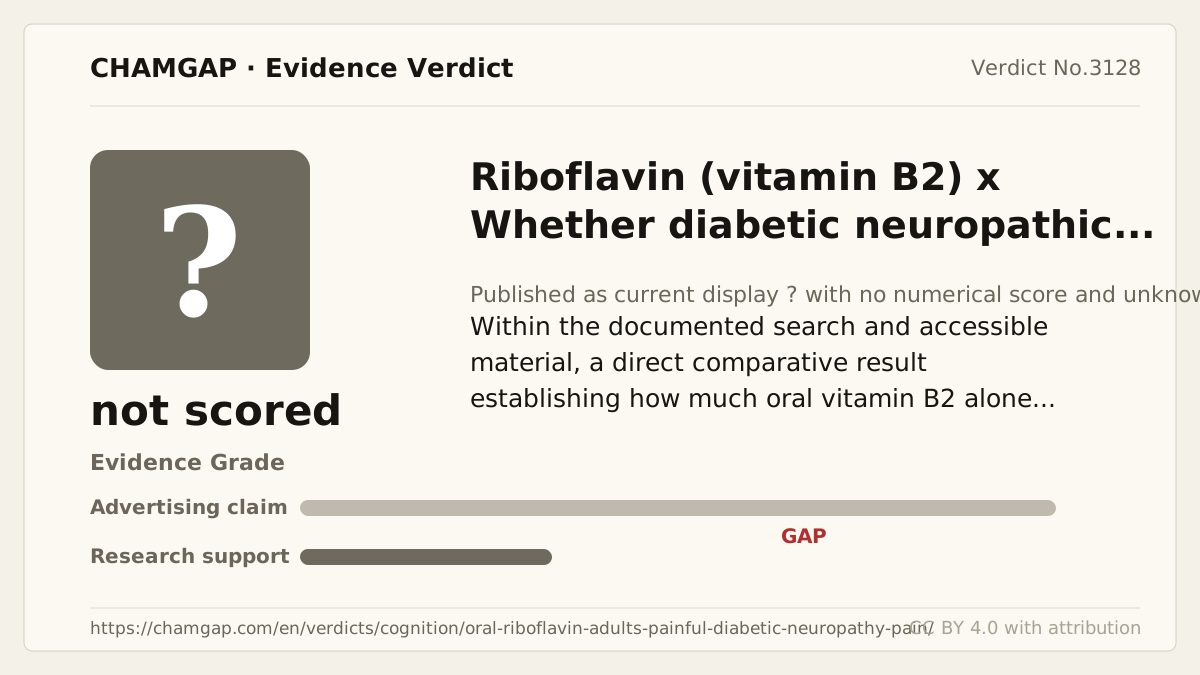
[Chamgap] Does oral vitamin B2 alone reduce pain in diabetic peripheral neuropathy? — Evidence Grade ?. 10 cited sources checked. Source: https://chamgap.com/en/verdicts/cognition/oral-riboflavin-adults-painful-diabetic-neuropathy-pain/ · CC BY 4.0CC BY 4.0 — free to use with attribution; do not distort grades, numbers, or verdict meaning.
What this document does and does not do
Chamgap is an information source. It reports what research has and has not confirmed; it does not tell readers what to take or buy. That decision belongs to readers and, when needed, medical or legal professionals. This verdict reflects literature available up to the search date and may change as new research appears. Nothing here is medical advice.