
Vitamin B12 × memory in older adults without diagnosed cognitive decline
research showsFor the question of whether additional B12 improves memory in older adults without diagnosed cognitive decline, the closest verified single-agent trial did not demonstrate improvement. In OPEN, oral cyanocobalamin 1 mg/day versus placebo produced a **12-month CVLT 20-minute delayed-recall adjusted difference of −0.4 words (95% CI −1.0 to 0.2)**, expressed as B12 minus placebo. This is not proof of an exactly zero effect or equivalence. [S01: Table 6]
ads claimThis is a research question; no specific advertising corpus was collected.
Four separate assessment dimensions
| Effect direction and size | Improvement in 12-month delayed recall was not demonstrated: −0.4 words, 95% CI −1.0 to 0.2. This is not exact zero or equivalence. |
|---|---|
| Evidence certainty | Based on an observable primary report and one selected trial family. Missingness, registry and multiplicity uncertainty limit confidence beyond the stated scope. |
| Applicability | Limited to the screened low-B12 cohort aged ≥75 with MMSE≥24, not replete adults, a formally all-MCI-excluded stratum, dementia/severe-deficiency treatment or other routes. |
| Safety | Caution. Event-specific denominators and the death’s allocation are unverified. Cobalt sensitivity and medicines affecting B12 status are described separately. |
The original calculator’s letter D is distinct from the supplied table’s D/zero-strength anchor of 28. Quality A is not efficacy D or safety Caution.
Useful facts when choosing a product
- The actual tested intervention was single-active oral cyanocobalamin tablets.
- Research exposure was 1 mg/day for 12 months, not a personal dosing recommendation.
- DSM’s material donation was verified; brand, batch and excipients were unreported.
Chamgap Semantic Classification Code
Permanent code issued
S.cyanocobalamin-tablet-1mg.oral.age75plus-mmse24plus-screened-low-b12.twelve-month-cvlt20min-delayed-recall.open-matching-placeboIngredients > Vitamin B12; actual intervention: single-active cyanocobalamin > Oral > Question: older adults without diagnosed cognitive decline. Actual: ≥75, MMSE≥24, dementia/anemia/diabetes excluded, screening B12 107≤level<210 pmol/L; formal MCI exclusion unverified > Page: CVLT correct words after a 20-minute delay at 12 months. Trial-wide primary: nerve-conduction CMAP > Matching placebo; detailed placebo ingredients unreported
Original D/28, oral sole cyanocobalamin, actual low-B12/age75plus/MMSE24plus,12-month CVLT delayed recall,formal all-MCI-exclusion unverified,19 uncertainties and whole KOEN/recorded execution preserved without regrading. The code identifies the intervention and claim; it never contains the evidence grade, score, or safety result.
Exact Claim Classification
These independent facets prevent evidence from different forms, routes, populations, effects, and comparators from being mixed.
| Intervention class | S — oral nutritional supplement |
|---|---|
| Canonical ingredient or intervention | Vitamin B12; actual intervention: single-active cyanocobalamin |
| Source or part used | Purified B12 material; manufacturing organism/source part unreported |
| Formulation or processing | Crystalline cyanocobalamin tablet; brand/excipients unreported |
| Route | Oral |
| Dose | Research exposure 1 mg (1000 μg)/day, once daily; not a personal dose recommendation |
| Duration | 12-month treatment assessment; mean actual treatment reported as 389 days |
| Population | Question: older adults without diagnosed cognitive decline. Actual: ≥75, MMSE≥24, dementia/anemia/diabetes excluded, screening B12 107≤level<210 pmol/L; formal MCI exclusion unverified |
| Effect or condition | Whether memory improves |
| Primary endpoint | Page: CVLT correct words after a 20-minute delay at 12 months. Trial-wide primary: nerve-conduction CMAP |
| Comparator | Matching placebo; detailed placebo ingredients unreported |
| Duplicate-detection key | Internal task boundary: single-active B12/oral/older adults without diagnosed decline question/delayed-recall memory/placebo. Not a reserved semantic code |
What the research actually shows
# Vitamin B12 × memory in older adults without diagnosed cognitive decline
## The 30-second answer For the question of whether additional B12 improves memory in older adults without diagnosed cognitive decline, the closest verified single-agent trial did not demonstrate improvement. In OPEN, oral cyanocobalamin 1 mg/day versus placebo produced a **12-month CVLT 20-minute delayed-recall adjusted difference of −0.4 words (95% CI −1.0 to 0.2)**, expressed as B12 minus placebo. This is not proof of an exactly zero effect or equivalence. [S01: Table 6]
The current efficacy judgement is **D · 28 points** under the supplied rules, not a treatment-success probability or an official GRADE rating. Safety **Caution** and manuscript quality **A (declared scope, same-model self-review)** are separate. This assessment does not negate treatment of diagnosed deficiency or instruct anyone to change a dose or prescription.
## The question versus verified facts The original question concerns B12 and memory in older adults without diagnosed cognitive decline. Oral treatment, a single active and placebo were provisional until verified in OPEN. The actual cohort was community-dwelling, aged at least 75, with MMSE≥24, diagnosed dementia/diabetes and anemia excluded, and screening serum B12 **107 inclusive to 210 exclusive pmol/L**. Investigators called this moderate deficiency, but very low B12 (<107) was excluded. This is not a B12-replete general population or treatment of symptomatic severe deficiency. [S01: Participants]
Formal diagnostic exclusion of MCI in every participant was not established. The estimate therefore applies to a **relatively healthy, cognitively screened older cohort with low B12**; a separate formally confirmed unimpaired-stratum effect is null. No such subgroup was invented or calculated. Screening used the Beckman Coulter assay, whereas baseline used a microbiologic assay that read approximately 25% higher, with a median 63-day interval (IQR 38–119). Baseline B12 medians of 222.9/228.0 pmol/L (n=86/84) do not justify ignoring those differences and relabeling the cohort as replete. [S01: Adherence, Table 1]
The verified research exposure was a crystalline cyanocobalamin single-active oral tablet, 1 mg (1000 μg) once daily for 12 months, compared with a matching placebo. This was not a randomized addition of folate or B6. DSM’s material donation was verified; finished-product brand, batch, excipients and detailed placebo ingredients were not reported. Total dietary B12 in μg/day was not reported; dietary patterns and some prescription-drug use were described. Baseline folate medians were 17.7/17.5 nmol/L. [S01: Procedures, Table 1]
## Why this endpoint and time point The selected memory endpoint is **the number of correct words recalled from the 16-item CVLT list after a 20-minute delay (possible range 0–16, higher is better)** at **12 months**. It matches the requested delayed-recall construct and the scheduled final assessment, rather than being chosen for statistical significance. The identical CVLT version was repeated at baseline and follow-up. [S01: Assessment of cognitive function]
The trial-wide primary outcome was posterior tibial CMAP amplitude at 12 months, consistent between the article and published protocol. Memory belonged to a secondary cognitive domain. The article describes both the first-three-trial total and delayed recall as the main cognitive outcome; delayed recall alone is not called the sole registered primary endpoint here. Original fields and amendment history in ISRCTN54195799 were not independently verified because registry access failed. [S01: neurologic/cognitive methods; S02: outcome measures; S04: access record]
## Actual human evidence | Item | B12 | Placebo | Interpretation/location | |---|---:|---:|---| | Valid baseline data | 99 people | 102 people | Total 201, distinct from 209 randomized. S01 Results/Table 1 | | Baseline delayed recall | 7.3±2.6 **SD** | 7.0±3.1 **SD** | Correct words. Table 3 | | 12-month delayed recall | 7.5±0.3 **SE**, n=91 | 7.7±0.4 **SE**, n=93 | Analysis n=184. Table 6 | | Selected adjusted contrast | −0.4 words | 95% CI −1.0 to 0.2 | B12−placebo, adjusted for baseline cognition, age and sex. Table 6/footnotes 2–4 | | Baseline-only adjusted contrast | −0.4 words | 95% CI −1.0 to 0.2 | Despite the heading “Unadjusted,” footnote 1 specifies baseline adjustment | | Other memory measure: first-three-trial CVLT total | −1.4 words | 95% CI −2.9 to 0.1 | Immediate learning total, not delayed recall. Table 6 | | Blood B12 before/after | 231.3→640.9 pmol/L, n=74 | 235.4→235.7, n=70 | Separate blood denominator in Table 4; not a memory effect |
Mean±SD and mean±SE are different. The simple endpoint-mean difference of −0.2 is not the adjusted −0.4 effect and does not replace it. Baseline and endpoint denominators differ, so differences of those means are not presented as paired within-person changes. Exact P, model SE, paired change and change SD/SE are null. Continuous models were bootstrapped for nonnormality; the text says ANCOVA and Table 6 footnotes use ANOVA terminology. Without IPD and a complete SAP, no new CI, P value or standardized effect was estimated. [S01: Statistical analysis; Tables 3/6]
## Denominators, design and contrary evidence There were 209 randomized people, of whom eight were allocated in error and provided no further data. Among 201 with valid baseline data, the text describes six withdrawals (B12 two/placebo four), one death, and three B12 participants who continued medication but supplied no endpoint data. Some 12-month outcome was available for 191. Memory n=184 (91/93), nerve testing n=182 (91/91), paired blood samples n=151 and analyte-specific denominators are not interchangeable. The authors’ “ITT” label is not rewritten as complete-data analysis of all 209. [S01: Results/Tables 4–6]
Central computerized allocation, balancing by age/sex, identical tablets/containers and staff blinding were verified. Formal maintenance-of-blinding results and complete imputation/sensitivity procedures were unreported or unavailable. No subgroup analysis was prespecified; a multiplicity-adjustment rule for the cognitive battery was not reported. Sample-size planning concerned nerve conduction, not a memory MCID. The protocol also planned B12/folate/homocysteine covariates, whereas the result’s cognitive model describes baseline outcome, age and sex. [S01/S02]
The R01-034 search, extraction and trial-family records were reused. Eussen2006 includes a genuine B12-only arm, but mixes CDR 0/0.5/1/2 without a separable target-stratum effect. Kwok2017 involved older adults with diabetes, 44% with CDR 0.5, and was not pooled as a strictly unimpaired delayed-recall estimate. Ma2019, Kwok2020, VITACOG and Alzheimer combination studies concern MCI/dementia or comparisons with multiple changing actives. Positive imaging/some cognitive signals in VITACOG and related combination work are acknowledged, but are not independent replications of B12 alone. Protocols, main reports, same-cohort reports and reviews are not counted as separate trials. This work used supplied records plus targeted web searches, not an exhaustive database systematic review. [Reused trial-family ledger; S01 Discussion]
## Funding and safety Support came from the UK Food Standards Agency (N05072), Department of Health, and NHS/King’s College Hospital services, with B12 material supplied by DSM. The paper reports no funder role in implementation, data, analysis, interpretation or the manuscript, and no related author conflict. The donation was not concealed to claim full independence, nor were manufacturer cash or employee authors invented. [S01: funding/COI]
The safety label is **Caution**. The text reports one death and no other reported serious adverse events, but does not supply the death’s allocation/causality or arm-specific nonserious-event denominators in the material accessed. “Not reported” is not “zero events” or verified safety. MHRA’s cobalt-sensitivity warning for cyanocobalamin/hydroxocobalamin is separate safety context. NIH’s absence of a tolerable upper intake level does not guarantee unlimited safety; acid inhibitors and metformin can affect B12 status. These facts are not instructions to stop medicines or estimates of this trial’s adverse-event rate. Injection-label risks are not transferred to oral incidence. [S01 Results; S05; S06]
## Seven evaluation explanations **Effect:** Improvement in 12-month delayed recall was not demonstrated: −0.4 words, 95% CI −1.0 to 0.2. This is not exact zero or equivalence.
**Certainty:** Based on an observable primary report and one selected trial family. Missingness, registry and multiplicity uncertainty limit confidence beyond the stated scope.
**Applicability:** Limited to the screened low-B12 cohort aged ≥75 with MMSE≥24, not replete adults, a formally all-MCI-excluded stratum, dementia/severe-deficiency treatment or other routes.
**Safety:** Caution. Event-specific denominators and the death’s allocation are unverified. Cobalt sensitivity and medicines affecting B12 status are described separately.
**Verification:** The same model compared primary HTML/tables, a published protocol, bibliography, official safety sources and supplied originals. This is not independent external clinical review or journal certification.
**Limitations:** Original registry access, IPD/SAP, formal MCI exclusion, exact P/model SE/paired change, MCID, nonserious-AE denominators and exhaustive searching remain limited.
**Score interpretation:** The original calculator’s letter D is distinct from the supplied table’s D/zero-strength anchor of 28. Quality A is not efficacy D or safety Caution.
## Seven coded fields and reasons | Field | Value | Reason | |---|---|---| | claim_type | B | B: A tested human efficacy question, not an established physiology/deficiency axiom (A) or a safety-only question. | | endpoint | P | P: Correct words on a validated memory performance test are the outcome itself, not a blood surrogate (S) or hard event (H). | | replication | R1 | R1: One closest eligible single-agent trial family; mixed MCI/dementia/diabetes or B-complex trials do not become same-question repeated refutations (RX). | | independence | I1 | I1: Public support plus DSM’s in-kind supply is conservatively treated as mixed support. Manufacturer cash funding or employee authorship is not invented; authors reported no related conflict. | | effect | E0 | E0: The selected between-group CI contains zero; improvement was not demonstrated. This code does not mean an exactly zero effect, equivalence, or no effect in every setting. | | bias | B2 | B2: Under supplied case 44 and axis 6, two distinct documentation limitations are counted: (1) post-allocation exclusions/available-case analysis and unverified missing-data handling; (2) unreported evidence that participant blinding was maintained. This does not assert that blinding was absent. Registry access failure is not counted as an additional design defect; analyzing 184 does not turn a 209-person randomized study into a sub-200 trial. Funding and CI are not double-counted. | | precision | C0 | C0: The benefit-side CI bound is +0.2 words. Without a verified applicable MCID/equivalence margin, C1 exclusion of meaningful benefit is not asserted; this does not assert that +0.2 words is clinically important. |
E0 with R1/C0 yields D under the supplied floor rule. None of H/R2/I2/E+/C1/B0/big_hard_rct is present, so the separate fixed anchor is 28. coprimary_split is null because original registered sole-primary status is unverified; no new split efficacy claim is created. Four receipts link actual calculator execution to the separately adopted numeric anchor.
## Twelve classification boundaries | Field | Current value | |---|---| | kind | S — oral nutritional supplement | | canonical_entity | Vitamin B12; actual intervention: single-active cyanocobalamin | | source_part | Purified B12 material; manufacturing organism/source part unreported | | formulation | Crystalline cyanocobalamin tablet; brand/excipients unreported | | route | Oral | | dose | Research exposure 1 mg (1000 μg)/day, once daily; not a personal dose recommendation | | duration | 12-month treatment assessment; mean actual treatment reported as 389 days | | population | Question: older adults without diagnosed cognitive decline. Actual: ≥75, MMSE≥24, dementia/anemia/diabetes excluded, screening B12 107≤level<210 pmol/L; formal MCI exclusion unverified | | claim | Whether memory improves | | primary_endpoint | Page: CVLT correct words after a 20-minute delay at 12 months. Trial-wide primary: nerve-conduction CMAP | | comparator | Matching placebo; detailed placebo ingredients unreported | | duplicate_key | Internal task boundary: single-active B12/oral/older adults without diagnosed decline question/delayed-recall memory/placebo. Not a reserved semantic code |
## All unresolved and out-of-scope values These nulls represent the current information state, not abandoned fields or a clinical hold.
**formal_MCI_exclusion — not_reported, null:** MMSE≥24 and dementia exclusion were verified, but formal MCI exclusion in every participant was not reported.
**strict_target_stratum_effect — not_reported, null:** No separate effect for a formally confirmed unimpaired stratum was reported; the screened-cohort estimate is not relabeled as such.
**registry_primary_original — inaccessible, null:** The registry identifier matches paper/protocol, but original registry fields and amendment history were inaccessible (holding/PDF failures).
**brand_and_excipients — not_reported, null:** DSM supplied B12 material. Finished-product brand, batch, excipients and detailed placebo composition were not reported.
**manufacturing_source — not_reported, null:** Manufacturing organism/strain or source part was not reported; no botanical part is invented.
**diet_total_B12 — not_reported, null:** Dietary patterns were collected, but total dietary B12 in μg/day and all co-supplement doses were not reported.
**exact_P_and_model_SE — not_reported, null:** Exact P and model SE for the selected contrast were not reported. No normal-approximation P was fabricated from a bootstrap CI.
**paired_change_SD_SE — not_reported, null:** Paired within-arm change, change SD/SE and covariance were not reported. Differences between means with different denominators are not paired changes.
**MCID_equivalence_margin — not_reported, null:** No applicable validated between-group MCID/equivalence margin was established for this population and test adaptation. No invented threshold or Cohen convention was treated as a clinical margin.
**missing_data_SAP_IPD — inaccessible, null:** IPD, full SAP and missing-data imputation/sensitivity analyses were unavailable. Reported analysis denominators are distinguished from the authors’ ITT label.
**multiplicity_adjustment — not_reported, null:** A multiplicity-adjustment rule for the several cognitive tests was not reported; nonreporting is not proof that none was performed.
**blinding_success_test — not_reported, null:** Identical tablets and blinded staff were verified; treatment-guess or formal maintenance-of-blinding results were not reported.
**safety_arm_event_denominators — not_reported, null:** The death’s allocation/causality, nonserious AE rates by arm and event-specific discontinuation reasons were not available in the accessed text.
**long_term_special_groups — not_searched, null:** Memory efficacy beyond 12 months and in pregnancy, children, hepatic/renal disease or diagnosed malabsorption was outside this selected scope.
**other_forms_routes — not_applicable, null:** This estimate is for oral cyanocobalamin; it does not establish equal effects for methyl/hydroxo/adenosyl forms, sublingual/IM/IV/transdermal routes or B-complex combinations.
**lab_interference — not_reported, null:** Assay interference outcomes were not reported. The documented difference between two B12 assays is not proof of absence of interference.
**correction_retraction_exhaustiveness — not_searched, null:** No related notice surfaced in the current PubMed Erratum/Retract checks and title searches. Publisher/Crossmark/unindexed notices were not exhaustively audited.
**advertising — not_searched, null:** This is a research question; no specific advertising corpus was collected.
**protocol_hemoglobin_units — conflicting, null:** The 2011 protocol prints hemoglobin cutoffs of 11/12 g/L, while the completed 2015 paper reports 110/120 g/L. Source text was not silently corrected; actual trial eligibility uses S01’s 110/120 g/L.
## Sources and records S01: Dangour et al., 2015, Am J Clin Nutr 102:639–647, DOI 10.3945/ajcn.115.110775, PMID 26135351, PMCID PMC4548176. Primary HTML, tables and footnotes were inspected. S02: Published OPEN protocol, Nutr J 2011;10:22, DOI 10.1186/1475-2891-10-22, PMID 21396086. It does not substitute for access to original registry fields. S03: PubMed bibliography and bounded correction/retraction notice checks. S04: Failed ISRCTN54195799 access record. S05: MHRA official cobalt-sensitivity advice. S06: NIH ODS official B12 nutrition/safety context. Direct URLs, locations, access dates and original reuse paths are in sources.json. Original grades, bilingual text and sources for 3111–3114 are preserved unchanged, not replaced by this judgement.
## Current completion and revision policy Evidence cutoff: 2026-09-18. This independent efficacy content is completed_with_uncertainty; publication_status=needs_id_assignment because identifiers are unreserved, while editorial status is ready_with_uncertainty. Site ID, slug, URL, semantic code and first-publication date are null. clinical_todo=[]; no clinical re-investigation, regrading or calculator rerun is delegated to the recipient. Initial corrections=[]; pre-submission changes are in a separate audit. Verified new evidence, newly obtained primary material, correction/retraction, numeric error or boundary change can trigger revision while retaining the subsequently assigned permanent identity. This delivery is not server publication or recipient FULL completion and does not start the next task.
S01: https://pmc.ncbi.nlm.nih.gov/articles/PMC4548176/ S02: https://pmc.ncbi.nlm.nih.gov/articles/PMC3062585/ S03: https://pubmed.ncbi.nlm.nih.gov/26135351/ S04: https://www.isrctn.com/ISRCTN54195799 S05: https://www.gov.uk/drug-safety-update/vitamin-b12-hydroxocobalamin-cyanocobalamin-advise-patients-with-known-cobalt-allergy-to-be-vigilant-for-sensitivity-reactions S06: https://ods.od.nih.gov/factsheets/VitaminB12-HealthProfessional/
Why this is classified as D (28)
The original calculator’s letter D is distinct from the supplied table’s D/zero-strength anchor of 28. Quality A is not efficacy D or safety Caution.
Counterpoint. Original registry access, IPD/SAP, formal MCI exclusion, exact P/model SE/paired change, MCID, nonserious-AE denominators and exhaustive searching remain limited.
Rejudgment record. Improvement in 12-month delayed recall was not demonstrated: −0.4 words, 95% CI −1.0 to 0.2. This is not exact zero or equivalence. — 참고자료/채점표.md:718–779; unchanged 등급도출.py
| Claim type | B | B: A tested human efficacy question, not an established physiology/deficiency axiom (A) or a safety-only question. |
| Endpoint | P | P: Correct words on a validated memory performance test are the outcome itself, not a blood surrogate (S) or hard event (H). |
| Replication | R1 | R1: One closest eligible single-agent trial family; mixed MCI/dementia/diabetes or B-complex trials do not become same-question repeated refutations (RX). |
| Independence | I1 | I1: Public support plus DSM’s in-kind supply is conservatively treated as mixed support. Manufacturer cash funding or employee authorship is not invented; authors reported no related conflict. |
| Effect size | E0 | E0: The selected between-group CI contains zero; improvement was not demonstrated. This code does not mean an exactly zero effect, equivalence, or no effect in every setting. |
| Precision | C0 | C0: The benefit-side CI bound is +0.2 words. Without a verified applicable MCID/equivalence margin, C1 exclusion of meaningful benefit is not asserted; this does not assert that +0.2 words is clinically important. |
| Risk of bias | B2 | B2: Under supplied case 44 and axis 6, two distinct documentation limitations are counted: (1) post-allocation exclusions/available-case analysis and unverified missing-data handling; (2) unreported evidence that participant blinding was maintained. This does not assert that blinding was absent. Registry access failure is not counted as an additional design defect; analyzing 184 does not turn a 209-person randomized study into a sub-200 trial. Funding and CI are not double-counted. |
Stored derived and displayed grades match; this is not a current recalculation or validity check (D).
Review performed and remaining limitations
Original registry access, IPD/SAP, formal MCI exclusion, exact P/model SE/paired change, MCID, nonserious-AE denominators and exhaustive searching remain limited.
Evidence Table
| Study | Design | Sample | Funding | Endpoint | Result | Weight |
|---|---|---|---|---|---|---|
| OPEN / Dangour 2015 | Randomized double-blind placebo-controlled trial | Randomized 209; valid baseline 201 (99/102); delayed recall 184 (91/93) | Public support plus DSM material donation | CVLT 20-minute delayed recall at 12 months | Adjusted between-group −0.4 words, 95% CI −1.0 to 0.2 | Closest single-agent evidence; formal MCI exclusion unverified |
Receipt — 18 References
Evidence access cutoff: 2026-09-18. Each citation states its actual access level (full-text transcription, abstract, index, or other) and remaining limitations. Bibliographic checking does not certify the study results or treatment efficacy.
Technical integration by: Codex · Evidence date: 2026-09-18 · Corrections: none
Cite this verdict
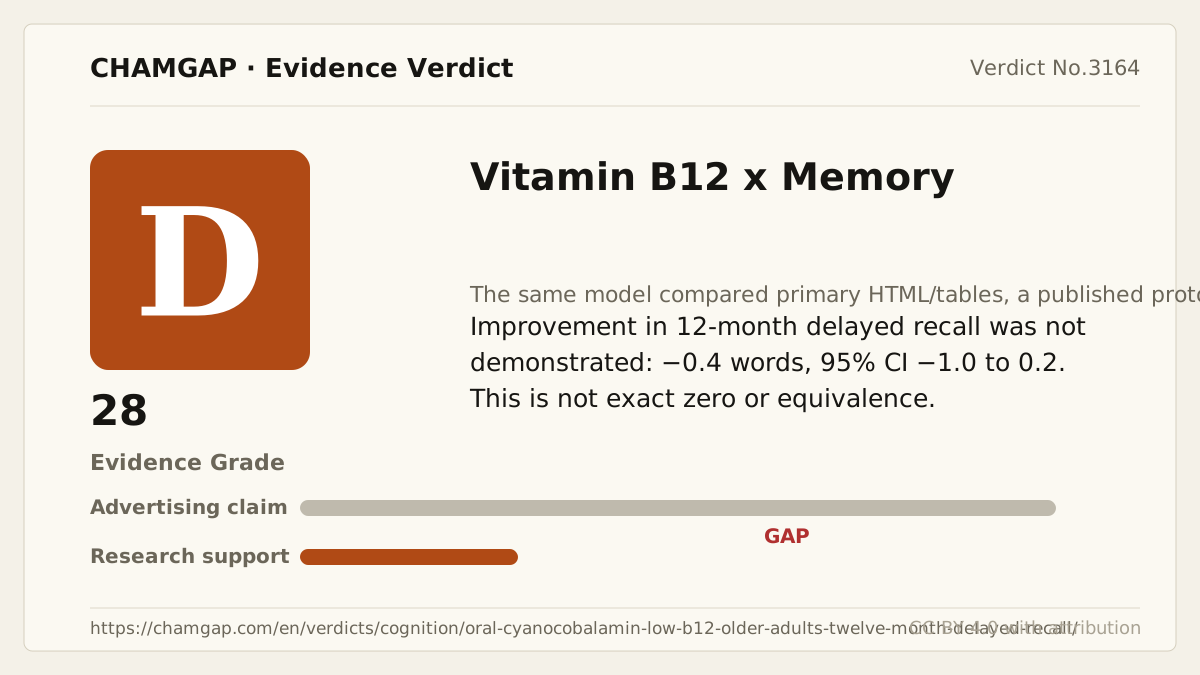
[Chamgap] Vitamin B12 × memory in older adults without diagnosed cognitive decline — Evidence Grade D·28. 18 cited sources checked. Source: https://chamgap.com/en/verdicts/cognition/oral-cyanocobalamin-low-b12-older-adults-twelve-month-delayed-recall/ · CC BY 4.0CC BY 4.0 — free to use with attribution; do not distort grades, numbers, or verdict meaning.
What this document does and does not do
Chamgap is an information source. It reports what research has and has not confirmed; it does not tell readers what to take or buy. That decision belongs to readers and, when needed, medical or legal professionals. This verdict reflects literature available up to the search date and may change as new research appears. Nothing here is medical advice.