
OnabotulinumtoxinA,
does it really help with Prevention of attack frequency in episodic migraine?
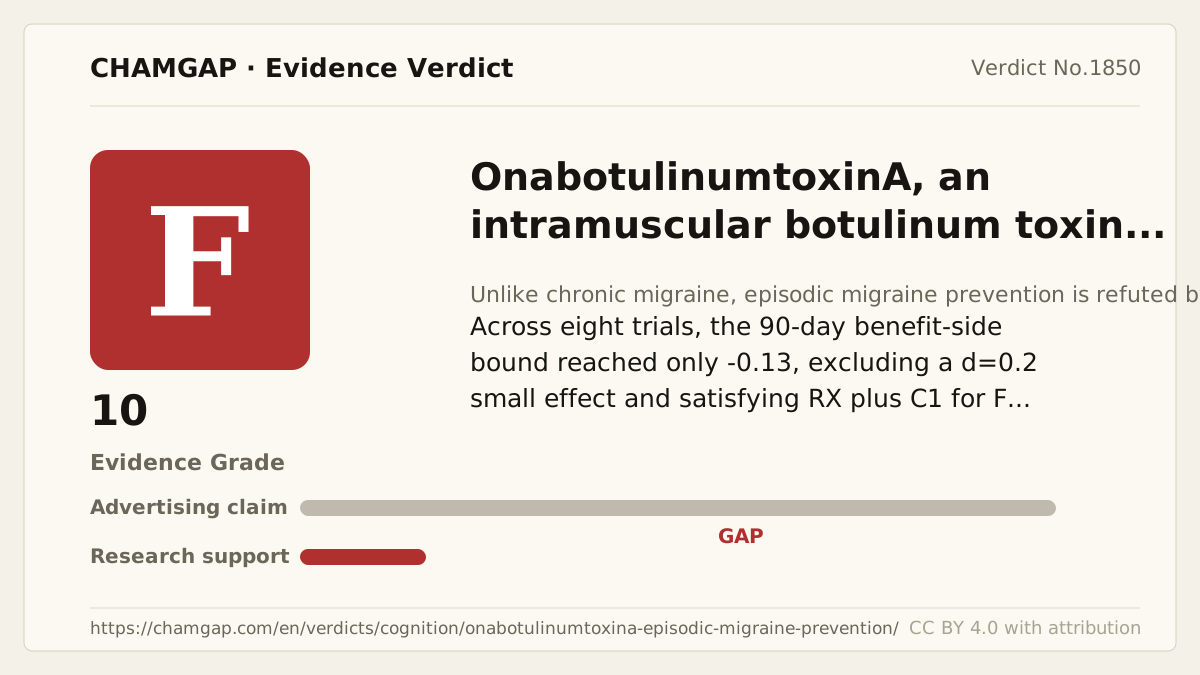
research showsOnabotulinumtoxinA is rated F because episodic-migraine trials were repeatedly null and the 90-day estimate across eight trials and 1,601 participants was Cohen d -0.05 (95% CI -0.13 to 0.04), not reaching Cohen's d=0.2 small-effect threshold.
ads claimEvidence from Botox use in chronic migraine is expanded to people with less frequent episodic migraine, despite repeated null direct episodic trials.
Useful facts when choosing a product
- The clinical boundary is fewer than 15 monthly headache days for episodic versus at least 15 for chronic migraine.
- Aurora randomized and analyzed 369; Relja randomized and analyzed 495.
Chamgap Semantic Classification Code
Candidate index · review held
M.onabotulinumtoxina.intramuscular.attack-frequency-in-episodic-migraine.prevent.placeboMedicinal interventions > OnabotulinumtoxinA > Intramuscular > attack frequency in episodic migraine > Occurrence-prevention claim > Placebo
An automated migration candidate, not an issued permanent code; exact claim scope remains under review. This machine-generated migration candidate helps retrieval but is not a permanent assignment. The original verdict ID and URL remain authoritative.
What the research actually shows
Episodic migraine has fewer than 15 headache days per month; chronic migraine is separate, with at least 15 days monthly for more than three months and at least eight migraine-feature days. Aurora with 369 participants and Relja with 495 failed. Shuhendler and colleagues synthesized eight trials and 1,601 participants: d=-0.06 (-0.14 to 0.03) at 30 days, -0.05 (-0.14 to 0.03) at 60 days, and -0.05 (-0.13 to 0.04), P=0.28, at 90 days. The benefit-side bound of -0.13 did not reach Cohen's d=0.2 small-effect threshold, giving C1. This is not a migraine-specific patient-based MCID. PRECLUDE in 2025 randomized 775 participants; differences were -0.1 (SE 0.33), P=.745, for 155 units and 0.0 (SE 0.33), P=.914, for 195 units. PREEMPT studied chronic migraine and was not transferred. verdict 1694, which is C with 55 points, verdict 1091, which is B with 74 points, verdict 129, which is B with 66 points, and verdict 1675, which is C with 45 points, were not transferred. Chamgap has seven botulinum-toxin verdicts: only verdict 1824, which is B with 70 points for cervical dystonia, is B; the others are C through F. The same substance diverges by indication because populations, endpoints, and direct trial results differ.
Why this is classified as F (12)
P, RX, I0, E0, B0, and C1 derive F with 12 points. Both repeated failure in episodic migraine and exclusion of a small meaningful benefit were verified.
Counterpoint. If headache frequency reaches at least 15 days per month, the chronic-migraine diagnosis and evidence base require separate reassessment.
Rejudgment record. Cross-check applied — Multiple failed primary endpoints in episodic migraine and an eight-trial pooled confidence interval excluding a small clinically relevant effect
| Endpoint | P | Symptom or function itself is the target - including patient reports and performance tests |
| Replication | RX | Repeatedly refuted in the same indication |
| Independence | I0 | Evidence comes only from manufacturer studies |
| Effect size | E0 | Null |
| Precision | C1 | The confidence interval excludes meaningful benefit |
Stored derived and displayed grades match; this is not a current recalculation or validity check (F).
Sub-claim grades by effect
This ingredient is marketed for several effects. A single overall grade blends strong and weak claims together, so each effect is graded separately here. The overall grade reflects the strongest disconfirming or core claim.
| Effect (sub-claim) | Grade | Basis |
|---|---|---|
| Reduction in monthly migraine episodes | F | Primary endpoints repeatedly failed in multiple large trials. |
| Reduction in migraine frequency at 90 days | F | Pooled d=-0.05 (-0.13 to 0.04) excluded even a small effect. |
| At least 50% attack-frequency response | F | No consistent responder benefit overturns the repeated null overall evidence. |
Cross-check — AI research and Codex final gate
Evidence Table
| Study | Design | Sample | Funding | Endpoint | Result | Weight |
|---|---|---|---|---|---|---|
| Aurora SK et al. 2007 | Multiple-treatment randomized double-blind placebo-controlled trial | 369 randomized and analyzed by intention to treat | Manufacturer trial by Allergan with employee coauthors | Change in monthly migraine episodes at day 180 in the placebo-nonresponder stratum | -2.4 versus -2.2 episodes, P>0.999; primary endpoint failed | Key large null trial |
| Relja M et al. 2007 | Three-cycle multicenter randomized double-blind placebo-controlled trial | 495 randomized and analyzed | Manufacturer trial by Allergan with employee coauthors | Change in monthly migraine episode frequency at day 180 | 225 U -1.6, 150 U -1.7, 75 U -1.5, placebo -1.4; all doses null and the primary endpoint failed | Separately conducted repeated null trial |
| Shuhendler AJ et al. 2009 | Meta-analysis of double-blind placebo-controlled randomized trials | Eight randomized trials and 1,601 participants | Funding not stated; University of Toronto academic team, with key included trials led by Allergan | Monthly migraine frequency at 30, 60, and 90 days | At 30 days d=-0.06 (-0.14 to 0.03), at 60 days -0.05 (-0.14 to 0.03), and at 90 days -0.05 (-0.13 to 0.04), P=0.28; excludes d=0.2 | Decisive replication and C1 precision evidence |
| Pozo-Rosich P et al. PRECLUDE, 2025 | Phase 3 randomized double-blind placebo-controlled trial | 775 randomized participants | Manufacturer program by AbbVie and Allergan | Change in monthly migraine days during months 5 and 6 | 155 units -0.1 (SE 0.33), P=.745; 195 units 0.0 (SE 0.33), P=.914 | Latest large repeated null trial |
Receipt — 4 References
All 4 cited sources were verified for existence at the original page (as of 2026-07-24).
Final verification and publication gate: Codex · Evidence date: 2026-07-24 · Corrections: none
Cite this verdict
[Chamgap] OnabotulinumtoxinA x prevention of episodic migraine — Evidence Grade F·12. 4 cited sources checked. Source: https://chamgap.com/en/verdicts/cognition/onabotulinumtoxina-episodic-migraine-prevention/ · CC BY 4.0CC BY 4.0 — free to use with attribution; do not distort grades, numbers, or verdict meaning.
What this document does and does not do
Chamgap is an information source. It reports what research has and has not confirmed; it does not tell readers what to take or buy. That decision belongs to readers and, when needed, medical or legal professionals. This verdict reflects literature available up to the search date and may change as new research appears. Nothing here is medical advice.