
OnabotulinumtoxinA,
does it really help with Improvement of abnormal posture, neck pain, and disability in cervical dystonia?
research showsBotulinum toxin A, including onabotulinumtoxinA, improves cervical dystonia symptoms and is graded B. In the 170-person Charles 2012 responder-rerandomization trial, both six-week coprimary endpoints succeeded. Cochrane pooled nine placebo-controlled trials and 1,144 participants, finding a four-week TWSTRS MD of -8.09 points (95% CI -9.96 to -6.22), which reached the patient-PGIC-based 8-point MCIC reported by Comella 2019. However, eight of nine trials had industry funding or study-drug support, only one was independently funded, and assessment was short term.
ads claimClaims of permanent neck realignment expand temporary symptom relief into structural cure.
Useful facts when choosing a product
- Outcomes are commonly assessed four to six weeks after injection, and retreatment is often around 12 weeks.
- Only this indication has both an independently funded trial and a Cochrane placebo-controlled synthesis. Verdict 1694, C with 55 points, and verdict 1705, C with 45 points, concern chronic migraine and sleep bruxism and have different evidence structures.
- Verdict 1733, C with 59 points, verdict 1734, C with 55 points, and verdict 1766, C with 59 points, concern axillary hyperhidrosis, glabellar lines, and overactive bladder; their evidence was not pooled here.
Chamgap Semantic Classification Code
Candidate index · review held
M.onabotulinumtoxina.intramuscular.abnormal-posture-neck-pain-and-disability-in-cervical-dystonia.improve.placeboMedicinal interventions > OnabotulinumtoxinA > Intramuscular > abnormal posture, neck pain, and disability in cervical dystonia > Improvement claim > Placebo
An automated migration candidate, not an issued permanent code; exact claim scope remains under review. This machine-generated migration candidate helps retrieval but is not a permanent assignment. The original verdict ID and URL remain authoritative.
What the research actually shows
The Charles CD-140 study randomized 170 open-label onabotulinumtoxinA responders to placebo in 82 or drug in 88 and analyzed all 170. Both six-week coprimary endpoints succeeded: CDSS change was -1.81 versus -0.31, P=0.012, and physician global improvement was 61.7% versus 41.5%, P=0.022. Allergan supplied treatment and led the study. The 2020 Cochrane update by Rodrigues and colleagues pooled nine placebo-controlled trials and 1,144 participants, finding a four-week TWSTRS MD of -8.09 (-9.96 to -6.22; I-squared 0%). Eight trials had industry funding or study-drug support; Greene 1990 was independently funded. The Allergan-supported CD PROBE analysis of 479 completers mapped minimal or greater patient global improvement to an 8-point TWSTRS total-score MCIC.
Why this is classified as B (70)
The profile is P, R2, I1, E+, and B1. Clinically meaningful benefit across nine placebo-controlled trials and one independently funded trial is accepted; eight of nine trials had industry involvement and follow-up was short, yielding B with 70 points.
Counterpoint. Eight of nine trials had industry funding or study-drug support, and only one was independently funded. A specialist must individualize muscles, dose, and interval according to posture pattern, prior response, and swallowing risk.
Rejudgment record. Cross-check applied — Accepted MCIC-level benefit across nine placebo-controlled trials and mixed funding, with a B1 ceiling for short follow-up
| Endpoint | P | Symptom or function itself is the target - including patient reports and performance tests |
| Replication | R2 | Independently replicated across trials |
| Independence | I1 | Mixed funding sources |
| Effect size | E+ | Meets the clinically important threshold |
Stored derived and displayed grades match; this is not a current recalculation or validity check (B).
Sub-claim grades by effect
This ingredient is marketed for several effects. A single overall grade blends strong and weak claims together, so each effect is graded separately here. The overall grade reflects the strongest disconfirming or core claim.
| Effect (sub-claim) | Grade | Basis |
|---|---|---|
| Improvement in clinical severity of cervical dystonia | B | Benefit was replicated across nine placebo-controlled trials, but eight had industry involvement and follow-up was short. |
| Reduction of neck pain | B | The pooled TWSTRS pain subscale favored treatment. |
| Improvement in daily disability | B | Multiple placebo-controlled trials include one independently funded study. |
Cross-check — AI research and Codex final gate
Evidence Table
| Study | Design | Sample | Funding | Endpoint | Result | Weight |
|---|---|---|---|---|---|---|
| Charles D et al. 2012 (CD-140) | Responder-enriched randomized double-blind placebo-controlled trial | 170 randomized and 170 analyzed (88 versus 82) | Manufacturer-led and supplied by Allergan, with company employees as coauthors | Six-week coprimary CDSS change and physician global assessment | -1.81 versus -0.31 (P=0.012), improvement 61.7% versus 41.5% (P=0.022); both coprimary endpoints successful. | Decisive product-specific trial |
| Rodrigues FB et al. 2020 Cochrane | Meta-analysis of nine randomized double-blind placebo-controlled trials | Nine trials and 1,144 participants | Eight of nine trials had industry funding or study-drug support and one was independently funded; the Cochrane review had no commercial funding | Four-week TWSTRS total score | MD -8.09 points (95% CI -9.96 to -6.22; I-squared 0%), reaching the 8-point MCIC from Comella 2019. | Randomized replication and clinical-significance evidence |
Receipt — 3 References
All 3 cited sources were verified for existence at the original page (as of 2026-07-24).
Final verification and publication gate: Codex · Evidence date: 2026-07-24 · Corrections: none
Cite this verdict
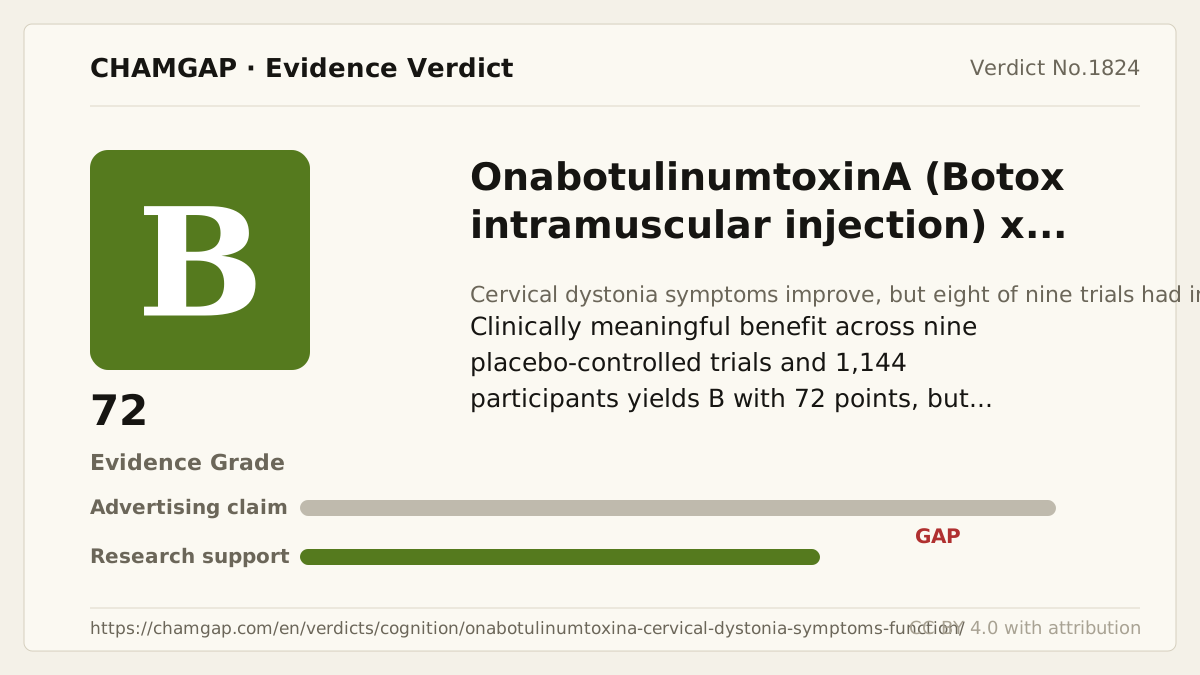
[Chamgap] OnabotulinumtoxinA x cervical dystonia symptoms and function — Evidence Grade B·70. 3 cited sources checked. Source: https://chamgap.com/en/verdicts/cognition/onabotulinumtoxina-cervical-dystonia-symptoms-function/ · CC BY 4.0CC BY 4.0 — free to use with attribution; do not distort grades, numbers, or verdict meaning.
What this document does and does not do
Chamgap is an information source. It reports what research has and has not confirmed; it does not tell readers what to take or buy. That decision belongs to readers and, when needed, medical or legal professionals. This verdict reflects literature available up to the search date and may change as new research appears. Nothing here is medical advice.