
Omega-3 EPA and DHA,
does it really help with Prevention of memory decline and incident dementia in cognitively healthy older adults?
research showsFish-oil EPA and DHA supplementation is rated D for the core claim of preventing cognitive decline in cognitively healthy older adults. In VITAL-Cog, 3,424 participants tested by telephone and 794 tested in person received no significant cognitive benefit from 1 g/day over two to three years, and the 3,501-person AREDS2 cognitive study was likewise null over about five years. Global cognitive differences were approximately -0.01 to -0.03 and statistically nonsignificant. VITAL-Cog, AREDS2, and MAPT did not adequately test incident dementia itself, so dementia prevention is unestablished rather than directly refuted. Repeated null large trials for cognitive decline support D with 25 points; dietary fish and other omega-3 indications are separate.
ads claimMarketing turns the biological fact that DHA is a brain-membrane constituent and observational data on fish consumption into a clinical promise that fish-oil capsules preserve memory and prevent dementia. Nutrient essentiality does not prove added benefit from supplementation in nondeficient older adults.
Useful facts when choosing a product
- VITAL-Cog tested 1 g/day fish oil containing 460 mg EPA and 380 mg DHA, while AREDS2 tested 650 mg EPA and 350 mg DHA per day.
- The trials address cognitive prevention at those supplement doses, not an overall dietary pattern containing fish or treatment of a medically confirmed deficiency.
- Fish-oil products differ in EPA and DHA content, oxidation, contaminant control, and serving size, so total fish-oil mass on the label is not the research dose.
- Usual doses are generally well tolerated, but fishy aftertaste and gastrointestinal symptoms are common; high doses and concurrent anticoagulant or antiplatelet use warrant attention to bleeding tendency and interactions.
Chamgap Semantic Classification Code
Candidate index · review held
S.omega-3-fatty-acids.UNK.memory-decline-and-incident-dementia-in-cognitively-healthy-older-adults.prevent.MULTISupplements and nutraceuticals > Omega-3 fatty acids > Unknown > memory decline and incident dementia in cognitively healthy older adults > Occurrence-prevention claim > Multiple: primary unresolved
An automated migration candidate, not an issued permanent code; exact claim scope remains under review. This machine-generated migration candidate helps retrieval but is not a permanent assignment. The original verdict ID and URL remain authoritative.
What the research actually shows
Kang and colleagues evaluated 3,424 healthy community-dwelling VITAL participants by telephone and 794 in person. Fish oil providing 840 mg EPA plus DHA within 1 g/day had no significant effect on global cognitive change over two to three years. The AREDS2 cognitive study by Chew and colleagues followed 3,501 participants for about five years; EPA 650 mg plus DHA 350 mg did not slow annual decline in a composite cognitive score. Andrieu and colleagues randomized 1,680 participants with memory complaints for three years, and neither omega-3 alone nor its combination with a multidomain intervention significantly improved the primary composite cognitive outcome versus placebo. Incident dementia was not a primary adequately powered endpoint, so that outcome remains unestablished, while the closely related memory-decline prevention claim was repeatedly null.
Why this is classified as D (25)
The VITAL cognitive program included more than 4,000 participants, AREDS2 included 3,501, and MAPT was also null on its primary endpoint, with nonsignificant global cognitive differences of about -0.01 to -0.03. Incident dementia was not adequately powered and remains unestablished rather than refuted, but the core claim of preventing cognitive decline failed repeatedly in large human trials. This gives D with 25 points. Other omega-3 indications and safety are separate.
Counterpoint. Exercise, blood-pressure and diabetes control, smoking cessation, hearing and sleep assessment, and a balanced diet take priority for cognitive health. Prescription omega-3 for cardiovascular indications or severe hypertriglyceridemia is outside this cognition verdict.
Rejudgment record. New verdict — Applied rule ② to null global or primary composite cognitive outcomes in the VITAL-Cog and CTSC-Cog program of more than 4,000 participants, 3,501-person AREDS2, and 1,680-person MAPT; separately limited inference because incident dementia was underpowered and dietary fish, deficiency, selected clinical groups, and other omega-3 indications are distinct
Sub-claim grades by effect
This ingredient is marketed for several effects. A single overall grade blends strong and weak claims together, so each effect is graded separately here. The overall grade reflects the strongest disconfirming or core claim.
| Effect (sub-claim) | Grade | Basis |
|---|---|---|
| Prevention of decline in global cognitive scores | D | Global cognitive differences in VITAL-Cog and AREDS2 were approximately -0.01 to -0.03 and statistically nonsignificant. |
| Improvement in individual cognitive domains such as memory | D | Large randomized trials did not identify a consistent significant benefit across individual cognitive domains. |
| Prevention of incident mild cognitive impairment or dementia | ? | VITAL-Cog, AREDS2, and MAPT did not adequately test incidence itself, so prevention is unestablished rather than directly refuted. |
Cross-check — AI research and Codex final gate
Evidence Table
| Study | Design | Sample | Funding | Endpoint | Result | Weight |
|---|---|---|---|---|---|---|
| Kang JH et al. 2022 VITAL-Cog and CTSC-Cog | Combined cognitive substudies of a large randomized double-blind placebo-controlled trial | 3,424 assessed by telephone and 794 assessed in person | Multiple United States NIH public grants; authors reported no conflicts | Annual change in global cognitive score over two to three years | The pooled difference was -0.01 standard units (95% CI -0.02 to 0.003; P=.15), with no significant benefit. | Key independent large null evidence |
| Chew EY et al. 2015 AREDS2 | Cognitive substudy of a multicenter randomized double-masked factorial trial | 3,741 consented and 3,501 completed baseline cognitive testing | United States National Eye Institute and NIH | Annual change in composite cognitive score over about five years | The difference in annual change was -0.03 (99% CI -0.20 to 0.13; P=.63), a null result. | Large long-term null evidence |
| Andrieu S et al. 2017 MAPT | Multicenter randomized placebo-controlled 2-by-2 factorial trial | 1,680 older adults with memory complaints | Mixed support from the French Ministry of Health, academic bodies, and Pierre Fabre among others | Change in composite cognitive z score over 36 months | Neither omega-3 alone nor its combination with a multidomain intervention significantly differed from placebo on the primary endpoint. | Corroborating null evidence in another at-risk older population |
Receipt — 3 References
All 3 cited sources were verified for existence at the original page (as of 2026-07-20).
Final verification and publication gate: Codex · Evidence date: 2026-07-20 · Corrections: none
Cite this verdict
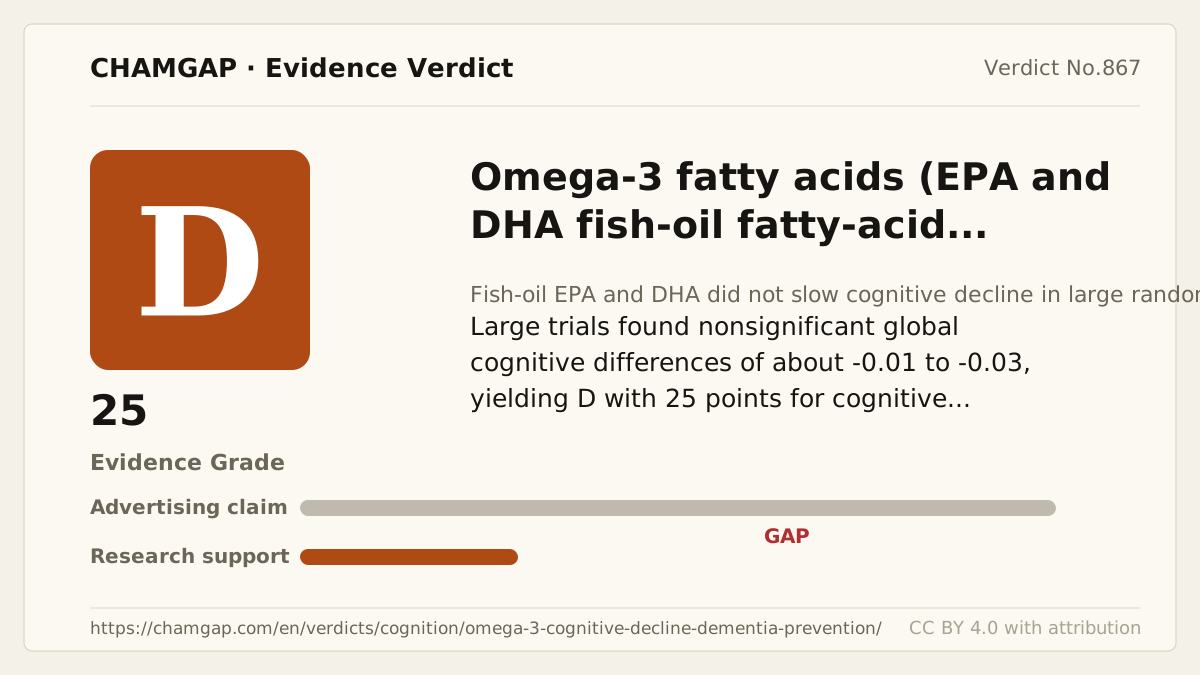
[Chamgap] Omega-3 EPA and DHA x prevention of cognitive decline and dementia in healthy older adults — Evidence Grade D·25. 3 cited sources checked. Source: https://chamgap.com/en/verdicts/cognition/omega-3-cognitive-decline-dementia-prevention/ · CC BY 4.0CC BY 4.0 — free to use with attribution; do not distort grades, numbers, or verdict meaning.
What this document does and does not do
Chamgap is an information source. It reports what research has and has not confirmed; it does not tell readers what to take or buy. That decision belongs to readers and, when needed, medical or legal professionals. This verdict reflects literature available up to the search date and may change as new research appears. Nothing here is medical advice.