
Ocrelizumab,
does it really help with Prevention of clinical relapses and sustained disability progression in relapsing multiple sclerosis?
research showsOcrelizumab is rated B because two identically designed phase 3 trials showed fewer clinical relapses and less confirmed disability progression than interferon beta-1a in relapsing multiple sclerosis. Annualized relapse rates were 46% and 47% lower in OPERA I and II, while pooled 24-week confirmed disability progression was 6.9% versus 10.5%, HR 0.60. Because this is active-comparator superiority evidence for relapse and progression prevention in one indication, B is more appropriate than A.
ads claimNear-elimination of MRI lesions should not be translated into cure or permanent prevention of all disability. The trials showed lower relapse and confirmed progression risk than interferon over 96 weeks, not prevention in every patient.
Useful facts when choosing a product
- Ocrelizumab is an intravenous prescription biologic generally administered every six months, with split initial dosing and premedication.
- Infusion reactions and infections are common; hepatitis B screening, vaccination status, and immune assessment are needed before treatment.
- Serious opportunistic infection and progressive multifocal leukoencephalopathy are rare but should be considered with new neurologic symptoms, and dosing is delayed during active infection.
Chamgap Semantic Classification Code
Candidate index · review held
M.ocrelizumab.UNK.clinical-relapses-and-sustained-disability-progression-in-relapsing-multiple-sclerosis.prevent.activeMedicinal interventions > Ocrelizumab > Unknown > clinical relapses and sustained disability progression in relapsing multiple sclerosis > Occurrence-prevention claim > Active comparator
An automated migration candidate, not an issued permanent code; exact claim scope remains under review. This machine-generated migration candidate helps retrieval but is not a permanent assignment. The original verdict ID and URL remain authoritative.
What the research actually shows
OPERA I and II randomized 1,656 participants with relapsing MS to ocrelizumab 600 mg intravenously or interferon beta-1a for 96 weeks. Annualized relapse rates were 0.16 versus 0.29 in each trial, reductions of 46% and 47%. In pooled analysis, 24-week confirmed disability progression was 6.9% versus 10.5%; gadolinium-enhancing T1 lesions and new or enlarging T2 lesions also declined. Later network meta-analysis supports high relative efficacy for relapse and disability progression, but remains indirect.
Why this is classified as B (76)
Two identically designed large phase 3 trials consistently found 46% to 47% lower relapse rates and 40% lower 24-week confirmed disability progression than interferon. Active-comparator superiority and disease-specific relapse and progression endpoints give B with 76 points. Infection and infusion reactions remain separate safety issues.
Counterpoint. Choice of therapy should reflect disease activity, prior treatment, infection risk, pregnancy plans, and patient preference; superiority to interferon does not establish superiority to every high-efficacy therapy.
Rejudgment record. New verdict — Assigned B because two large phase 3 OPERA trials consistently reduced clinical relapse and 24-week confirmed disability progression versus interferon beta-1a, while the evidence remains active-comparator superiority for disease-specific relapse and progression prevention
Sub-claim grades by effect
This ingredient is marketed for several effects. A single overall grade blends strong and weak claims together, so each effect is graded separately here. The overall grade reflects the strongest disconfirming or core claim.
| Effect (sub-claim) | Grade | Basis |
|---|---|---|
| Reduction in clinical relapses | B | Annualized relapse rates were 46% to 47% lower than with interferon in OPERA I and II. |
| Prevention of sustained disability progression | B | Pooled 24-week confirmed disability progression was 6.9% versus 10.5%, HR 0.60. |
| Reduction in inflammatory MRI lesions | B | Gadolinium-enhancing T1 and new or enlarging T2 lesions were lower than with interferon. |
Cross-check — AI research and Codex final gate
Evidence Table
| Study | Design | Sample | Funding | Endpoint | Result | Weight |
|---|---|---|---|---|---|---|
| Hauser SL et al. OPERA I and II. 2017 | Two identically designed phase 3 randomized double-blind active-controlled trials | 1,656 participants with relapsing multiple sclerosis | Funded by F. Hoffmann-La Roche | Annualized clinical relapse rate, 12- and 24-week confirmed disability progression, and MRI lesions | Relapse rates fell 46% to 47% versus interferon; pooled 24-week confirmed disability progression was 6.9% versus 10.5%, HR 0.60. | Pivotal replicated active-comparator evidence |
| Samjoo IA et al. 2023 | Network meta-analysis of therapies for relapsing multiple sclerosis | 39 randomized trials in the annualized-relapse-rate network | Supported by Novartis with conflicts reported | Annualized relapse rate and 3- and 6-month confirmed disability progression | Ranked ocrelizumab among highly efficacious therapies for relapse and confirmed disability progression. | Supportive indirect synthesis |
Receipt — 2 References
All 2 cited sources were verified for existence at the original page (as of 2026-07-23).
Final verification and publication gate: Codex · Evidence date: 2026-07-23 · Corrections: none
Cite this verdict
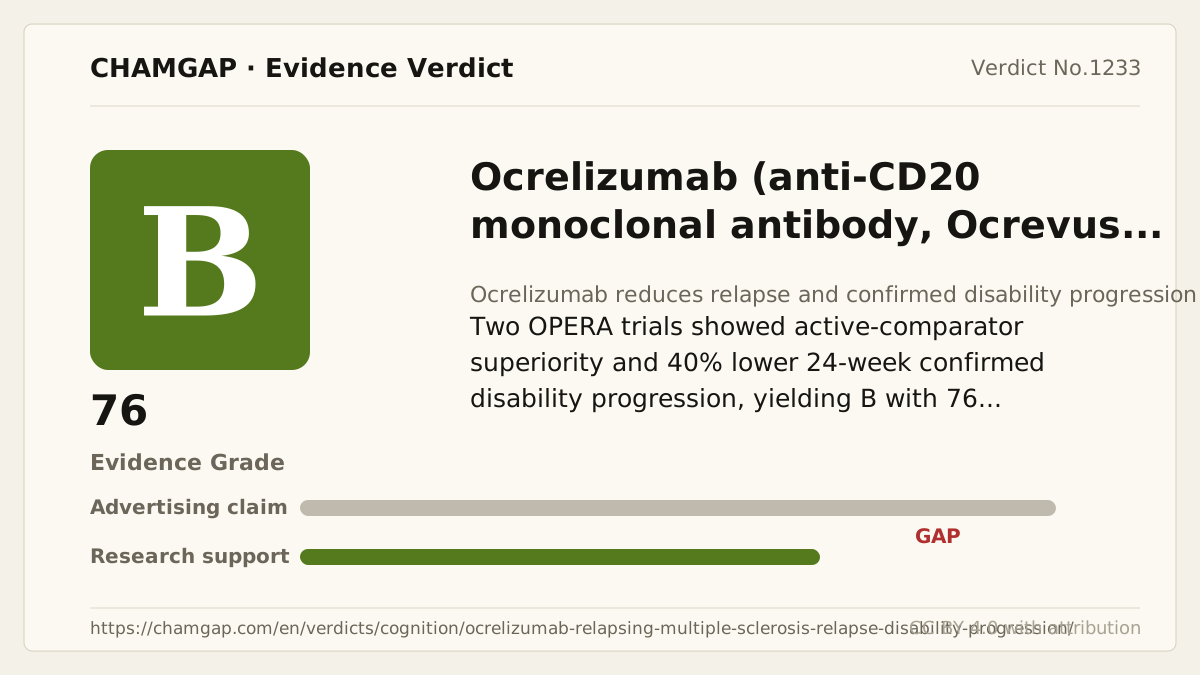
[Chamgap] Ocrelizumab x prevention of relapse and disability progression in relapsing multiple sclerosis — Evidence Grade B·76. 2 cited sources checked. Source: https://chamgap.com/en/verdicts/cognition/ocrelizumab-relapsing-multiple-sclerosis-relapse-disability-progression/ · CC BY 4.0CC BY 4.0 — free to use with attribution; do not distort grades, numbers, or verdict meaning.
What this document does and does not do
Chamgap is an information source. It reports what research has and has not confirmed; it does not tell readers what to take or buy. That decision belongs to readers and, when needed, medical or legal professionals. This verdict reflects literature available up to the search date and may change as new research appears. Nothing here is medical advice.