
Supervised Nordic walking with poles,
does it really help with Improved gait, balance, and motor function in mild-to-moderate Parkinson's disease?
research showsGrade C with 54 points. In a 40-person six-week trial, the Nordic-walking program reduced the primary UPDRS-III outcome more than standard rehabilitation (median reduction 8.5 versus 6.0; P=.047), while a 33-person head-to-head walking trial found a null group-by-time effect (P=.352). Program effects and the added effect of poles must be separated.
ads claimClaims that walking with poles uniquely restores Parkinson gait convert general exercise effects and selected small-study outcomes into a pole-specific benefit.
Useful facts when choosing a product
- Most programs were supervised and lasted weeks to six months.
- A direct comparison found no advantage over ordinary walking.
- Falls, injuries, and long-term durability remain incompletely established.
Chamgap Semantic Classification Code
Permanent code issued
X.nordic-walking.behavioral.parkinson-motor-function.improve.active-exerciseBehaviors, exposures and policies > Supervised Nordic walking with poles > Behavioral delivery > Improved gait, balance, and motor function in mild-to-moderate Parkinson's disease > Improvement claim > Active exercise
Codex retrospectively verified the principal intervention, delivery, population, endpoint, and comparator from the existing reviewed verdict and issued a permanent semantic code. Secondary outcomes on the page are not transferred as separate claims. The code identifies the intervention and claim; it never contains the evidence grade, score, or safety result.
Exact Claim Classification
These independent facets prevent evidence from different forms, routes, populations, effects, and comparators from being mixed.
| Intervention class | X · Behavior, exposure, or policy |
|---|---|
| Canonical ingredient or intervention | Supervised Nordic walking with poles |
| Source or part used | Plant source not applicable; specified behavior or training |
| Formulation or processing | Supervised Nordic walking with poles |
| Route | Behavioral delivery |
| Dose | Supervised Nordic walking with poles |
| Duration | Six months |
| Population | 90 participants over six months |
| Effect or condition | Improved gait, balance, and motor function in mild-to-moderate Parkinson's disease |
| Primary endpoint | UPDRS, gait, postural stability, and quality of life |
| Comparator | Active exercise |
| Duplicate-detection key | nordic-walking|behavioral|90 participants over six months|parkinson-motor-function|Six months |
What the research actually shows
Nordic walking was compared with equal-period ordinary walking, treadmill training, flexibility/relaxation, or standard rehabilitation. Between-group differences were prioritized over within-group improvement.
Why this is classified as C (54)
A prespecified primary outcome versus standard rehabilitation and independent functional signals are strengths. A 40-person six-week active intervention, lack of masking, and a null ordinary-walking comparison give C with 54 points for the overall program and a lower C level for the pole-specific effect.
Counterpoint. Ordinary walking can also improve outcomes, so participation in exercise and the added effect of poles are separate questions.
Rejudgment record. Cross-check applied — Separated the whole program effect versus standard rehabilitation from the pole-specific effect versus ordinary walking and prioritized the prespecified primary UPDRS-III outcome
| Endpoint | P | Symptom or function itself is the target - including patient reports and performance tests |
| Replication | R1 | Single confirmatory trial |
| Independence | I2 | Decisive evidence is publicly or non-profit funded |
| Effect size | E+ | Meets the clinically important threshold |
| Precision | CX | No pooled confidence interval could be confirmed |
Stored derived and displayed grades match; this is not a current recalculation or validity check (C).
Sub-claim grades by effect
This ingredient is marketed for several effects. A single overall grade blends strong and weak claims together, so each effect is graded separately here. The overall grade reflects the strongest disconfirming or core claim.
| Effect (sub-claim) | Grade | Basis |
|---|---|---|
| Motor-function improvement from the Nordic-walking program versus standard rehabilitation | C | The primary outcome was borderline positive in a 40-person, six-week trial. |
| Added pole-specific benefit over ordinary walking | C | The direct comparison's group-by-time effect was null, warranting a lower rating within grade C. |
| Fall prevention or durable long-term benefit | D | Clinical fall events and post-training durability are not adequately established. |
Cross-check — AI research and Codex final gate
Evidence Table
| Study | Design | Sample | Funding | Endpoint | Result | Weight |
|---|---|---|---|---|---|---|
| Reuter I et al. 2011 | Three-arm randomized flexibility, walking, and Nordic-walking trial | 90 participants over six months | Academic study; specific funding unverified | UPDRS, gait, postural stability, and quality of life | Nordic walking superior on selected posture, stride, and variability measures | Largest longer direct trial |
| Monteiro EP et al. 2021 | Single-blind randomized Nordic-walking versus walking trial | 33 participants over eight weeks | Public funding with poles supplied | Motor, functional, gait, and quality-of-life outcomes | UPDRS group-by-time P=.352; no superiority over ordinary walking | Contrary direct walking control |
| Szefler-Derela J et al. 2020 | Randomized Nordic-walking versus standard-rehabilitation trial | 40 participants over six weeks | No external funding reported; one author employed by Novartis | Primary UPDRS-III outcome, DGI, gait, and quality of life | Median UPDRS-III reduction 8.5 versus 6.0, P=.047; DGI P=.064 | Direct trial with a prespecified primary outcome |
Receipt — 4 References
All 4 cited sources were verified for existence at the original page (as of 2026-09-07).
Final verification and publication gate: Codex · Evidence date: 2026-09-07 · Corrections: none
Cite this verdict
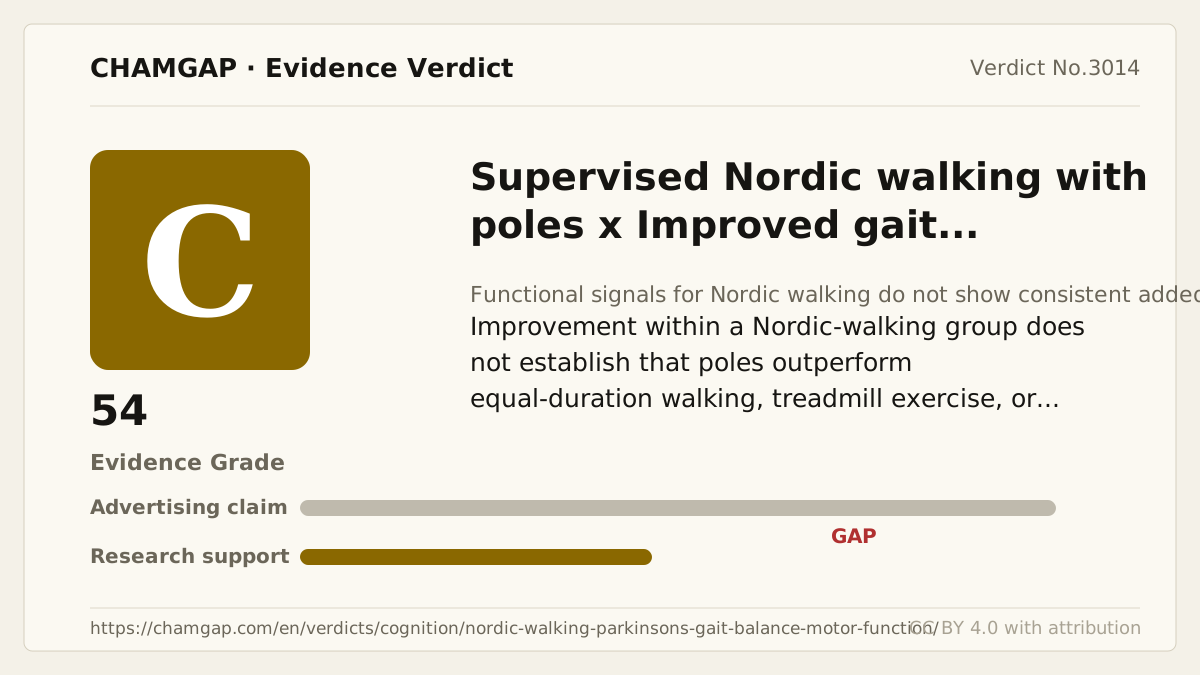
[Chamgap] Nordic Walking for Parkinson's Disease—Added Benefit From Poles Over Ordinary Walking Varies Across Trials — Evidence Grade C·54. 4 cited sources checked. Source: https://chamgap.com/en/verdicts/cognition/nordic-walking-parkinsons-gait-balance-motor-function/ · CC BY 4.0CC BY 4.0 — free to use with attribution; do not distort grades, numbers, or verdict meaning.
What this document does and does not do
Chamgap is an information source. It reports what research has and has not confirmed; it does not tell readers what to take or buy. That decision belongs to readers and, when needed, medical or legal professionals. This verdict reflects literature available up to the search date and may change as new research appears. Nothing here is medical advice.