
Nonimmersive virtual-reality rehabilitation,
does it really help with Superior post-stroke arm recovery versus time-matched recreational activity?
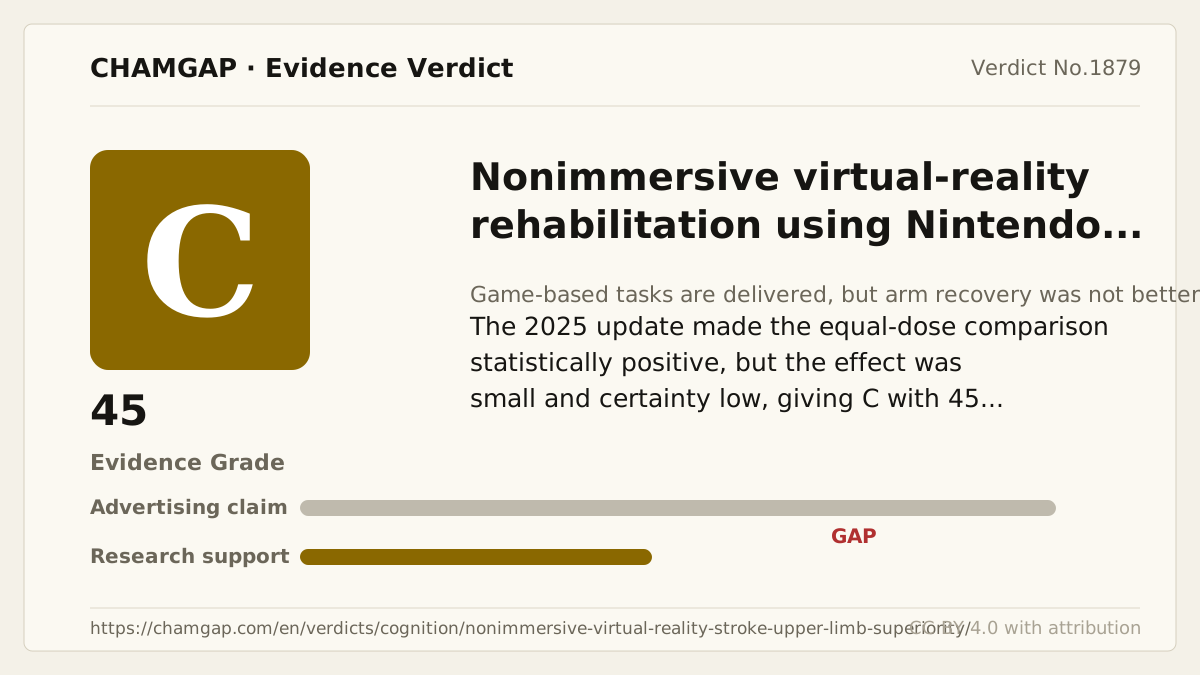
research showsNonimmersive virtual-reality rehabilitation for post-stroke arm function is rated C with 50 points. The 2025 Cochrane update found SMD 0.20 (95% CI 0.12 to 0.28) across 67 trials and 2,830 participants when virtual reality replaced an equal dose of conventional rehabilitation, with low certainty. When it added extra therapy time, 21 trials and 689 participants gave SMD 0.42 (95% CI 0.26 to 0.58), with moderate certainty.
ads claimThe factual ability to map movement into a game and deliver interactive tasks should not be expanded into superior neurologic recovery over equal-time rehabilitation.
Useful facts when choosing a product
- EVREST delivered ten 60-minute Nintendo Wii upper-limb sessions over two weeks.
- The control group received the same schedule of cards, bingo, Jenga, or ball games. Interactive task delivery is factual; clinical superiority is separate.
- The 141 randomized participants must be distinguished from the 121 in the actual primary analysis.
Chamgap Semantic Classification Code
Candidate index · review held
UNK.nonimmersive-virtual-reality-rehabilitation-using-nintendo-wii-upper-limb-tasks.UNK.superior-post-stroke-arm-recovery.superiority.activeUnknown > Nonimmersive virtual-reality rehabilitation using Nintendo Wii upper-limb tasks > Unknown > Superior post-stroke arm recovery > Superiority claim > Active comparator
An automated migration candidate, not an issued permanent code; exact claim scope remains under review. This machine-generated migration candidate helps retrieval but is not a permanent assignment. The original verdict ID and URL remain authoritative.
What the research actually shows
EVREST randomized 141 participants, but the actual two-week primary analysis used 121 completers. Its assessor-masked Wolf Motor Function Test difference was 4.1 seconds (95% CI -14.4 to 22.6), P=0.469. Laver 2025 updated the Cochrane review to 190 trials and 7,188 participants. Equal-dose replacement included 67 trials and 2,830 participants, SMD 0.20 (95% CI 0.12 to 0.28), with low certainty downgraded once for inconsistency. Additional therapy included 21 trials and 689 participants, SMD 0.42 (95% CI 0.26 to 0.58), with moderate certainty. Exact I-squared values could not be confirmed from the source and are omitted. The 2017 equal-dose estimate of SMD 0.07 (-0.05 to 0.20) across 22 trials and 1,038 participants changed to a positive estimate in 2025, showing that evidence updates can change a conclusion.
Why this is classified as C (50)
The latest pooled evidence is positive for both equal-dose replacement and additional therapy, so repeated null evidence no longer applies. The equal-dose effect is small, certainty is low, results vary across trials, and EVREST has small-size, two-week, completer-analysis, and active-control limitations, giving C with 50 points.
Counterpoint. Virtual reality can separately be evaluated as a way to add therapy time and engagement. This verdict addresses superiority over equal-time activity.
Rejudgment record. Cross-check applied — Positive pooled findings in the 2025 Cochrane update, tempered by small effects, low certainty, and EVREST limitations including small size, short duration, completer analysis, and active control only
| Endpoint | P | Symptom or function itself is the target - including patient reports and performance tests |
| Replication | R0 | Trials conflict in direction |
| Independence | I2 | Decisive evidence is publicly or non-profit funded |
| Effect size | E~ | Statistically positive but below the threshold |
Stored derived and displayed grades match; this is not a current recalculation or validity check (C).
Sub-claim grades by effect
This ingredient is marketed for several effects. A single overall grade blends strong and weak claims together, so each effect is graded separately here. The overall grade reflects the strongest disconfirming or core claim.
| Effect (sub-claim) | Grade | Basis |
|---|---|---|
| Improved Wolf Motor Function Test performance versus time-matched activity | D | The EVREST primary outcome failed at P=0.469. |
| Improved upper-limb function versus equal-dose conventional rehabilitation | C | The 2025 pooled estimate across 67 trials was SMD 0.20 (0.12 to 0.28), with low certainty. |
| Improved upper-limb function when used as additional therapy time | C | The 21-trial pooled estimate was SMD 0.42 (0.26 to 0.58), with moderate certainty. |
Cross-check — AI research and Codex final gate
Evidence Table
| Study | Design | Sample | Funding | Endpoint | Result | Weight |
|---|---|---|---|---|---|---|
| Saposnik G et al. 2016 (EVREST) | Multinational randomized single-blind time-matched active-controlled trial | 141 randomized; 121 in the actual primary analysis | Initial funding from the South East Toronto Stroke Network; the principal investigator was supported by a Heart and Stroke Foundation Canada Clinician-Scientist Award | Two-week Wolf Motor Function Test completion time | The primary outcome failed: adjusted difference 4.1 seconds (95% CI -14.4 to 22.6), P=0.469. | Pivotal independent time-matched trial |
| Laver KE et al. 2025 | Updated Cochrane systematic review and meta-analysis | 190 trials and 7,188 participants overall; 67 trials and 2,830 participants for equal dose; 21 trials and 689 participants for additional therapy | Academic Cochrane review; funding varied across included trials | Upper-limb function with equal-dose replacement and additional therapy | Equal-dose SMD 0.20 (95% CI 0.12 to 0.28), low certainty; additional-therapy SMD 0.42 (95% CI 0.26 to 0.58), moderate certainty. | Latest large updated synthesis |
Receipt — 2 References
All 2 cited sources were verified for existence at the original page (as of 2026-07-24).
Final verification and publication gate: Codex · Evidence date: 2026-07-24 · Corrections: none
Cite this verdict
[Chamgap] Nonimmersive virtual-reality rehabilitation x superior arm recovery after stroke — Evidence Grade C·50. 2 cited sources checked. Source: https://chamgap.com/en/verdicts/cognition/nonimmersive-virtual-reality-stroke-upper-limb-superiority/ · CC BY 4.0CC BY 4.0 — free to use with attribution; do not distort grades, numbers, or verdict meaning.
What this document does and does not do
Chamgap is an information source. It reports what research has and has not confirmed; it does not tell readers what to take or buy. That decision belongs to readers and, when needed, medical or legal professionals. This verdict reflects literature available up to the search date and may change as new research appears. Nothing here is medical advice.