
Night-time earplugs alone,
does it really help with Reduced incidence of strict ICU delirium?
research showsStrict delirium incidence was not reduced. A single small trial did find fewer or later events when the threshold was broadened to include early and mild confusion.
ads claimA claim that night-time earplugs prevent hospital delirium is inconsistent with the strict delirium event counts. A possible reduction in early confusion is the defensible limit.
Useful facts when choosing a product
- The intervention was Bilsom polyurethane earplugs alone, without an eye mask, lighting protocol, or counselling.
- They were worn from 22:00 to 06:00 for up to five ICU nights.
- Verdict 1476 is D with 35 points for subjective sleep and cites the Karimi 2021 meta-analysis, which includes this same 136-person trial; this is a different endpoint from the same data source.
- Verdict 2302 is C with 56 points for multicomponent non-drug care, while verdict 1148 is F with 18 points for melatonin; both are different interventions.
Chamgap Semantic Classification Code
Candidate index · review held
UNK.night-time-earplugs.UNK.incidence-of-strict-icu-delirium.reduce.usual-careUnknown > Night-time earplugs > Unknown > incidence of strict ICU delirium > Reduction claim > Usual care
An automated migration candidate, not an issued permanent code; exact claim scope remains under review. This machine-generated migration candidate helps retrieval but is not a permanent assignment. The original verdict ID and URL remain authoritative.
What the research actually shows
A Belgian medical-surgical ICU randomized 136 adults to earplugs (69) or no-earplug usual care (67). Each night at 22:00 a nurse opened an opaque canister, inserted the Bilsom polyurethane earplugs when present, and removed them at 06:00 for up to five nights. No eye mask accompanied the intervention. NEECHAM used nurses' 24-hour observations and was recorded at 08:00, 16:00, and 22:00: 27-30 normal, 25-26 at risk, 20-24 early or mild confusion, and 0-19 moderate to severe confusion classified as delirium. This verdict uses only strict delirium incidence as its target endpoint; events were 14/69 versus 13/67 and the result was null. The separate composite including mild confusion occurred in 19/69 versus 32/67, with a hazard ratio of 0.47 (0.27 to 0.82), but was not used as the grading endpoint. Researchers collecting data were blinded, but bedside nurses who inserted the plugs and supplied the observations could know allocation. The trial was also smaller than 200 participants.
Why this is classified as D (34)
The target outcome, strict delirium, was not reduced, with no independent replication of earplugs alone. The pivotal trial was small and the nurses whose observations fed the outcome could know allocation, giving D with 34 points.
Counterpoint. The broader confusion composite was 19/69 versus 32/67, with a statistically significant hazard ratio of 0.47, and the authors reported neither study funding nor ties to the earplug supplier. The strict delirium interval, however, permits both substantial benefit and harm.
Rejudgment record. Cross-check applied — Separated strict delirium events from the broader NEECHAM confusion time-to-event result and cross-checked the sleep data source used in verdict 1476
| Endpoint | H | Hard endpoint - actual events such as death |
| Replication | R1 | Single confirmatory trial |
| Independence | I2 | Decisive evidence is publicly or non-profit funded |
| Effect size | E0 | Null |
| Precision | C0 | The confidence interval leaves room for benefit |
Stored derived and displayed grades match; this is not a current recalculation or validity check (D).
Sub-claim grades by effect
This ingredient is marketed for several effects. A single overall grade blends strong and weak claims together, so each effect is graded separately here. The overall grade reflects the strongest disconfirming or core claim.
| Effect (sub-claim) | Grade | Basis |
|---|---|---|
| Prevention of strict delirium | D | Events were 14/69 versus 13/67, RR 1.05 (0.53 to 2.06), with no reduction. |
| Delay of cognitive disturbance including early or mild confusion | C | Events were 19/69 versus 32/67 with a hazard ratio of 0.47 (0.27 to 0.82), but this was a separate composite outcome from one small trial. |
Cross-check — AI research and Codex final gate
Evidence Table
| Study | Design | Sample | Funding | Endpoint | Result | Weight |
|---|---|---|---|---|---|---|
| Van Rompaey B et al. 2012 | Single-center randomized usual-care controlled trial | 136 randomized and analyzed, 69 versus 67 | Original statement: neither the study nor authors were funded, with no relations or contacts with the earplug supplier | Incidence of strict NEECHAM delirium | Strict delirium 14/69 versus 13/67, RR 1.05 (0.53 to 2.06), was null; the separate broader composite was 19/69 versus 32/67, with a hazard ratio of 0.47 (0.27 to 0.82). | Pivotal direct evidence |
| Hu RF et al. 2015 Cochrane review | Systematic review of non-drug ICU sleep interventions | Two studies with 177 participants in the delirium synthesis | Cochrane review; included interventions differed between earplugs alone and combined eye-mask/earplug approaches | Delirium during ICU stay | RR 0.55 (0.38 to 0.80), two studies; intervention differences prevent treating this as independent replication of earplugs alone. | Indirect pooled evidence |
Receipt — 4 References
All 4 cited sources were verified for existence at the original page (as of 2026-08-08).
Final verification and publication gate: Codex · Evidence date: 2026-08-08 · Corrections: none
Cite this verdict
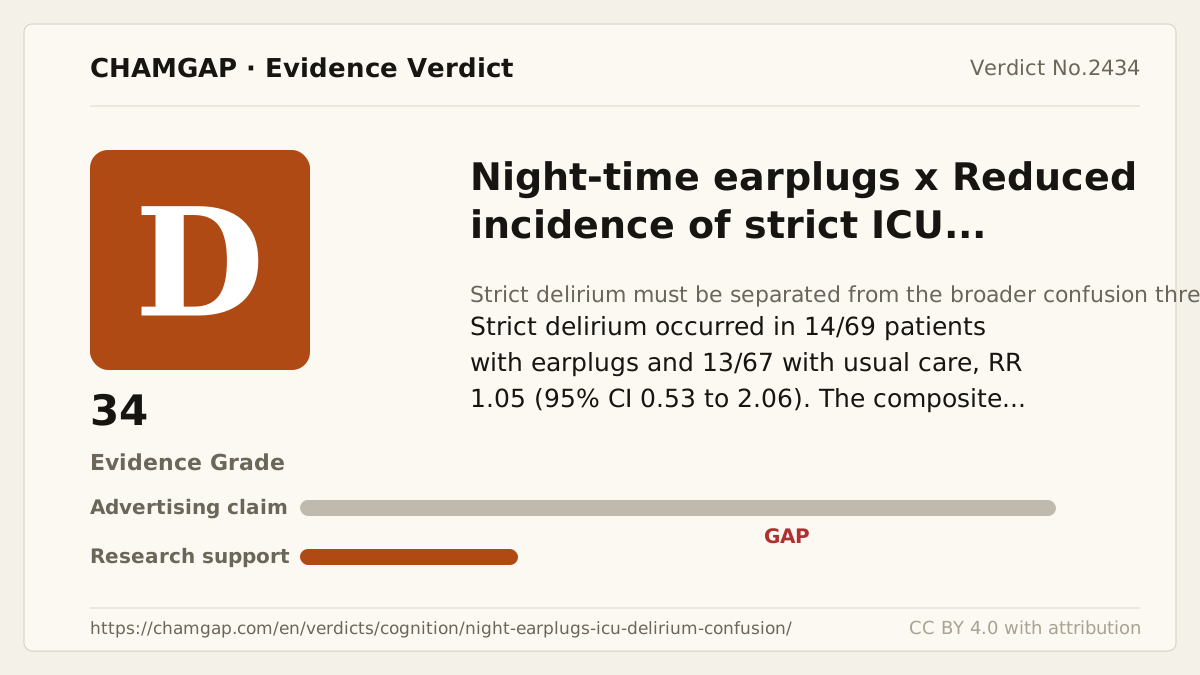
[Chamgap] Night-time earplugs alone x reduced incidence of strict ICU delirium — Evidence Grade D·34. 4 cited sources checked. Source: https://chamgap.com/en/verdicts/cognition/night-earplugs-icu-delirium-confusion/ · CC BY 4.0CC BY 4.0 — free to use with attribution; do not distort grades, numbers, or verdict meaning.
What this document does and does not do
Chamgap is an information source. It reports what research has and has not confirmed; it does not tell readers what to take or buy. That decision belongs to readers and, when needed, medical or legal professionals. This verdict reflects literature available up to the search date and may change as new research appears. Nothing here is medical advice.