
Nicotinamide riboside,
does it really help with Improvement in 10-week change in MoCA total score in older adults with clinical MCI?
research showsIn adults aged at least 65 years with clinically defined mild cognitive impairment (MCI), the reported 10-week course of oral NIAGEN NR escalated to a target of 1000 mg/day did not demonstrate greater improvement in MoCA total-score change than placebo. The current grade for this comparison is D, 28 points. This does not establish an exactly 0 effect or exclude important benefit. [S01]
ads claimThis paragraph explains the claim boundary rather than quoting a particular advertisement. NR, nicotinamide, nicotinic acid, NMN and NAD/NADH are not automatic synonyms. An increase in NAD cannot be relabeled as cognitive improvement in MCI, and a shared brand does not verify another trial’s salt, purity or batch. [S01][S08][S09]
Four separate assessment dimensions
| Effect direction and size | The direct trial did not demonstrate MoCA improvement. The arithmetic +0.59-point change difference and P=0.57 do not establish zero effect or equivalence. |
|---|---|
| Evidence certainty | The original rubric/calculator axes are B / P / R1 / I1 / E0 / B2 / CX. They reflect one direct trial, mixed public support/product provision/author interests, and failure to demonstrate improvement. B2 follows the original rules for a total sample below 200 and duration below 12 weeks for chronic cognitive efficacy. Unverified concealment was not asserted absent. With 0 strong axes, the fixed D anchor is 28 points. RX and C1 were not established, so F is not assigned. |
| Applicability | Clinical MCI age >=65; TARCC or investigator diagnosis, newly evaluated candidates MoCA below 26 and preserved ADL/IADL; subtype unverified; 250→500→750→1000 mg/day escalation; target 500 mg twice daily; Reported 10-week course; exact target-dose days unverified |
| Safety | Caution: 18 AEs were reported in 7/10 NR participants and 21 in 7/10 placebo participants. One NR participant reduced 1000→750 mg/day for 1 week because of severe nausea/heartburn before returning to target dosing. The article’s no-serious-AE statement conflicts with its report of a placebo stroke in 1 participant; this classification inconsistency is disclosed. In the separate Wu trial, 1 worsening of a pre-existing gait disorder during NR was classified as a possibly related SAE, not confirmed causation. Long-term MCI safety and complete numerical liver/renal laboratory verification remain unverified. Harms of other B3 forms were not copied to NR, and trial doses are not personal dosing instructions. Products and concomitant medicines should be reviewed with a clinician. [S01][S06][S08][S09] In Martens’s different 12-week trial, 1 NR participant stopped because of a low eGFR laboratory measurement; this does not establish NR-induced kidney injury. [S07] A nominal group-difference P=0.035 was also reported for the GDS depression scale; it is not interpreted as multiplicity-confirmed clinical mood harm or as MoCA improvement. [S01] |
D, 28 is the evidence tier for the fixed MoCA improvement claim, not zero effect, equivalence, individual success probability, safety or document quality.
Useful facts when choosing a product
- NIAGEN NR and placebo were supplied by ChromaDex. The intervention is treated as a single-active-NR capsule; exact salt, crystal form, synthetic/fermentation source, purity, batch, release profile and placebo excipients are unverified. [S01][S02]
- Escalation of 250→500→750→1000 mg/day and target dosing of 500 mg twice daily are described. The reported overall course is 10 weeks, but Figure 1 step durations and narrative timing do not fully align; exact target-dose days were not invented. [S01]
- MCI was diagnosed through TARCC or by the investigator; newly evaluated candidates required MoCA below 26, preserved ADL/IADL and exclusion of confounds. Amnestic subtype, trial MoCA version/language/education correction, actual baseline nutritional status and the complete concomitant-treatment inventory are unverified. This is not interpreted as an add-on to cognition drugs. [S01]
- Figure 1 places MoCA at screening study week 1 and final study week 13. The reported 10-week treatment is therefore not represented as the exact interval between MoCA tests; individual elapsed intervals remain unverified. [S01]
Chamgap Semantic Classification Code
Permanent code issued
S.niagen-nicotinamide-riboside.oral.mci-moca-total-score.improve.placeboSubstances and nutrients > NIAGEN nicotinamide riboside > Oral > MoCA total score in mild cognitive impairment > Improvement claim > Placebo
Technically bound to the ChatGPT-fixed current-value question of clinical MCI age 65 or older, NIAGEN NR escalated to 1000 mg/day over a reported 10-week course, and MoCA total-score change versus ChromaDex-supplied placebo. Exact salt, timing, denominator, between-group CI and test details remain in multidimensional fields and revision history. The code identifies the intervention and claim; it never contains the evidence grade, score, or safety result.
Exact Claim Classification
These independent facets prevent evidence from different forms, routes, populations, effects, and comparators from being mixed.
| Intervention class | S · Supplement or nutraceutical |
|---|---|
| Canonical ingredient or intervention | Nicotinamide riboside (NR; NIAGEN) |
| Source or part used | Manufacturing source unverified; supplied by ChromaDex |
| Formulation or processing | Single-active-NR capsule; exact salt, crystal form, purity, batch and release profile unverified |
| Route | oral |
| Dose | 250→500→750→1000 mg/day escalation; target 500 mg twice daily |
| Duration | Reported 10-week course; exact target-dose days unverified |
| Population | Clinical MCI age >=65; TARCC or investigator diagnosis, newly evaluated candidates MoCA below 26 and preserved ADL/IADL; subtype unverified |
| Effect or condition | Improvement in MoCA total-score change |
| Primary endpoint | NR−placebo comparison of MoCA total-score change from screening/baseline to final visit; Figure 1 study weeks 1 and 13, reported treatment 10 weeks; article primary outcome |
| Comparator | ChromaDex placebo; composition and full common-care inventory unverified; not a cognition-drug add-on |
| Duplicate-detection key | NR-NIAGEN|salt-unverified|oral-capsule|escalation-250-500-750-to-1000mg-per-day|reported-10weeks|age-ge65-clinical-MCI-preserved-ADL-IADL|MoCA-total-change-improve|placebo-ChromaDex|NCT02942888 |
What the research actually shows
Orr’s placebo-controlled pilot primarily investigated safety and named MoCA as the article’s primary outcome. Its statistical primary objective was estimation of within-NR change, with Welch t tests described for group differences. Figure 2 shows 22 randomized, 2 MRI-related exclusions and 20 completers (10 per arm), whereas the abstract says 20 randomized. MoCA endpoint-specific analysis denominators were not verified. Full prospective alignment with registry history and the analysis plan is unverified. [S01][S05]
Why this is classified as D (28)
The original rubric/calculator axes are B / P / R1 / I1 / E0 / B2 / CX. They reflect one direct trial, mixed public support/product provision/author interests, and failure to demonstrate improvement. B2 follows the original rules for a total sample below 200 and duration below 12 weeks for chronic cognitive efficacy. Unverified concealment was not asserted absent. With 0 strong axes, the fixed D anchor is 28 points. RX and C1 were not established, so F is not assigned.
Counterpoint. Subsequent cognitive results were checked. In Wu’s first 8-week comparison, RBANS total-score P=0.55; a nominal attention difference was not significant after adjustment. Martens 2026 reported no significant improvement on other cognitive scales in a 12-week amnestic-MCI trial. These are separate trial families, but were not pooled as exact confirming or refuting replications of this 10-week MoCA comparison. [S06][S07]
Rejudgment record. Improvement not demonstrated in the fixed comparison; not zero effect, equivalence, or exclusion of important benefit — original calculator + fixed D/zero-strength anchor
| Endpoint | P | Symptom or function itself is the target - including patient reports and performance tests Case application: A clinical cognitive-function scale for a cognition claim, not a hard dementia-prevention event or NAD surrogate. |
| Replication | R1 | Single confirmatory trial Case application: One direct family for the fixed 10-week MoCA comparison. R1 is the original single-trial slot, not an assertion that this safety pilot provides adequate confirmatory evidence. Other scales/durations are not exact replications. |
| Independence | I1 | Mixed funding sources Case application: Public NIH/VA support coexists with ChromaDex product provision and Brenner NR intellectual-property, advisory and equity interests. Manufacturer involvement is not counted twice in bias. |
| Effect size | E0 | Null Case application: The reported group-difference P=0.57 did not demonstrate improvement. E0 is not used to assert an exactly zero effect or exclusion of important benefit. |
| Precision | CX | No pooled confidence interval could be confirmed Case application: Within-arm 95% CIs were verified, but a between-group change CI was not. No applicable between-group MCID was verified; C1/F is not justified. |
Review performed and remaining limitations
MoCA analysis denominator, between-group CI, meaning of ± values, applicable MCID, MCI subtype, test version/language/education correction, exact product details, registry history and long-term safety remain unverified.
Search scope and limitations. R01-014 verified package: search_log.json; selection_log.json; sources.json
Evidence Table
| Study | Design | Sample | Funding | Endpoint | Result | Weight |
|---|---|---|---|---|---|---|
| Orr MCI trial (NCT02942888) | Randomized double-blind placebo-controlled safety pilot; MoCA described as an article primary outcome. | Figure 2 shows 22 randomized, 2 MRI-related exclusions and 20 completers; abstract/text describe 20 randomized. MoCA analysis denominator unverified. | Public NIH/VA support; ChromaDex supplied NR/placebo. Brenner disclosed NR patent, advisory and equity interests; Orr disclosed a separate patent. | MoCA total-score change from screening/baseline to final visit; Figure 1 labels study weeks 1 and 13 while treatment is reported as 10 weeks; NR-minus-placebo comparison. | NR −0.30 points, placebo −0.89; arithmetic change difference +0.59; reported between-group P=0.57. Between-group CI, endpoint denominator and applicable MCID unverified. | Only direct family for the fixed question. Improvement was not demonstrated, but this is not zero effect, equivalence or exclusion of important benefit. |
| Wu cognition trial (NCT04078178) | Placebo lead-in crossover trial in a mixed subjective-cognitive-decline and MCI population. | Not an analysis denominator for the fixed MoCA question. | Not used for this page independence axis because population and scale differ from the direct question. | RBANS total scaled score; the first 8-week block and crossover results belong to one family. | Primary first-block RBANS total-score between-group P=0.55; not a MoCA result. | Indirect context with population, scale and duration mismatch; not counted as direct replication. |
| Martens amnestic-MCI pilot (NCT03482167) | Twelve-week randomized controlled phase-II pilot in older adults with amnestic MCI. | Not an analysis denominator for the fixed 10-week MoCA question. | Not used for this page independence axis because the scales and duration differ. | CVLT-III, WMS-IV and NIH Toolbox cognition; not MoCA total score. | No significant cognitive improvement was reported, but it is not pooled as direct replication of the fixed MoCA comparison. | Indirect context with scale, MCI-definition and exposure-schedule mismatch. |
Receipt — 12 References
Evidence access cutoff: 2026-09-15. Each citation states its actual access level (full-text transcription, abstract, index, or other) and remaining limitations. Bibliographic checking does not certify the study results or treatment efficacy.
Technical integration by: Codex · Evidence date: 2026-09-15 · Corrections: none
Cite this verdict
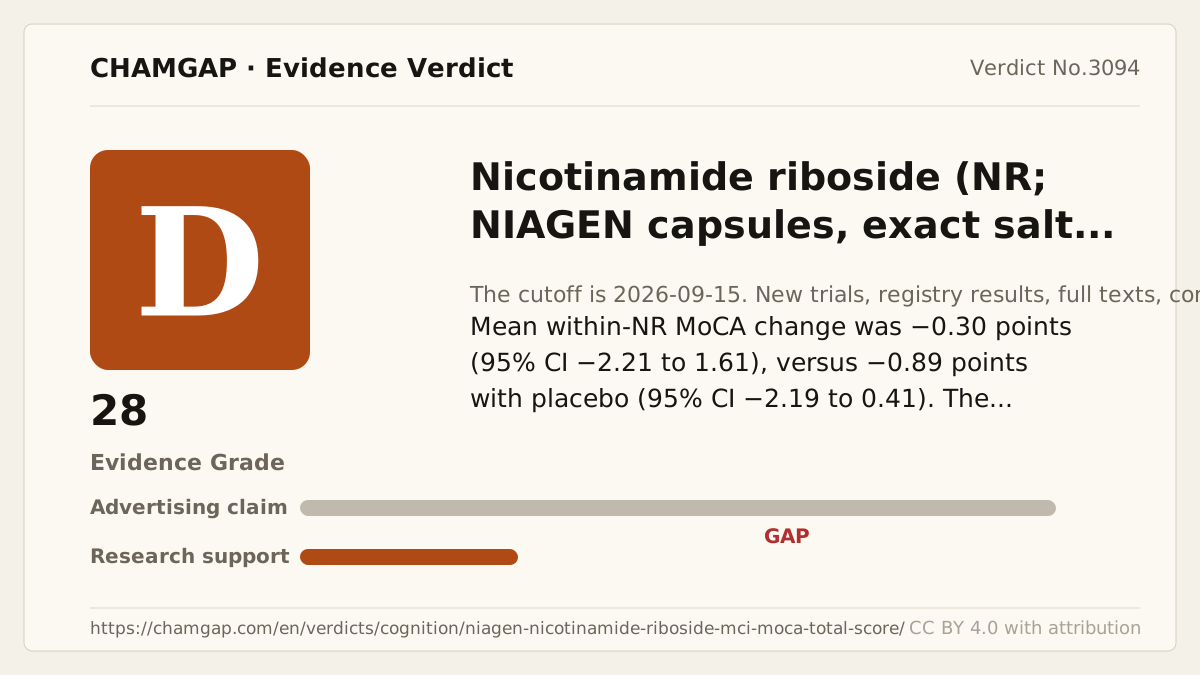
[Chamgap] NR (NIAGEN) × improvement in MoCA total score in MCI — Evidence Grade D·28. 12 cited sources checked. Source: https://chamgap.com/en/verdicts/cognition/niagen-nicotinamide-riboside-mci-moca-total-score/ · CC BY 4.0CC BY 4.0 — free to use with attribution; do not distort grades, numbers, or verdict meaning.
What this document does and does not do
Chamgap is an information source. It reports what research has and has not confirmed; it does not tell readers what to take or buy. That decision belongs to readers and, when needed, medical or legal professionals. This verdict reflects literature available up to the search date and may change as new research appears. Nothing here is medical advice.