
Nature walk,
does it really help with Immediate improvement in working-memory performance?
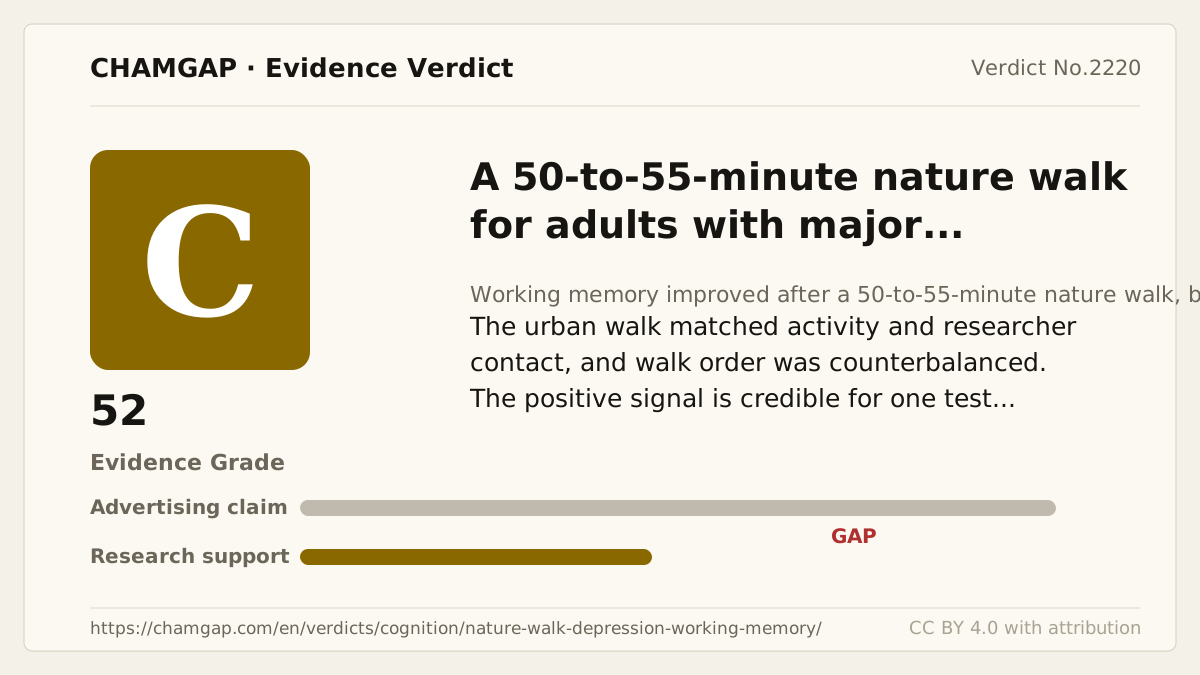
research showsThe grade is C with 54 points. Twenty adults with major depressive disorder completed nature and urban walks one week apart, with 19 analyzed. The backward digit-span time-by-environment interaction was F(1,18)=20.5, P<.001, partial eta-squared 0.53, a large effect by statistical convention. This was a single-session, small trial whose registration status could not be verified from the paper, and it cannot establish sustained cognitive improvement or treatment of depression.
ads claimA better working-memory test immediately after a 50-to-55-minute nature walk is not proof of depression treatment, long-term memory recovery, or medication replacement.
Useful facts when choosing a product
- Both nature and urban routes were 2.8 miles and 50 to 55 minutes, with GPS confirmation.
- Walk order was counterbalanced and no significant order effect was found.
- Partial eta-squared was 0.53 for the working-memory interaction, but only 19 participants were analyzed.
Chamgap Semantic Classification Code
Candidate index · review held
UNK.50-to-nature-walk.UNK.immediate-improvement-in-working-memory-performance.improve.activeUnknown > 50-to- nature walk > Unknown > Immediate improvement in working-memory performance > Improvement claim > Active comparator
An automated migration candidate, not an issued permanent code; exact claim scope remains under review. This machine-generated migration candidate helps retrieval but is not a permanent assignment. The original verdict ID and URL remain authoritative.
What the research actually shows
Of 20 adults with clinician-confirmed major depressive disorder, 19 were analyzed. Each participant completed a 2.8-mile, 50-to-55-minute arboretum walk and an urban walk one week apart, with GPS confirmation. Order was counterbalanced and was not a significant predictor when included in memory and mood analyses. A two-by-two repeated analysis compared pre-to-post change by location. Registration status and a prespecified primary endpoint could not be verified from the paper. NIMH and TKF Foundation supported the work, and the authors reported no conflicts.
Why this is classified as C (54)
A large immediate effect in an active-control counterbalanced crossover supports the narrow claim, but this was one single-session study of 19 people and registration status could not be verified from the paper, giving C with 54 points.
Counterpoint. Immediate working memory versus an urban walk is not treatment of depressive symptoms or sustained cognition.
Rejudgment record. Cross-check applied — Cross-checked analyzed sample, active urban comparator, route length, counterbalancing and order-effect analysis, test statistic and effect size, registration, and funding in the original paper
| Endpoint | P | Symptom or function itself is the target - including patient reports and performance tests |
| Replication | R1 | Single confirmatory trial |
| Independence | I2 | Decisive evidence is publicly or non-profit funded |
| Effect size | E+ | Meets the clinically important threshold |
Stored derived and displayed grades match; this is not a current recalculation or validity check (C).
Sub-claim grades by effect
This ingredient is marketed for several effects. A single overall grade blends strong and weak claims together, so each effect is graded separately here. The overall grade reflects the strongest disconfirming or core claim.
| Effect (sub-claim) | Grade | Basis |
|---|---|---|
| Immediate working-memory improvement after a nature walk | C | Partial eta-squared was 0.53 versus the urban walk. |
| Sustained working-memory improvement | ? | The trial measured only the immediate post-walk period. |
| Treatment of depressive symptoms | ? | The positive endpoint in this verdict was a working-memory task, not a depression scale. |
Cross-check — AI research and Codex final gate
Evidence Table
| Study | Design | Sample | Funding | Endpoint | Result | Weight |
|---|---|---|---|---|---|---|
| Berman et al. crossover trial 2012 | Counterbalanced active-control crossover trial | 20 participated and 19 were analyzed | NIMH grant MH60655 and TKF Foundation | Immediate post-walk backward digit-span working memory | Time-by-environment F(1,18)=20.5, P<.001, partial eta-squared 0.53; no significant order effect. | Pivotal single immediate-effect evidence |
Receipt — 1 References
All 1 cited sources were verified for existence at the original page (as of 2026-08-04).
Final verification and publication gate: Codex · Evidence date: 2026-08-04 · Corrections: none
Cite this verdict
[Chamgap] Nature walk x working memory in adults with depression — Evidence Grade C·54. 1 cited sources checked. Source: https://chamgap.com/en/verdicts/cognition/nature-walk-depression-working-memory/ · CC BY 4.0CC BY 4.0 — free to use with attribution; do not distort grades, numbers, or verdict meaning.
What this document does and does not do
Chamgap is an information source. It reports what research has and has not confirmed; it does not tell readers what to take or buy. That decision belongs to readers and, when needed, medical or legal professionals. This verdict reflects literature available up to the search date and may change as new research appears. Nothing here is medical advice.