
MIND diet,
does it really help with Prevention of cognitive decline?
research showsThe grade is D with 34 points. In a 604-participant, three-year randomized trial, global cognition changed by 0.205 standardized units with MIND versus 0.170 with the equally calorie-restricted control, a between-group difference of 0.035 (95% CI -0.022 to 0.092; P=0.23). Diet scores genuinely separated to about 11.0 versus 8.5 and weight loss was similar at -5.0 versus -4.8 kg, yet the registered primary cognitive outcome showed no added prevention benefit.
ads claimParticipants did change toward the MIND food pattern. That change did not preserve cognition better than equal calorie restriction and counseling in the control group.
Useful facts when choosing a product
- MIND scores ten encouraged and five limited food groups in a modified Mediterranean-DASH pattern.
- From six months onward, scores were about 11.0 versus 8.5, a real 2.5-point separation that does not support inadequate adherence.
- Both groups targeted a 250-kcal/day reduction, and three-year weight changes were -5.0 versus -4.8 kg.
- Verdict 1714 is C with 58 points for DASH and blood pressure, while verdict 1741 is A with 84 points for Mediterranean diet and major cardiovascular events; both address different outcomes from MIND cognition.
Chamgap Semantic Classification Code
Candidate index · review held
D.mind-dietary-pattern.dietary.cognitive-decline.prevent.UNKDietary patterns and eating practices > MIND dietary pattern > Dietary regimen > cognitive decline > Occurrence-prevention claim > Unknown
An automated migration candidate, not an issued permanent code; exact claim scope remains under review. This machine-generated migration candidate helps retrieval but is not a permanent assignment. The original verdict ID and URL remain authoritative.
What the research actually shows
NCT02817074 randomized 604 adults aged at least 65 years, without cognitive impairment, with a first-degree family history of dementia, BMI at least 25, and MIND score no higher than 8; 301 received MIND and 303 control. A total of 93.4% completed the trial, attrition was 6.6%, the repeated-measures analysis followed intention to treat, and cognitive assessors were masked to assignment. The MIND score rose from 7.7 to 11.0 at six months and stayed near that level; control rose from 7.8 to 8.5. Blood carotenoids supported adherence. Both groups received a 250-kcal/day reduction goal and equal counseling frequency. The US NIA/NIH funded the trial.
Why this is classified as D (34)
A large publicly funded three-year trial with genuine diet separation found a null registered primary cognitive outcome. Its interval did not include a conventionally small effect, but no validated clinical threshold establishes exclusion of meaningful benefit, giving D with 34 points.
Counterpoint. Control improvement may have reduced the contrast, but it also shows no MIND-specific advantage over equally supported calorie restriction.
Rejudgment record. Cross-check applied — A null registered primary cognitive outcome in a publicly funded three-year trial with genuine dietary separation and similar weight loss, but no validated clinical exclusion threshold
| Endpoint | P | Symptom or function itself is the target - including patient reports and performance tests |
| Replication | R1 | Single confirmatory trial |
| Independence | I2 | Decisive evidence is publicly or non-profit funded |
| Effect size | E0 | Null |
| Precision | C0 | The confidence interval leaves room for benefit |
Stored derived and displayed grades match; this is not a current recalculation or validity check (D).
Sub-claim grades by effect
This ingredient is marketed for several effects. A single overall grade blends strong and weak claims together, so each effect is graded separately here. The overall grade reflects the strongest disconfirming or core claim.
| Effect (sub-claim) | Grade | Basis |
|---|---|---|
| Improved MIND food score and adherence markers | B | Scores separated to about 11.0 versus 8.5 and blood markers supported adherence. |
| Prevention of cognitive decline beyond equal calorie restriction | D | The three-year global-cognition difference of 0.035 had an interval including zero. |
Cross-check — AI research and Codex final gate
Evidence Table
| Study | Design | Sample | Funding | Endpoint | Result | Weight |
|---|---|---|---|---|---|---|
| Barnes LL et al. 2023 MIND trial | Assessor-masked two-site three-year randomized parallel-group trial | 604 randomized (301/303), 93.4% completed and 6.6% attrition, repeated-measures intention-to-treat | US NIA/NIH grant R01AG52583 | Three-year change in global cognition derived from a 12-test battery | 0.205 versus 0.170 standardized units; difference 0.035 (95% CI -0.022 to 0.092; P=0.23) | Pivotal publicly funded long-term primary outcome |
Receipt — 2 References
All 2 cited sources were verified for existence at the original page (as of 2026-08-04).
Final verification and publication gate: Codex · Evidence date: 2026-08-04 · Corrections: none
Cite this verdict
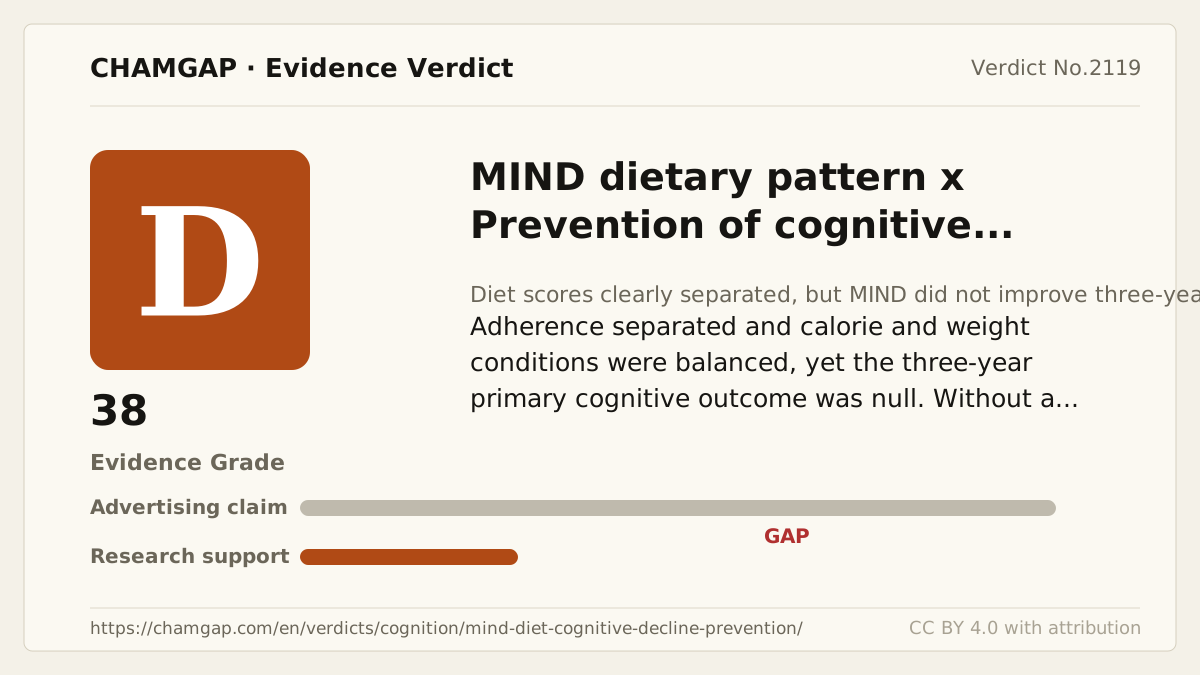
[Chamgap] MIND diet x prevention of cognitive decline — Evidence Grade D·34. 2 cited sources checked. Source: https://chamgap.com/en/verdicts/cognition/mind-diet-cognitive-decline-prevention/ · CC BY 4.0CC BY 4.0 — free to use with attribution; do not distort grades, numbers, or verdict meaning.
What this document does and does not do
Chamgap is an information source. It reports what research has and has not confirmed; it does not tell readers what to take or buy. That decision belongs to readers and, when needed, medical or legal professionals. This verdict reflects literature available up to the search date and may change as new research appears. Nothing here is medical advice.