
Midlife drinking of 1-14 UK units/week,
does it really help with Prevention of incident dementia?
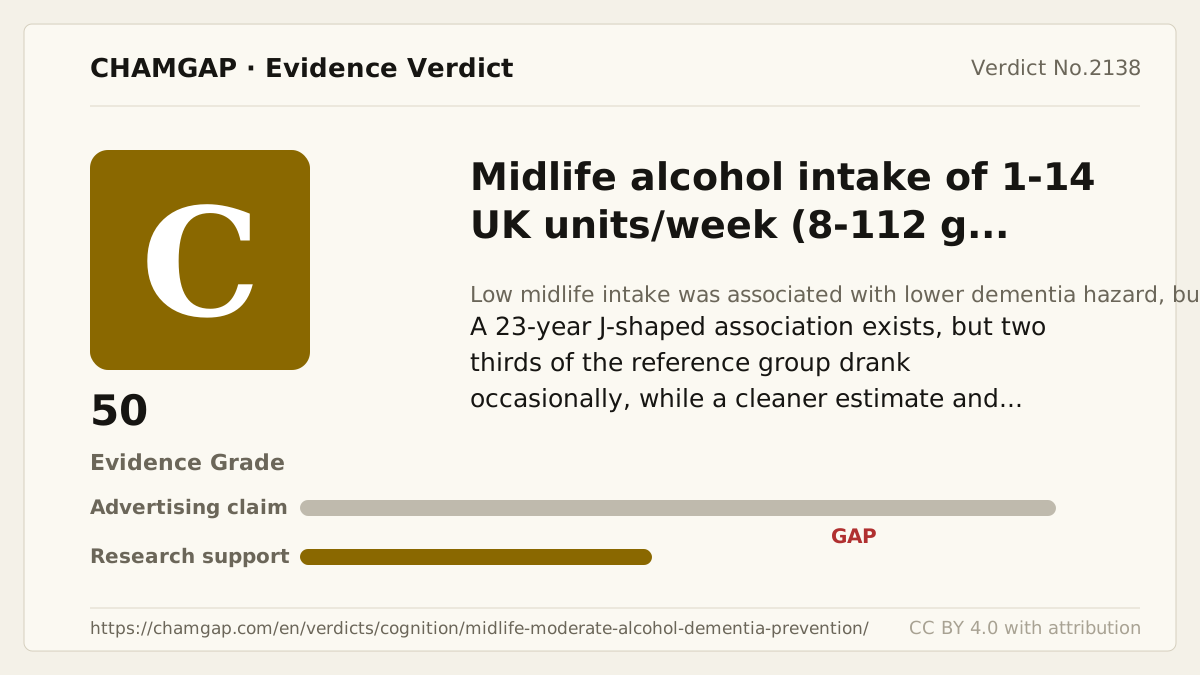
research showsThe grade is C. Whitehall II found less dementia among people drinking 1-14 units/week than in a combined abstinence group, but 862 of the 1,303 reference participants, 66.2%, were occasional drinkers. Thus about two thirds of the 'nondrinking' group actually drank occasionally. The cardiometabolic-disease-free direct transition was nonsignificant, HR 1.33 (0.88-2.02), and Mendelian-randomization studies did not reproduce the observational protection.
ads claimOne UK unit is 8 g ethanol, so 1-14 units/week equals 8-112 g/week or about 1.1-16 g/day. This differs from the 14 g US drink and roughly 10 g Korean or Japanese drink. A lower hazard in an observational reference category does not show that starting one drink tonight prevents dementia.
Useful facts when choosing a product
- One UK unit is 8 g ethanol; 1-14 units/week is 8-112 g/week.
- The abstinence group of 1,303 contained 862 occasional drinkers (66.2%), 172 former drinkers (13.2%), and 269 ten-year abstainers (20.6%).
- None of the five sensitivity-analysis families excluded early dementia events.
Chamgap Semantic Classification Code
Candidate index · review held
F.midlife-alcohol-intake-of-1-14-uk-units-week.food.incident-dementia.prevent.reference-exposureFoods and beverages > Midlife alcohol intake of 1-14 UK units/week > Food consumption > incident dementia > Occurrence-prevention claim > Reference exposure
An automated migration candidate, not an issued permanent code; exact claim scope remains under review. This machine-generated migration candidate helps retrieval but is not a permanent assignment. The original verdict ID and URL remain authoritative.
What the research actually shows
The 1-14 unit reference included 5,552 people and 229 cases. The combined abstinence group contained 862 occasional drinkers (66.2%), 172 former drinkers (13.2%), and 269 ten-year abstainers (20.6%). Versus long-term 1-14 unit consumption, long-term abstinence had HR 1.74 (1.31-2.30) and decreasing consumption HR 1.55 (1.08-2.22). The direct transition to dementia without cardiometabolic disease had HR 1.33 (0.88-2.02). Mendelian-randomization studies did not reproduce the observed protection.
Why this is classified as C (54)
The reference was 66.2% occasional drinkers, the disease-free direct-transition estimate was nonsignificant, and genetic-instrument studies did not reproduce protection, giving C with 54 points.
Counterpoint. Above 14 units/week, dementia hazard rose 17% per additional seven units, so more was not better.
Rejudgment record. Cross-check applied — The abstinence reference was 66.2% occasional drinkers, the cardiometabolic-disease-free direct-transition estimate was nonsignificant, and Mendelian-randomization studies did not reproduce protection
| Endpoint | H | Hard endpoint - actual events such as death |
| Replication | R1 | Single confirmatory trial |
| Independence | I2 | Decisive evidence is publicly or non-profit funded |
| Effect size | E~ | Statistically positive but below the threshold |
Stored derived and displayed grades match; this is not a current recalculation or validity check (C).
Sub-claim grades by effect
This ingredient is marketed for several effects. A single overall grade blends strong and weak claims together, so each effect is graded separately here. The overall grade reflects the strongest disconfirming or core claim.
| Effect (sub-claim) | Grade | Basis |
|---|---|---|
| Association of 1-14 UK units/week in midlife with lower dementia hazard | C | A long-term event association exists, but the abstinence reference was mixed. |
| Starting alcohol prevents dementia in nondrinkers | ? | This was not a trial assigning nondrinkers to start alcohol. |
Cross-check — AI research and Codex final gate
Evidence Table
| Study | Design | Sample | Funding | Endpoint | Result | Weight |
|---|---|---|---|---|---|---|
| Sabia S et al. 2018 Whitehall II | Prospective cohort | 9,087 participants; 397 dementia cases; mean 23.2 years | NIH, UK MRC, British Heart Foundation, and other public/nonprofit sources | Incident dementia through linked health records | Abstinence versus 1-14 units/week HR 1.47 (1.15-1.89); healthy-transition HR 1.33 (0.88-2.02) | Long-term hard outcome with a mixed reference group |
Receipt — 2 References
All 2 cited sources were verified for existence at the original page (as of 2026-08-04).
Final verification and publication gate: Codex · Evidence date: 2026-08-04 · Corrections: none
Cite this verdict
[Chamgap] Midlife drinking of 1-14 UK units/week x dementia prevention — Evidence Grade C·54. 2 cited sources checked. Source: https://chamgap.com/en/verdicts/cognition/midlife-moderate-alcohol-dementia-prevention/ · CC BY 4.0CC BY 4.0 — free to use with attribution; do not distort grades, numbers, or verdict meaning.
What this document does and does not do
Chamgap is an information source. It reports what research has and has not confirmed; it does not tell readers what to take or buy. That decision belongs to readers and, when needed, medical or legal professionals. This verdict reflects literature available up to the search date and may change as new research appears. Nothing here is medical advice.