
Methylphenidate,
does it really help with Improved concentration, examination scores, and academic performance in healthy students without ADHD?
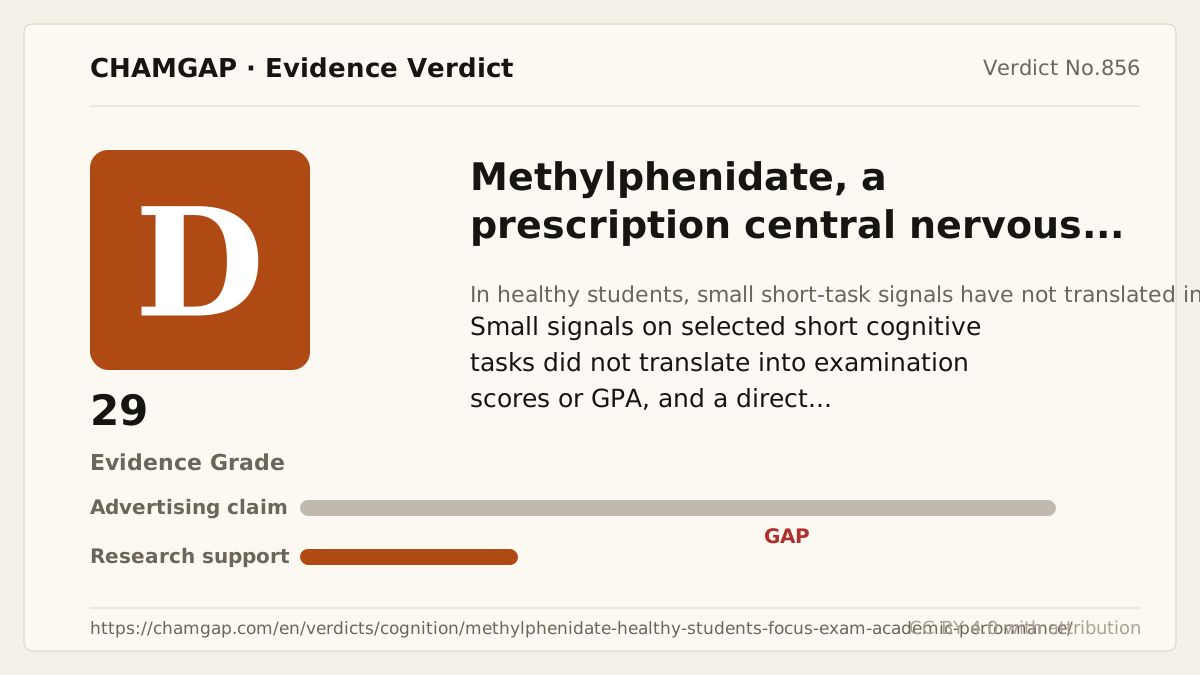
research showsThe claim that methylphenidate improves concentration and examination performance in healthy students is graded D. Meta-analysis of acute cognitive tasks in healthy adults found small effects in sustained attention, recall, and inhibitory control, but these were short laboratory experiments with poor representation of real use. In a randomized double-blind trial of 75 healthy undergraduates, 20 mg before studying or before an examination did not improve any question type, the average grade, or the pass rate. Treatment efficacy in ADHD must be separated from off-label academic enhancement in healthy people, while misuse, dependence, insomnia, appetite suppression, and cardiovascular effects remain separate safety issues.
ads claimMarketing and online anecdotes convert wakefulness, confidence, and longer study time into more accurate learning and higher grades. Arousal or a small change on a laboratory task is not the same as knowledge acquisition, inference, examination performance, or long-term GPA.
Useful facts when choosing a product
- Methylphenidate is a prescription central nervous system stimulant used for ADHD and, in some countries, narcolepsy. Academic enhancement in healthy students is not an approved indication.
- Extended-release products such as Concerta and immediate-release formulations differ in release rate and duration. Crushing tablets or escalating the dose can materially change exposure and risk.
- Buying, sharing, or diverting medication that was not prescribed to the user is not a safe study method and may constitute illegal distribution and misuse.
- Insomnia, appetite loss, anxiety, headache, and increased heart rate or blood pressure can occur. High-dose or non-oral misuse increases the risk of dependence and serious cardiovascular or psychiatric harm.
Chamgap Semantic Classification Code
Candidate index · review held
M.methylphenidate.UNK.concentration-examination-scores-and-academic-performance-in-healthy-students-without-adhd.improve.placeboMedicinal interventions > Methylphenidate > Unknown > concentration, examination scores, and academic performance in healthy students without ADHD > Improvement claim > Placebo
An automated migration candidate, not an issued permanent code; exact claim scope remains under review. This machine-generated migration candidate helps retrieval but is not a permanent assignment. The original verdict ID and URL remain authoritative.
What the research actually shows
Roberts 2020 pooled 24 methylphenidate studies with 47 effect sizes in healthy non-sleep-deprived adults and reported an overall SMD of 0.21, with recall 0.43, sustained attention 0.42, and inhibitory control 0.27, while emphasizing small effects and poor real-world representation. Sambeth 2026 randomized 75 healthy undergraduates to placebo-placebo, methylphenidate-placebo, or placebo-methylphenidate across separate learning and examination days; all three question types, average grade, and pass rate were unchanged. Arria 2017 followed 898 undergraduates without ADHD and found no GPA increase or detectable advantage associated with nonmedical prescription-stimulant use. These studies address a different question from treatment in ADHD.
Why this is classified as D (29)
Selected acute cognitive tasks show a small signal around SMD 0.21, but a direct examination-performance trial in healthy undergraduates was null for question scores, average grade, and pass rate, and longitudinal GPA data showed no advantage. The null direct academic endpoint yields D with 29 points; prescription-drug misuse harms are graded separately from efficacy.
Counterpoint. Symptom and functional benefits from clinician-prescribed methylphenidate in diagnosed ADHD belong to a separate evidence domain. This verdict applies only to off-label academic enhancement in healthy students without ADHD.
Rejudgment record. New verdict — Accepted small acute effects on selected cognitive tasks in healthy people, but applied rule ② for a null direct academic endpoint because a randomized examination-performance trial was negative and no GPA advantage was detected in students without ADHD
Sub-claim grades by effect
This ingredient is marketed for several effects. A single overall grade blends strong and weak claims together, so each effect is graded separately here. The overall grade reflects the strongest disconfirming or core claim.
| Effect (sub-claim) | Grade | Basis |
|---|---|---|
| Improved concentration, examination scores, and academic performance in healthy students | D | Unlike selected task signals, direct examination and GPA evidence did not show an academic benefit. |
| Acute improvement on selected attention, working-memory, or recall tasks | C | Small positive signals vary by task and have low ecological validity, limiting this subclaim to C. |
| Treatment of symptoms in patients with ADHD | B | This is a separate approved treatment domain and cannot be extrapolated to academic enhancement in healthy students. |
| Wakefulness or longer study time leading to higher grades | D | Arousal and perceived performance are not equivalent to improved examination results. |
Cross-check — AI research and Codex final gate
Evidence Table
| Study | Design | Sample | Funding | Endpoint | Result | Weight |
|---|---|---|---|---|---|---|
| Sambeth A et al. 2026 | Randomized double-blind placebo-controlled examination-performance trial | 75 healthy undergraduates without ADHD | Partly supported by an internal Maastricht University grant; no relevant conflicts declared | Factual and inference multiple-choice and open questions, average grade, and pass rate | Methylphenidate 20 mg before learning or before the examination was not superior to placebo on any examination endpoint. | Key null randomized trial with a direct academic endpoint |
| Roberts CA et al. 2020 | Systematic review and meta-analysis of acute cognitive tasks in healthy adults | 24 methylphenidate studies and 47 effect sizes | Academic research with no commercial sponsorship reported in the article | Executive functions, spatial working memory, recall, selective attention, and sustained attention | The overall effect was small at SMD 0.21, with signals in recall, sustained attention, and inhibitory control, but experiments poorly represented real use. | Indirect short-term task signal |
| Arria AM et al. 2017 | Longitudinal observational study of undergraduates | 898 undergraduates without an ADHD diagnosis | United States public research support through NIH-related grants | Change in registrar-recorded GPA from the second to third college year | Nonmedical prescription-stimulant users showed no GPA increase or detectable advantage over nonusers. | Supportive real-world academic evidence; nonrandomized |
Receipt — 4 References
All 4 cited sources were verified for existence at the original page (as of 2026-07-20).
Final verification and publication gate: Codex · Evidence date: 2026-07-20 · Corrections: none
Cite this verdict
[Chamgap] Methylphenidate x improved concentration, examination scores, and academic performance in healthy students — Evidence Grade D·29. 4 cited sources checked. Source: https://chamgap.com/en/verdicts/cognition/methylphenidate-healthy-students-focus-exam-academic-performance/ · CC BY 4.0CC BY 4.0 — free to use with attribution; do not distort grades, numbers, or verdict meaning.
What this document does and does not do
Chamgap is an information source. It reports what research has and has not confirmed; it does not tell readers what to take or buy. That decision belongs to readers and, when needed, medical or legal professionals. This verdict reflects literature available up to the search date and may change as new research appears. Nothing here is medical advice.