
Memantine,
does it really help with Delayed decline in cognition and daily function in moderate-to-severe Alzheimer's disease?
research showsMemantine is rated B because it produces a small delay in deterioration of cognition, daily function, and global status in moderate-to-severe Alzheimer's disease. The 2019 Cochrane review found high-certainty benefits across up to 14 placebo-controlled trials and about 3,700 participants: 3.11 SIB points, 1.09 ADL19 points, and 0.21 CIBIC+ points. The effect is modest, and one 350-participant monotherapy trial failed its prespecified 24-week primary analyses. This is symptomatic slowing, not arrest or prevention of disease, and the claim does not extend to mild Alzheimer's disease or mild cognitive impairment.
ads claimDescriptions can expand the evidence into restored memory, stopped dementia progression, or protected brain cells. The demonstrated range is a small average slowing on symptom scales over roughly six months, not normal-memory enhancement, prevention, or cure.
Useful facts when choosing a product
- Memantine is a prescription NMDA receptor medicine that is usually started at a low dose and titrated weekly to a maintenance dose of 20 mg daily.
- It may be used alone or with a cholinesterase inhibitor such as donepezil, with function, behavior, and caregiver burden reassessed regularly.
- Dose reduction may be needed in severe renal impairment, and conditions or medicines that alkalinize urine can slow elimination.
- Dizziness, headache, constipation, somnolence, or confusion can occur, and fall risk and concomitant neurologic medicines require review.
Chamgap Semantic Classification Code
Candidate index · review held
M.memantine.UNK.delayed-decline-in-cognition-and-daily-function-in-moderate-to-severe-alzheimers-disease.reduce.MULTIMedicinal interventions > Memantine > Unknown > Delayed decline in cognition and daily function in moderate-to-severe Alzheimer's disease > Reduction claim > Multiple: primary unresolved
An automated migration candidate, not an issued permanent code; exact claim scope remains under review. This machine-generated migration candidate helps retrieval but is not a permanent assignment. The original verdict ID and URL remain authoritative.
What the research actually shows
Tariot 2004 randomized 404 donepezil-treated patients to memantine 20 mg daily or placebo for 24 weeks. Changes favored memantine for SIB, 0.9 versus -2.5, and ADCS-ADL19, -2.0 versus -3.4. Reisberg 2003 also favored memantine for daily function and cognition in 252 patients, although its global LOCF analysis was borderline. The 350-participant van Dyck trial failed its final primary analyses. After incorporating this inconsistency, the 2019 Cochrane synthesis still found small average benefits across four clinical domains.
Why this is classified as B (65)
High-certainty synthesis of up to 14 trials and about 3,700 participants found small consistent benefits of 3.11 SIB points, 1.09 ADL19 points, and 0.21 global-assessment points. The modest effect and a 350-participant trial that failed its prespecified primary analyses give B with 65 points. Safety concerns are assessed separately.
Counterpoint. If function, behavior, or caregiver burden does not meaningfully benefit after an adequate trial, or adverse effects are substantial, continuation should be reviewed with the prescriber.
Rejudgment record. New verdict — Accepted consistent small benefits of 3.11 SIB points, 1.09 ADL19 points, and 0.21 global-assessment points across up to 14 placebo-controlled trials and about 3,700 participants, while assigning B for modest effect size and a trial that failed prespecified 24-week primary outcomes
Sub-claim grades by effect
This ingredient is marketed for several effects. A single overall grade blends strong and weak claims together, so each effect is graded separately here. The overall grade reflects the strongest disconfirming or core claim.
| Effect (sub-claim) | Grade | Basis |
|---|---|---|
| Delayed cognitive and daily-functional decline in moderate-to-severe Alzheimer's disease | B | Multiple trials and a Cochrane synthesis show small consistent benefits on direct symptom outcomes. |
| Major functional recovery or arrest of disease progression | D | The average effect is small, with no evidence that neurodegeneration is stopped or reversed. |
| Extension to mild Alzheimer's disease, mild cognitive impairment, or prevention | D | Major mild-disease outcomes were null, and prevention has not been demonstrated. |
Cross-check — AI research and Codex final gate
Evidence Table
| Study | Design | Sample | Funding | Endpoint | Result | Weight |
|---|---|---|---|---|---|---|
| McShane R et al. 2019 | Systematic review and meta-analysis of double-blind placebo-controlled randomized trials | Up to 14 trials and about 3,700 participants with moderate-to-severe Alzheimer's disease | Academic Cochrane synthesis; many included trials used company data | Global rating, SIB cognition, ADL19 daily function, and NPI behavior | High-certainty evidence showed small consistent benefits across all four domains. | Key synthesis |
| Tariot PN et al. 2004 | Multicenter randomized double-blind placebo-controlled add-on trial | 404 patients taking donepezil | Supported by Forest Laboratories | 24-week SIB, ADCS-ADL19, and CIBIC-Plus | Memantine significantly favored SIB, 0.9 versus -2.5, and ADCS-ADL19, -2.0 versus -3.4. | Large direct randomized trial |
| van Dyck CH et al. 2007 | Randomized double-blind placebo-controlled monotherapy trial | 350 participants | Forest Laboratories research program | 24-week SIB, ADCS-ADL19, and CIBIC-Plus | All three final prespecified analyses were nonsignificant. | Key conflicting trial |
Receipt — 5 References
All 5 cited sources were verified for existence at the original page (as of 2026-07-20).
Final verification and publication gate: Codex · Evidence date: 2026-07-20 · Corrections: none
Cite this verdict
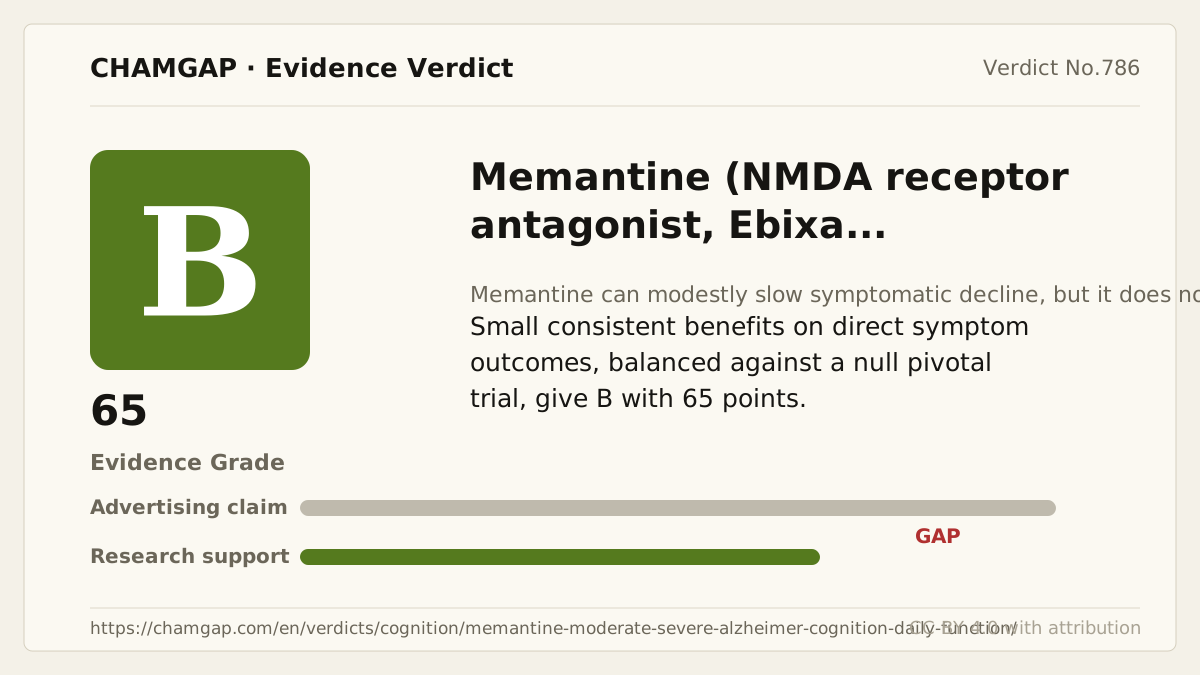
[Chamgap] Memantine x delayed cognitive and functional decline in moderate-to-severe Alzheimer's disease — Evidence Grade B·65. 5 cited sources checked. Source: https://chamgap.com/en/verdicts/cognition/memantine-moderate-severe-alzheimer-cognition-daily-function/ · CC BY 4.0CC BY 4.0 — free to use with attribution; do not distort grades, numbers, or verdict meaning.
What this document does and does not do
Chamgap is an information source. It reports what research has and has not confirmed; it does not tell readers what to take or buy. That decision belongs to readers and, when needed, medical or legal professionals. This verdict reflects literature available up to the search date and may change as new research appears. Nothing here is medical advice.