
Matcha powdered drink, two servings daily,
does it really help with Prevention of overall cognitive decline in older adults?
research showsThe grade is D with 28 points. A 12-week trial randomized 61 people but analyzed only 54 completers. Overall MoCA change was +1.6 with matcha versus +0.6 with placebo, and the group-by-time interaction was not significant (P=0.0859). A positive female subgroup cannot replace the null overall result.
ads claimMatcha does deliver the whole leaf plus caffeine, theanine, and catechins. That composition did not establish prevention of overall cognitive decline in the full trial population.
Useful facts when choosing a product
- Each 15-g powdered drink contained 1.5 g matcha and was taken twice daily, totaling two servings and 3 g matcha per day.
- Table 1 gave manufacturer-provided composition information of 40.5 mg caffeine and 25.2 mg L-theanine per serving, totaling 81 mg caffeine daily.
- Unlike an infusion from which leaves are removed, a matcha drink includes the consumed leaf powder.
- Verdict 425 is C with 51 points for heat-treated green-tea extract, and verdict 876 is C with 51 points for isolated L-theanine. Verdict 2022 asks a different question about a whole-leaf matcha drink and global cognitive decline.
Chamgap Semantic Classification Code
Candidate index · review held
S.matcha-powdered-drink.UNK.overall-cognitive-decline.prevent.placeboSupplements and nutraceuticals > Matcha powdered drink > Unknown > overall cognitive decline > Occurrence-prevention claim > Placebo
An automated migration candidate, not an issued permanent code; exact claim scope remains under review. This machine-generated migration candidate helps retrieval but is not a permanent assignment. The original verdict ID and URL remain authoritative.
What the research actually shows
Each serving contained 1.5 g matcha. Table 1 reported manufacturer-provided composition information of 40.5 mg caffeine, 25.2 mg L-theanine, and 138.5 mg tea catechins per serving. Twice-daily totals were 3 g matcha, 81 mg caffeine, 50.4 mg L-theanine, and 277 mg tea catechins. The paper treated MoCA as its main analysis and calculated sample size from MoCA; the registration number is UMIN000036331. The Matcha Health Research Group was established with Nestlé Japan involvement, and JSPS also supported the work. A Nestlé Japan author participated in test-product preparation, analysis, and manuscript writing.
Why this is classified as D (28)
Overall MoCA, MMSE, and delayed recall were null, while only a female subgroup was positive. The small completer-only analysis adds two major limitations, yielding D with 28 points.
Counterpoint. An independent long-term trial of a matcha beverage with all randomized participants analyzed is needed.
Rejudgment record. Cross-check applied — The paper was checked for 61 randomized, 54 completers analyzed, the null overall MoCA result, female subgroup, two-drink dose, stated registration number UMIN000036331, and manufacturer-provided caffeine composition
| Endpoint | P | Symptom or function itself is the target - including patient reports and performance tests |
| Replication | R1 | Single confirmatory trial |
| Independence | I1 | Mixed funding sources |
| Effect size | E0 | Null |
| Precision | C0 | The confidence interval leaves room for benefit |
Stored derived and displayed grades match; this is not a current recalculation or validity check (D).
Sub-claim grades by effect
This ingredient is marketed for several effects. A single overall grade blends strong and weak claims together, so each effect is graded separately here. The overall grade reflects the strongest disconfirming or core claim.
| Effect (sub-claim) | Grade | Basis |
|---|---|---|
| The matcha drink supplied leaf powder and 81 mg caffeine daily | ? | This is manufacturer-provided composition information in Table 1, not a graded clinical outcome. |
| A matcha drink prevents cognitive decline in the overall older-adult population | D | Overall cognitive results were null, with positivity confined to a female subgroup. |
Cross-check — AI research and Codex final gate
Evidence Table
| Study | Design | Sample | Funding | Endpoint | Result | Weight |
|---|---|---|---|---|---|---|
| Sakurai K et al., Nutrients, 2020 | Twelve-week double-blind placebo-controlled randomized parallel trial | 61 randomized; 54 completers analyzed, 28 matcha and 26 placebo | Matcha Health Research Group, established with Nestlé Japan involvement, and JSPS; a Nestlé Japan author joined product preparation, analysis, and writing | Overall-sample MoCA, MMSE, delayed recall, and impulsivity | MoCA +1.6±2.0 versus +0.6±2.0, interaction P=0.0859; other overall cognitive outcomes were also null | Direct beverage trial, but a small completer analysis with a null overall result |
Receipt — 2 References
All 2 cited sources were verified for existence at the original page (as of 2026-08-03).
Final verification and publication gate: Codex · Evidence date: 2026-08-03 · Corrections: none
Cite this verdict
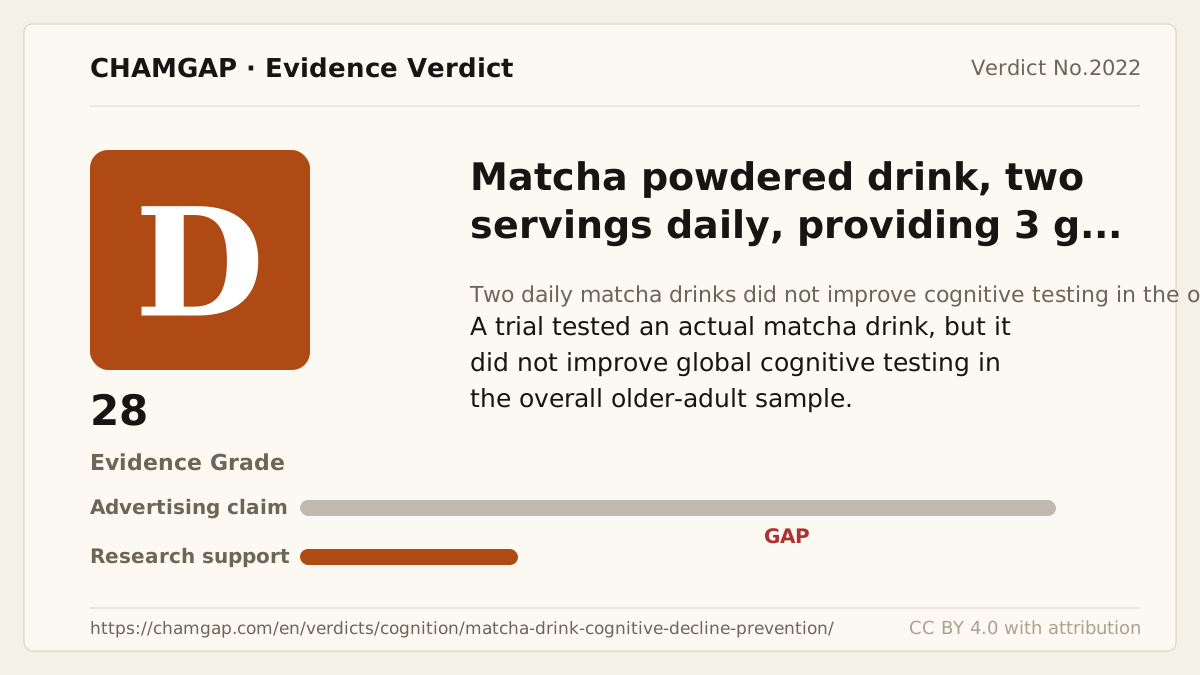
[Chamgap] Matcha powdered drink, two servings daily x prevention of cognitive decline in older adults — Evidence Grade D·28. 2 cited sources checked. Source: https://chamgap.com/en/verdicts/cognition/matcha-drink-cognitive-decline-prevention/ · CC BY 4.0CC BY 4.0 — free to use with attribution; do not distort grades, numbers, or verdict meaning.
What this document does and does not do
Chamgap is an information source. It reports what research has and has not confirmed; it does not tell readers what to take or buy. That decision belongs to readers and, when needed, medical or legal professionals. This verdict reflects literature available up to the search date and may change as new research appears. Nothing here is medical advice.