
Lower indoor carbon dioxide,
does it really help with Improved simulated decision-making performance in office workers?
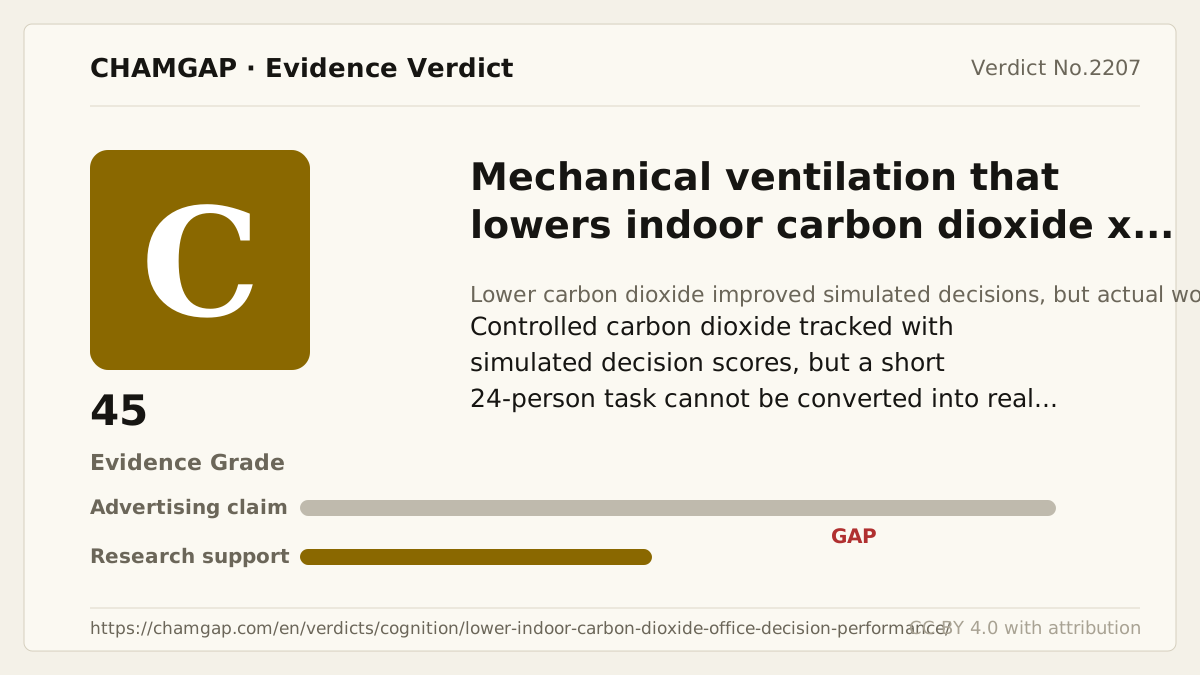
research showsThe grade is C with 46 points. In a blinded six-day controlled-office study of 24 people, average computerized simulated decision scores were 15% lower near 945 ppm and 50% lower near 1,400 ppm than near 550 ppm. The endpoint was Strategic Management Simulation, not actual output, errors, or revenue, and independent studies did not reproduce the same dose-response even at 2,500 to 5,000 ppm.
ads claimVentilation can lower indoor concentration, but this trial did not test whether opening windows improves actual company productivity. Carbon dioxide is also a ventilation marker, and real spaces change VOCs, temperature, and noise at the same time.
Useful facts when choosing a product
- Three independently calibrated monitors measured carbon dioxide in real time at about 550, 945, and 1,400 ppm.
- Outdoor air was 20 or 40 cfm per person; direct carbon-dioxide tests fixed it at 40 and injected ultra-pure gas.
- The endpoint was a nine-domain computerized Strategic Management Simulation, not actual workplace output.
- Null replication studies used different populations, higher levels, and different exposure durations, preventing a direct estimate-to-estimate comparison.
Chamgap Semantic Classification Code
Candidate index · review held
UNK.mechanical-ventilation-that-lowers-indoor-carbon-dioxide.UNK.simulated-decision-making-performance-in-office-workers.improve.UNKUnknown > Mechanical ventilation that lowers indoor carbon dioxide > Unknown > simulated decision-making performance in office workers > Improvement claim > Unknown
An automated migration candidate, not an issued permanent code; exact claim scope remains under review. This machine-generated migration candidate helps retrieval but is not a permanent assignment. The original verdict ID and URL remain authoritative.
What the research actually shows
Allen enrolled 24 office professionals for Tuesday-through-Thursday sessions from 09:00 to 17:00 over two weeks. They did normal work in a controlled office and completed the computerized Strategic Management Simulation. Outdoor air was 20 or 40 cfm per person; direct carbon-dioxide comparisons fixed outdoor air at 40 cfm per person and injected ultra-pure gas. Three calibrated monitors maintained about 550, 945, and 1,400 ppm. Average normalized scores were about 15% lower at 945 ppm and 50% lower at 1,400 ppm, with seven of nine domains declining at each increase. A United Technologies gift supported the study and its research center gave limited design input on adding a control day and third level; the article says it had no role in collection, analysis, interpretation, presentation, or drafting.
Why this is classified as C (46)
Direct control and blinding are strengths, but 24 participants, six days, a simulation, an industry gift, noncomparable null studies, and unreconstructable standardized magnitude give C with 46 points.
Counterpoint. This does not prove that lower carbon dioxide necessarily improves real work. The verdict is limited to controlled simulated decision performance.
Rejudgment record. Cross-check applied — Direct carbon-dioxide control and blinding were weighed against 24 participants, six days, a simulated endpoint, industry support, uncertain replication, and an unreconstructable standardized magnitude
| Endpoint | S | Surrogate marker - laboratory or imaging measures |
| Replication | R1 | Single confirmatory trial |
| Independence | I1 | Mixed funding sources |
| Effect size | EX | The clinical size of the effect could not be judged |
Stored derived and displayed grades match; this is not a current recalculation or validity check (C).
Sub-claim grades by effect
This ingredient is marketed for several effects. A single overall grade blends strong and weak claims together, so each effect is graded separately here. The overall grade reflects the strongest disconfirming or core claim.
| Effect (sub-claim) | Grade | Basis |
|---|---|---|
| Controlled-room carbon dioxide and simulated decision scores | C | A positive directly controlled study exists, but external results and magnitude are unstable. |
| Ventilation improves actual workplace productivity | ? | No confirmatory trial directly measuring actual work output was verified in this evidence set. |
Cross-check — AI research and Codex final gate
Evidence Table
| Study | Design | Sample | Funding | Endpoint | Result | Weight |
|---|---|---|---|---|---|---|
| Allen JG et al. 2016 | Double-blind controlled-office repeated-measures trial | 24 participants, six workdays, 09:00 to 17:00 | United Technologies gift plus NIH training and academic support | Nine-domain Strategic Management Simulation scores | Average score was about 15% lower near 945 ppm and 50% lower near 1,400 ppm versus 550 ppm. | Principal directly controlled trial |
| Scully RR et al. 2019 NASA | Randomized balanced crossover exposure trial | 22 healthy astronaut-like adults | NASA research | SMS and additional cognitive tasks | Did not reproduce the earlier clear impairment across 600, 1,200, 2,500, and 5,000 ppm. | Independent but noncomparable external check |
Receipt — 4 References
All 4 cited sources were verified for existence at the original page (as of 2026-08-04).
Final verification and publication gate: Codex · Evidence date: 2026-08-04 · Corrections: none
Cite this verdict
[Chamgap] Lower indoor carbon dioxide x simulated office decision performance — Evidence Grade C·46. 4 cited sources checked. Source: https://chamgap.com/en/verdicts/cognition/lower-indoor-carbon-dioxide-office-decision-performance/ · CC BY 4.0CC BY 4.0 — free to use with attribution; do not distort grades, numbers, or verdict meaning.
What this document does and does not do
Chamgap is an information source. It reports what research has and has not confirmed; it does not tell readers what to take or buy. That decision belongs to readers and, when needed, medical or legal professionals. This verdict reflects literature available up to the search date and may change as new research appears. Nothing here is medical advice.