
Low-dose aspirin,
does it really help with Prevention of dementia, mild cognitive impairment, and cognitive decline in healthy older adults?
research showsThe claim that healthy older adults can start low-dose aspirin 100 mg to prevent dementia, mild cognitive impairment, or cognitive decline is rated F. In ASPREE with 19,114 participants, HRs were null at 1.03 for dementia, 1.12 for mild cognitive impairment, and 1.04 for cognitive decline. A meta-analysis of five randomized trials and 46,804 participants was also null at OR 0.93 for dementia, 1.00 for mild cognitive impairment, and 1.02 for cognitive decline. Repeated refutation across multiple randomized-trial lines takes precedence over D and invokes F. Major bleeding at HR 1.38 is a separate safety harm, not statistical evidence of efficacy failure.
ads claimMarketing or self-medication logic turns blood thinning and a possible cerebral-blood-flow mechanism directly into dementia prevention. In healthy older adults, randomized evidence did not prevent dementia, mild cognitive impairment, or decline on cognitive testing.
Useful facts when choosing a product
- ASPREE tested enteric-coated aspirin 100 mg every day, which is a different question from occasional higher-dose aspirin taken for pain.
- Antiplatelet secondary prevention after myocardial infarction, ischemic stroke, or coronary stenting is a different indication from dementia prevention and should not be stopped without medical direction.
- Aspirin can increase gastrointestinal bleeding, peptic ulcer, and intracranial hemorrhage. Anticoagulants, other antiplatelet drugs, nonsteroidal anti-inflammatory drugs, and heavy alcohol use can further increase bleeding risk.
- There is no evidence to start aspirin solely for dementia prevention in a healthy older adult; management of blood pressure, diabetes, physical activity, smoking, hearing, and social engagement takes priority.
Chamgap Semantic Classification Code
Candidate index · review held
M.aspirin.UNK.dementia-mild-cognitive-impairment-and-cognitive-decline.prevent.placeboMedicinal interventions > aspirin > Unknown > dementia, mild cognitive impairment, and cognitive decline > Occurrence-prevention claim > Placebo
An automated migration candidate, not an issued permanent code; exact claim scope remains under review. This machine-generated migration candidate helps retrieval but is not a permanent assignment. The original verdict ID and URL remain authoritative.
What the research actually shows
The 2020 ASPREE cognition analysis by Ryan and colleagues assessed prespecified dementia, mild-cognitive-impairment, and cognitive-decline outcomes in 19,114 participants assigned enteric-coated aspirin 100 mg or placebo. There were 575 adjudicated dementia cases, with no difference between groups, and trajectories on tests of memory, language and executive function, and processing speed were also similar. Xie and colleagues in 2023 synthesized five randomized trials and 46,804 participants and found no benefit for dementia, mild cognitive impairment, cognitive decline, or global cognitive scores. A separate ASPREE bleeding analysis reported major hemorrhage rates of 8.6 versus 6.2 per 1,000 person-years for aspirin and placebo. The bleeding result is a safety finding distinct from the direct null cognitive-efficacy result.
Why this is classified as F (14)
ASPREE in 19,114 participants was null for dementia, mild cognitive impairment, and cognitive decline, and a meta-analysis of five randomized trials and 46,804 participants repeatedly found all cognitive-prevention outcomes null. Repeated refutation across multiple randomized-trial lines makes F take precedence over D, yielding F14. Major bleeding at HR 1.38 remains a separate safety finding.
Counterpoint. Someone already prescribed aspirin for cardiovascular secondary prevention should not stop it because of this cognition verdict. Conversely, there is no reason to start it solely for dementia prevention; individual cardiovascular and bleeding risks should be reviewed with a clinician.
Rejudgment record. Cross-check revision — Cross-check: repeated null findings across multiple randomized trials invoke repeated-refutation F, while bleeding is separated under safety
Sub-claim grades by effect
This ingredient is marketed for several effects. A single overall grade blends strong and weak claims together, so each effect is graded separately here. The overall grade reflects the strongest disconfirming or core claim.
| Effect (sub-claim) | Grade | Basis |
|---|---|---|
| Prevention of incident dementia in healthy older adults | F | Dementia prevention was repeatedly null, with HR 1.03 in ASPREE and OR 0.93 in the five-trial meta-analysis. |
| Prevention of mild cognitive impairment and cognitive decline in healthy older adults | F | Results were repeatedly null: ASPREE HRs were 1.12 for mild cognitive impairment and 1.04 for cognitive decline, while meta-analytic ORs were 1.00 and 1.02. |
Cross-check — AI research and Codex final gate
Evidence Table
| Study | Design | Sample | Funding | Endpoint | Result | Weight |
|---|---|---|---|---|---|---|
| Ryan J et al. 2020 ASPREE cognition trial | Prespecified cognition analysis of a large randomized double-blind placebo-controlled trial | 19,114 healthy older adults; median follow-up of 4.7 years | Public support including the US NIA and NCI and Australian NHMRC; aspirin and placebo supplied by Bayer | Adjudicated dementia, probable Alzheimer disease, mild cognitive impairment, cognitive decline, and cognitive-test trajectories | There was no significant prevention: HR 1.03 for dementia, 1.12 for mild cognitive impairment, and 1.04 for cognitive decline. | Decisive large direct null randomized trial |
| Xie X et al. 2023 | Systematic review and meta-analysis of randomized aspirin trials for cognitive prevention | Five randomized trials with 46,804 participants | Academic research; no industry sponsorship reported | Dementia, mild cognitive impairment, cognitive decline, global cognition, and verbal-learning scores | All outcomes were null: OR 0.93 for dementia, 1.00 for mild cognitive impairment, 1.02 for cognitive decline, and SMD -0.01 for global cognition. | Large consistent null synthesis |
| McNeil JJ et al. 2018 ASPREE bleeding trial | Large randomized double-blind placebo-controlled trial | 19,114 healthy older adults | Public funding; aspirin and placebo supplied by Bayer | Major hemorrhage and cardiovascular events | Major hemorrhage increased from 6.2 to 8.6 per 1,000 person-years, HR 1.38 (95% CI 1.18 to 1.62). | Key safety evidence separated from efficacy |
Receipt — 3 References
All 3 cited sources were verified for existence at the original page (as of 2026-07-20).
Final verification and publication gate: Codex · Evidence date: 2026-07-20 · Corrections: none
Cite this verdict
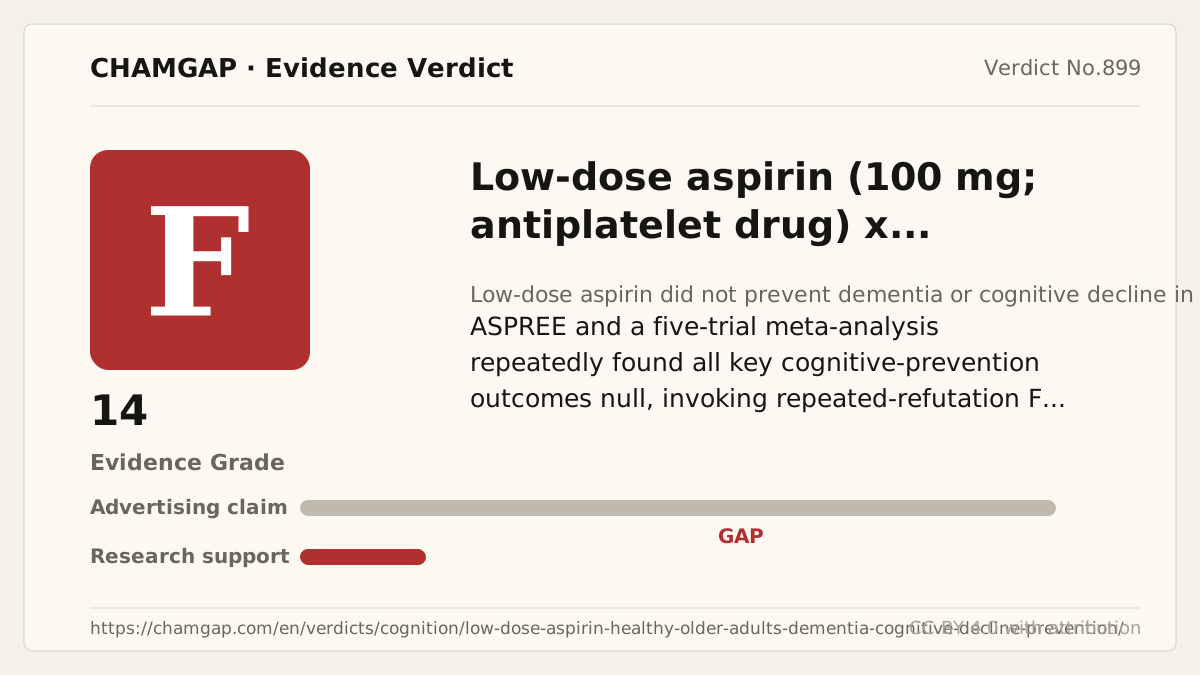
[Chamgap] Low-dose aspirin x prevention of dementia, mild cognitive impairment, and cognitive decline in healthy older adults — Evidence Grade F·14. 3 cited sources checked. Source: https://chamgap.com/en/verdicts/cognition/low-dose-aspirin-healthy-older-adults-dementia-cognitive-decline-prevention/ · CC BY 4.0CC BY 4.0 — free to use with attribution; do not distort grades, numbers, or verdict meaning.
What this document does and does not do
Chamgap is an information source. It reports what research has and has not confirmed; it does not tell readers what to take or buy. That decision belongs to readers and, when needed, medical or legal professionals. This verdict reflects literature available up to the search date and may change as new research appears. Nothing here is medical advice.