
Lasmiditan,
does it really help with Pain freedom two hours after dosing for an acute migraine attack?
research showsLasmiditan receives B with 62 points. In SAMURAI, two-hour pain freedom with 200 mg was 32.2% versus 15.3% with placebo, and SPARTAN replicated the result at 38.8% versus 21.3%. Multiple large phase 3 trials therefore met the standard patient-reported acute-migraine endpoint, but the absolute difference was limited. Dizziness, somnolence, and the eight-hour post-dose driving restriction reduce clinical utility, placing the result at the lower end of B in alignment with B-rated preventive CGRP treatments.
ads claimPain free within two hours can sound universal. Even with 200 mg, only about one in three participants became pain free at two hours, and the eight-hour restriction matters whenever driving or machinery operation is planned.
Useful facts when choosing a product
- Lasmiditan is a selective 5-HT1F agonist without vasoconstriction as its principal action and is a prescription acute-attack treatment rather than migraine prevention.
- Trials primarily assessed complete absence of pain two hours after treatment of a single attack that began at moderate or severe intensity.
- Safety and efficacy of a second dose within 24 hours are not established, so the prescribed daily maximum and product instructions must be followed.
- Dizziness, somnolence, fatigue, and paresthesia are common, and patients must not drive or operate machinery for at least eight hours even if they feel well.
Chamgap Semantic Classification Code
Candidate index · review held
M.lasmiditan.UNK.pain-freedom-after-dosing-for-an-acute-migraine-attack.assess.placeboMedicinal interventions > Lasmiditan > Unknown > Pain freedom after dosing for an acute migraine attack > Association or change assessment > Placebo
An automated migration candidate, not an issued permanent code; exact claim scope remains under review. This machine-generated migration candidate helps retrieval but is not a permanent assignment. The original verdict ID and URL remain authoritative.
What the research actually shows
SAMURAI randomized 2,231 participants, 1,856 took study drug, and the modified intention-to-treat analysis included 1,545; two-hour pain freedom with 200 mg was 32.2% versus 15.3% with placebo. SPARTAN randomized 3,005 participants and included 2,156 in the primary analysis, with two-hour pain-freedom rates of 38.8% for 200 mg, 31.4% for 100 mg, 28.6% for 50 mg, and 21.3% for placebo. Pooled pain-freedom rates were 35.6%, 29.9%, 28.6%, and 18.3%, respectively. Multiple phase 3 trials replicated the standard patient-reported endpoint, but absolute differences were limited, and integrated safety analysis found dose-related central nervous system adverse effects, particularly dizziness, somnolence, and paresthesia.
Why this is classified as B (62)
SAMURAI found two-hour pain freedom of 32.2% versus 15.3% with 200 mg, SPARTAN replicated the endpoint, and CENTURION strengthened multi-attack consistency. Limited absolute added benefit, a patient-reported endpoint, dizziness, and the eight-hour driving restriction constrain clinical utility. Alignment with B-rated preventive CGRP treatments yields lower-B with 62 points.
Counterpoint. This nonvasoconstrictive option may help patients with triptan contraindication, intolerance, or insufficient response, but driving plans, adverse effects, cost, and other acute treatments still require comparison.
Rejudgment record. New verdict — Multiple phase 3 trials met the standard patient-reported endpoint, including two-hour pain freedom of 32.2% versus 15.3% with 200 mg in SAMURAI and replication in SPARTAN, but limited absolute differences, dizziness, somnolence, and the eight-hour driving restriction supported the lower end of B in alignment with B-rated preventive CGRP treatments
Sub-claim grades by effect
This ingredient is marketed for several effects. A single overall grade blends strong and weak claims together, so each effect is graded separately here. The overall grade reflects the strongest disconfirming or core claim.
| Effect (sub-claim) | Grade | Basis |
|---|---|---|
| Pain freedom two hours after dosing for acute migraine | B | Two large phase 3 placebo-controlled trials repeatedly found positive direct endpoints at all evaluated doses. |
| Two-hour pain freedom for every patient | F | Even at 200 mg, only about 36% to 39% became pain free, so most still had pain at two hours. |
| Prevention of migraine attacks | F | Lasmiditan is an acute-attack treatment, and the evidence in this verdict did not evaluate prevention. |
Cross-check — AI research and Codex final gate
Evidence Table
| Study | Design | Sample | Funding | Endpoint | Result | Weight |
|---|---|---|---|---|---|---|
| Kuca B et al. 2018 SAMURAI | Phase 3 multicenter randomized double-blind placebo-controlled single-attack trial | 2,231 randomized, 1,856 dosed, and 1,545 in the modified intention-to-treat analysis | CoLucid Pharmaceuticals and Eli Lilly development program | Two-hour pain freedom and freedom from the most bothersome symptom | Both 100 mg and 200 mg were significantly superior to placebo for two-hour pain freedom. | Key direct large randomized trial |
| Goadsby PJ et al. 2019 SPARTAN | Phase 3 multinational randomized double-blind placebo-controlled single-attack trial | 3,005 randomized and 2,156 in the primary analysis | CoLucid Pharmaceuticals and Eli Lilly | Pain freedom and freedom from the most bothersome symptom two hours after dosing | Pain-freedom rates were 38.8% for 200 mg, 31.4% for 100 mg, 28.6% for 50 mg, and 21.3% for placebo. | Key replicated direct large randomized trial |
| Krege JH et al. 2019 pooled safety | Integrated safety analysis of SAMURAI and SPARTAN | 4,439 participants in the safety population | Eli Lilly | Adverse events within 48 hours of dosing | Central nervous system adverse effects were common, especially dose-related dizziness. | Safety evidence separated from efficacy |
Receipt — 4 References
All 4 cited sources were verified for existence at the original page (as of 2026-07-20).
Final verification and publication gate: Codex · Evidence date: 2026-07-20 · Corrections: none
Cite this verdict
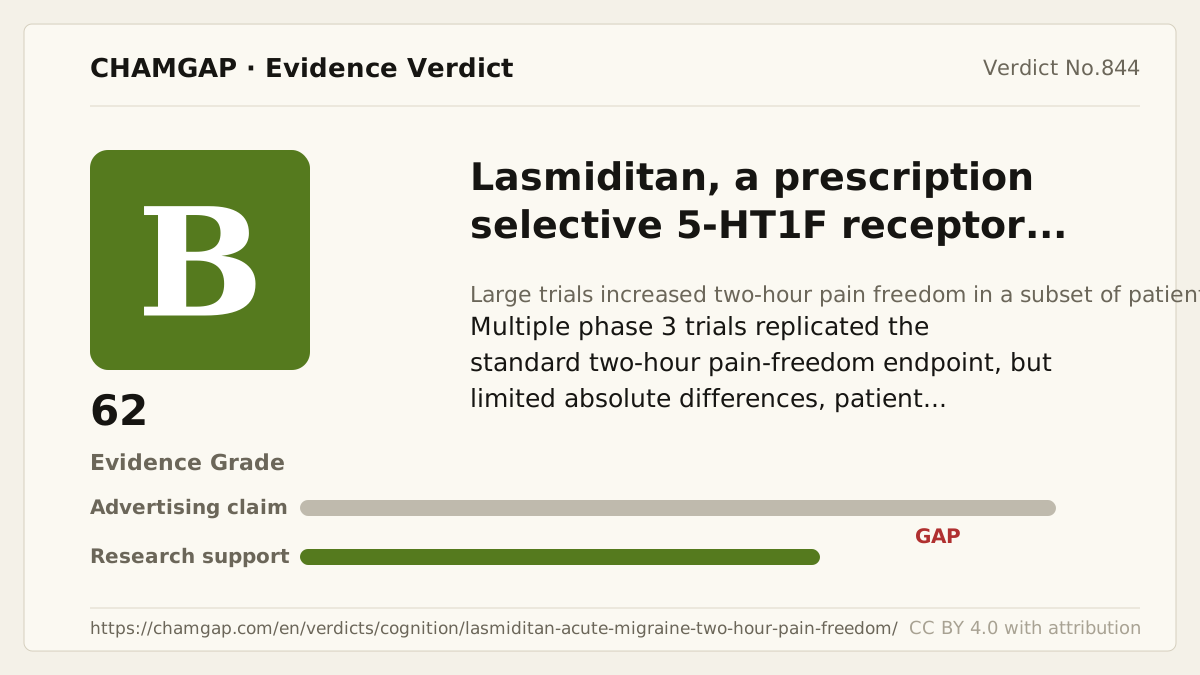
[Chamgap] Lasmiditan x pain freedom two hours after an acute migraine attack — Evidence Grade B·62. 4 cited sources checked. Source: https://chamgap.com/en/verdicts/cognition/lasmiditan-acute-migraine-two-hour-pain-freedom/ · CC BY 4.0CC BY 4.0 — free to use with attribution; do not distort grades, numbers, or verdict meaning.
What this document does and does not do
Chamgap is an information source. It reports what research has and has not confirmed; it does not tell readers what to take or buy. That decision belongs to readers and, when needed, medical or legal professionals. This verdict reflects literature available up to the search date and may change as new research appears. Nothing here is medical advice.