
Intramuscular midazolam,
does it really help with Seizure cessation before emergency-department arrival in prehospital convulsive status epilepticus?
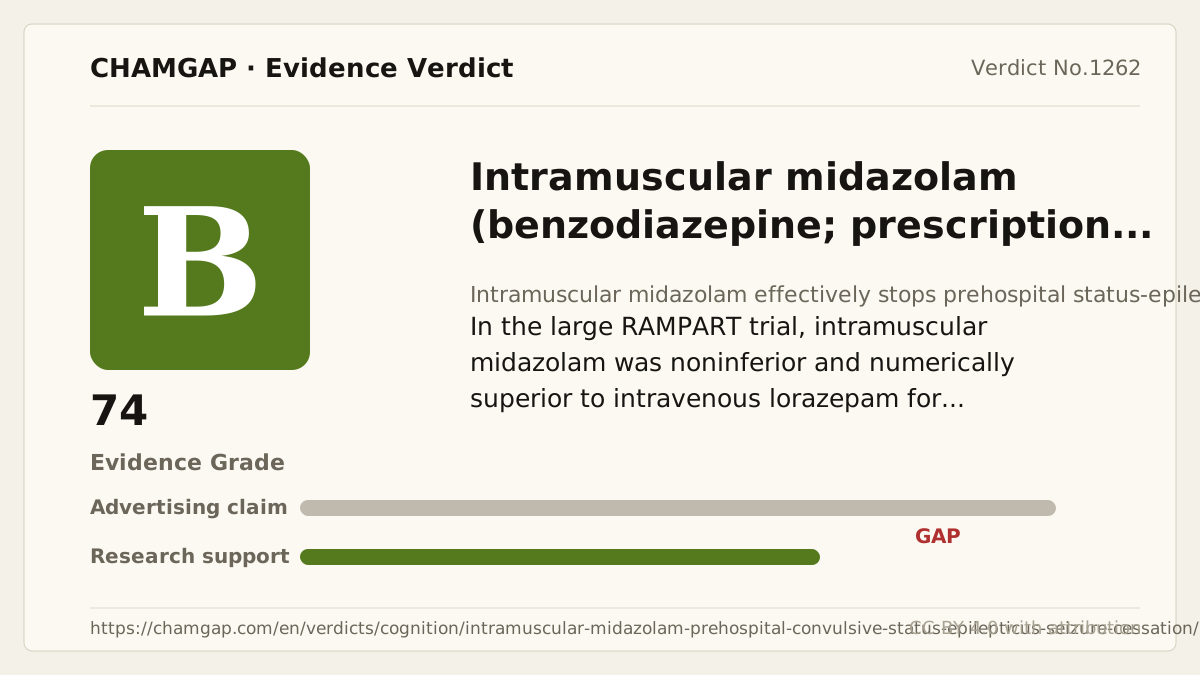
research showsIntramuscular midazolam is rated B because, when administered by paramedics for prehospital convulsive status epilepticus, it effectively stops seizures before emergency-department arrival. In the NIH-led RAMPART analysis of 893 participants, 73.4% in the intramuscular-midazolam group versus 63.4% in the intravenous-lorazepam group were seizure-free on arrival without rescue medication, meeting both noninferiority and superiority tests. Intramuscular drug action itself was slower after administration, but treatment began sooner because intravenous access was unnecessary. This was a large double-blind trial with a direct clinical endpoint, but it used an active comparator and the conclusion for this exact prehospital strategy is dominated by one pivotal trial, limiting the grade to B rather than A.
ads claimA simplified summary may say that an intramuscular injection is pharmacologically faster or stronger than intravenous treatment. The observed advantage mainly arose by avoiding delays in establishing intravenous access; after active drug administration, intravenous lorazepam stopped seizures faster.
Useful facts when choosing a product
- Midazolam is a prescription benzodiazepine injection with rapid sedative and anticonvulsant effects. Prehospital status-epilepticus treatment is performed by trained emergency personnel under a clinical protocol.
- RAMPART evidence applies to an intramuscular-autoinjector strategy in patients whose convulsions had persisted for more than five minutes and continued after paramedic arrival. It did not study every seizure or preventive use.
- Intramuscular delivery can begin without establishing intravenous access, but breathing, level of consciousness, oxygen saturation, and seizure recurrence require continuous monitoring after administration.
- Important harms include respiratory depression, excessive sedation, hypotension, and impaired airway protection. Other central nervous system depressants, especially opioids, can increase risk, so airway and ventilation support must be available.
Chamgap Semantic Classification Code
Candidate index · review held
M.midazolam.intramuscular.seizure-cessation-before-emergency-department-arrival-in-prehospital-convulsive-status-epilepticus.assess.activeMedicinal interventions > midazolam > Intramuscular > Seizure cessation before emergency-department arrival in prehospital convulsive status epilepticus > Association or change assessment > Active comparator
An automated migration candidate, not an issued permanent code; exact claim scope remains under review. This machine-generated migration candidate helps retrieval but is not a permanent assignment. The original verdict ID and URL remain authoritative.
What the research actually shows
RAMPART was an NIH-supported double-dummy noninferiority trial comparing an intramuscular midazolam autoinjector with intravenous lorazepam infusion in children and adults with prehospital convulsive status epilepticus. Its primary endpoint was no seizure on emergency-department arrival without rescue therapy and occurred in 73.4% versus 63.4%. Endotracheal intubation occurred in 14.1% versus 14.4%, and recurrent seizures in 11.4% versus 10.6%. The prospective design article specified the 10-percentage-point noninferiority margin and the same direct endpoint. A separate 24-child randomized trial also found that intramuscular midazolam was administered sooner and shortened total time to seizure cessation compared with intravenous diazepam, supporting the direction but with major limitations from size and an in-hospital setting.
Why this is classified as B (74)
In 893 RAMPART participants, seizure cessation before emergency-department arrival occurred in 73.4% versus 63.4%, an absolute difference of 10.0 percentage points that met noninferiority and superiority criteria. The active-comparator advantage is attributable to a delivery strategy that included an autoinjector, and the evidence is concentrated in one pivotal large trial, supporting B with 74 points. Respiratory depression and sedation are separate safety issues.
Counterpoint. Because treatment delay itself is dangerous in convulsive status epilepticus, the intramuscular route has a major practical advantage when intravenous access would be delayed. Dose, age, personnel, and airway-support capacity must still follow the local emergency protocol.
Rejudgment record. New verdict — RAMPART met a direct clinical endpoint of seizure cessation before emergency-department arrival in a large double-blind trial, but it was an active comparison with intravenous lorazepam, tested an autoinjector-inclusive strategy, and remains one dominant pivotal trial, supporting B
Sub-claim grades by effect
This ingredient is marketed for several effects. A single overall grade blends strong and weak claims together, so each effect is graded separately here. The overall grade reflects the strongest disconfirming or core claim.
| Effect (sub-claim) | Grade | Basis |
|---|---|---|
| Seizure cessation before emergency-department arrival | B | The RAMPART primary endpoint occurred in 73.4% with intramuscular midazolam versus 63.4% with intravenous lorazepam. |
| Noninferiority to intravenous lorazepam and faster treatment initiation | B | Both noninferiority and superiority were met, and median time to active treatment was 1.2 versus 4.8 minutes. |
| Reduced recurrent seizures after emergency-department arrival | D | Recurrent seizures occurred in 11.4% versus 10.6%, with no reduction from intramuscular midazolam. |
Cross-check — AI research and Codex final gate
Evidence Table
| Study | Design | Sample | Funding | Endpoint | Result | Weight |
|---|---|---|---|---|---|---|
| Silbergleit R et al. 2012 RAMPART | Multicenter double-blind double-dummy randomized noninferiority trial | 1,023 enrollments; 893 in the primary efficacy analysis (448 IM and 445 IV) | Supported by the US NINDS, NIH, and the public neurological emergency trial network | Absence of seizures on emergency-department arrival without rescue therapy | Intramuscular midazolam achieved 73.4% versus 63.4% with intravenous lorazepam, an absolute difference of 10.0 percentage points (95% CI 4.0 to 16.1); P<0.001 for both noninferiority and superiority. | Pivotal large prehospital direct clinical trial |
| Silbergleit R et al. 2011 RAMPART design | Prospective double-blind randomized trial design and methods article | Planned pediatric and adult prehospital status enrollment; 1,023 final trial enrollments | US NINDS and NETT public research network; authors reported no conflicts of interest | A 10-percentage-point noninferiority margin and a primary endpoint of no seizure and no rescue therapy at emergency-department arrival | Prespecified the route comparison, direct primary endpoint, and safety and timing outcomes, reducing concern about selective outcome interpretation. | Prospective methodological confirmation |
| Chamberlain JM et al. 1997 | Open randomized active-controlled pediatric trial | 24 children with motor seizures lasting at least 10 minutes | Not reported in the abstract | Time to treatment and seizure cessation | Initial treatment succeeded in 22 of 24 patients; intramuscular midazolam was administered sooner and total time to seizure cessation was 7.8 versus 11.2 minutes with intravenous diazepam. | Small in-hospital supportive evidence |
Receipt — 3 References
All 3 cited sources were verified for existence at the original page (as of 2026-07-24).
Final verification and publication gate: Codex · Evidence date: 2026-07-24 · Corrections: none
Cite this verdict
[Chamgap] Intramuscular midazolam x prehospital cessation of status-epilepticus seizures — Evidence Grade B·74. 3 cited sources checked. Source: https://chamgap.com/en/verdicts/cognition/intramuscular-midazolam-prehospital-convulsive-status-epilepticus-seizure-cessation/ · CC BY 4.0CC BY 4.0 — free to use with attribution; do not distort grades, numbers, or verdict meaning.
What this document does and does not do
Chamgap is an information source. It reports what research has and has not confirmed; it does not tell readers what to take or buy. That decision belongs to readers and, when needed, medical or legal professionals. This verdict reflects literature available up to the search date and may change as new research appears. Nothing here is medical advice.