
Intracranial stenting,
does it really help with Reduced recurrent stroke in severe symptomatic intracranial stenosis?
research showsThe grade is D. In SAMMPRIS, 30-day stroke or death was 33/224 (14.7%) with stenting versus 13/227 (5.8%) with medical therapy. At about three years, events were 52/224 (23%) versus 34/227 (15%), an absolute difference of 9.0 points (95% CI 1.5-16.5). VISSIT also favored harm: its 30-day safety endpoint was 14/58 (24.1%) versus 5/53 (9.4%), and the one-year stroke or hard-TIA endpoint was 21/58 (36.2%) versus 8/53 (15.1%). Major investigators overlapped across trials, so they were not counted as independent repeated refutation; the result is D with 34 points.
ads claimMechanically widening a stenosed artery does not guarantee fewer strokes. In this population, added periprocedural risk increased total clinical events.
Useful facts when choosing a product
- SAMMPRIS tested the self-expanding Wingspan system; VISSIT tested the balloon-expandable PHAROS Vitesse system.
- The 2011 SAMMPRIS paper and 2014 long-term report describe the same 451-person trial.
- VISSIT first author Zaidat and investigators including Barnwell also participated in SAMMPRIS.
- Unlike verdict 1501 on aneurysm coiling, this verdict concerns recurrent-stroke prevention in atherosclerotic intracranial stenosis.
Chamgap Semantic Classification Code
Candidate index · review held
UNK.intracranial-arterial-stenting-added-to-aggressive-medical-therapy.UNK.recurrent-stroke-in-severe-symptomatic-intracranial-stenosis.reduce.addonUnknown > Intracranial arterial stenting added to aggressive medical therapy > Unknown > recurrent stroke in severe symptomatic intracranial stenosis > Reduction claim > Added intervention on common background care
An automated migration candidate, not an issued permanent code; exact claim scope remains under review. This machine-generated migration candidate helps retrieval but is not a permanent assignment. The original verdict ID and URL remain authoritative.
What the research actually shows
SAMMPRIS randomized 451 patients with recent symptoms and 70%-99% stenosis to Wingspan stenting plus identical aggressive medical management, 224, or medical management, 227. The statistical coordinating center generated the sequence, potential events were adjudicated by masked independent panels, and primary analysis followed intention to treat. The NCT00576693 composite primary endpoint matched the paper. NINDS U01 NS058728 was the main support; Stryker supplied devices and some third-party monitoring. The 2014 report was longer follow-up of the same trial, not replication. VISSIT randomized 112, while the reported primary analysis used 58 and 53 treated patients. Micrus Endovascular initiated and funded VISSIT, and Codman stopped it after an unplanned analysis. The NCT00816166 one-year primary endpoint matched the publication.
Why this is classified as D (34)
Large hard-outcome trials found significant harm opposite to the benefit claim, but investigator overlap prevented classification as independent repeated refutation, giving D with 34 points.
Counterpoint. D does not mean the risk was small. It means the strong early harm signal lacks the investigator independence required for the strongest repeated-refutation grade.
Rejudgment record. Cross-check applied — SAMMPRIS and VISSIT reports, long-term follow-up, and both registrations were checked for event counts, intention-to-treat analysis, funding, early stopping, same-trial reporting, and author overlap
| Endpoint | H | Hard endpoint - actual events such as death |
| Replication | R1 | Single confirmatory trial |
| Independence | I1 | Mixed funding sources |
| Effect size | E- | Harm increased in the trials |
| Precision | C0 | The confidence interval leaves room for benefit |
Stored derived and displayed grades match; this is not a current recalculation or validity check (D).
Sub-claim grades by effect
This ingredient is marketed for several effects. A single overall grade blends strong and weak claims together, so each effect is graded separately here. The overall grade reflects the strongest disconfirming or core claim.
| Effect (sub-claim) | Grade | Basis |
|---|---|---|
| Reduced 30-day stroke or death | D | Both SAMMPRIS and VISSIT had more events with stenting. |
| Reduced recurrent events at one to three years | D | Three-year SAMMPRIS and one-year VISSIT outcomes both favored medical therapy. |
Cross-check — AI research and Codex final gate
Evidence Table
| Study | Design | Sample | Funding | Endpoint | Result | Weight |
|---|---|---|---|---|---|---|
| Chimowitz MI et al.; SAMMPRIS Trial Investigators. 2011 | Multicenter randomized aggressive-medical-therapy-controlled trial | 451 randomized, 224 stenting versus 227 medical; intention to treat | Main support from NINDS U01 NS058728; Stryker provided devices and some third-party monitoring | Composite of 30-day stroke or death and later stroke in the qualifying territory | Thirty-day events were 33/224 (14.7%) versus 13/227 (5.8%); enrollment stopped early. | Large pivotal hard-outcome trial |
| Derdeyn CP et al.; SAMMPRIS Trial Investigators. 2014 long-term report | Long-term follow-up of the same SAMMPRIS trial | Same 451 participants; median follow-up 32.4 months | NINDS with in-kind device and monitoring support from industry partners | Long-term composite primary endpoint | Events were 52/224 (23%) versus 34/227 (15%); three-year absolute difference 9.0 points (1.5-16.5). | Continuation of the same trial, not separate replication |
| Zaidat OO et al.; VISSIT Trial Investigators. 2015 | International multicenter randomized device trial versus medical therapy | 112 randomized; 111 in reported analysis, 58 versus 53 | Initiated and funded by Micrus Endovascular; Codman & Shurtleff managed and conducted the unplanned analysis | Thirty-day safety endpoint and one-year same-territory stroke or hard TIA | Thirty-day events were 14/58 (24.1%) versus 5/53 (9.4%); one-year events were 21/58 (36.2%) versus 8/53 (15.1%). | Same harm direction but with major investigator overlap with SAMMPRIS |
Receipt — 4 References
All 4 cited sources were verified for existence at the original page (as of 2026-08-15).
Final verification and publication gate: Codex · Evidence date: 2026-08-15 · Corrections: none
Cite this verdict
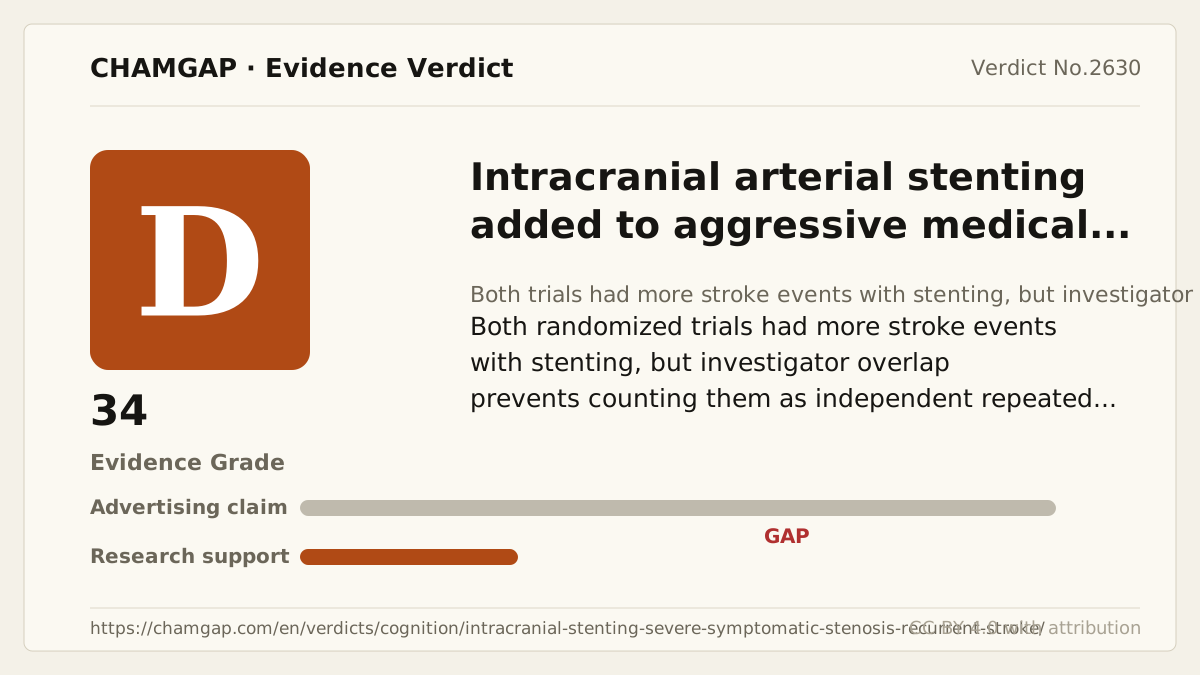
[Chamgap] Intracranial stenting x fewer recurrent strokes in severe symptomatic stenosis — Evidence Grade D·34. 4 cited sources checked. Source: https://chamgap.com/en/verdicts/cognition/intracranial-stenting-severe-symptomatic-stenosis-recurrent-stroke/ · CC BY 4.0CC BY 4.0 — free to use with attribution; do not distort grades, numbers, or verdict meaning.
What this document does and does not do
Chamgap is an information source. It reports what research has and has not confirmed; it does not tell readers what to take or buy. That decision belongs to readers and, when needed, medical or legal professionals. This verdict reflects literature available up to the search date and may change as new research appears. Nothing here is medical advice.