
Interferon beta-1a,
does it really help with Prevention of clinical relapses and disability progression in relapsing-remitting multiple sclerosis?
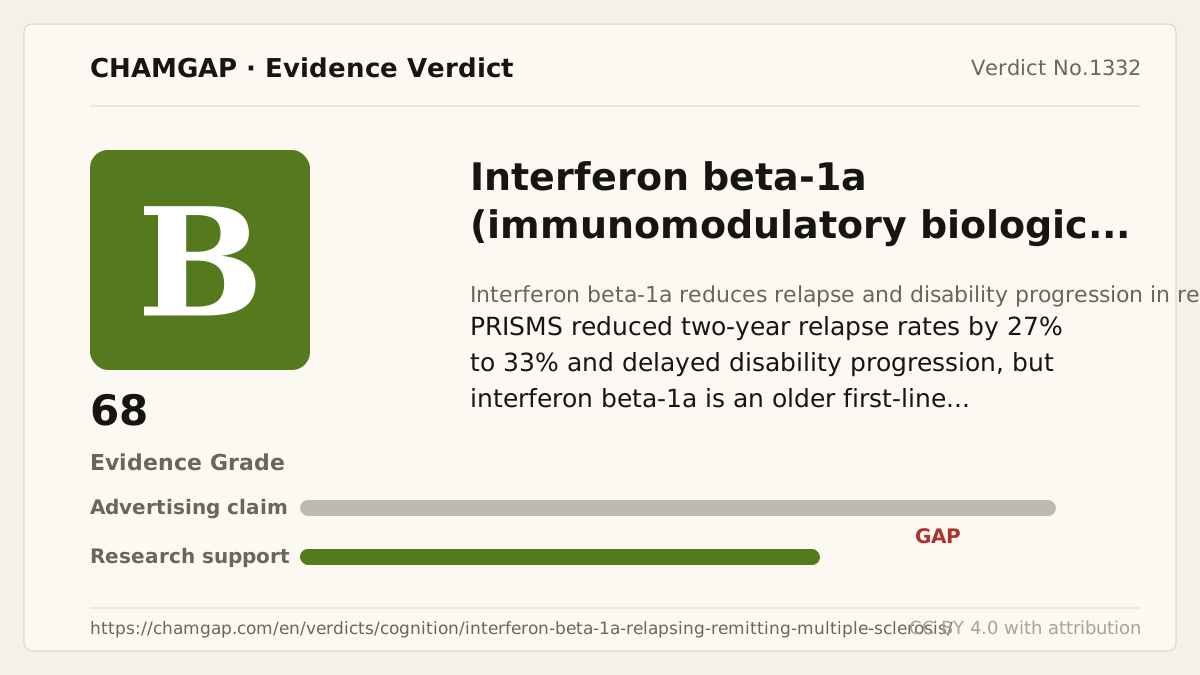
research showsPRISMS reduced two-year relapse rates by 27% to 33% and delayed disability progression, but interferon beta-1a is an older first-line agent and was inferior to ocrelizumab in OPERA, yielding B with 68 points. The reductions in clinical relapse and disability progression versus placebo are genuine. This component must be distinguished from ocrelizumab in verdict 1233; comparative inferiority in OPERA and the burden of repeated injections place it below newer high-efficacy agents.
ads claimMarketing can expand relapse reduction into disease arrest or permanent prevention of disability. It is an older disease-modifying therapy that lowers relapse and short-term confirmed disability-progression risk; individual disease activity and comparative efficacy of newer agents also matter.
Useful facts when choosing a product
- Rebif is a subcutaneous product generally administered three times weekly; titration and self-injection training follow the prescription.
- Flu-like symptoms and injection-site reactions are common; analgesic or antipyretic use and rotation of injection sites may help.
- Liver injury, elevated liver enzymes, and cytopenias require blood testing before and during treatment.
- Depression and suicidal thoughts can worsen, so mood changes should be reported promptly to a clinician.
Chamgap Semantic Classification Code
Candidate index · review held
M.interferon-beta-1a.UNK.clinical-relapses-and-disability-progression-in-relapsing-remitting-multiple-sclerosis.prevent.MULTIMedicinal interventions > Interferon beta-1a > Unknown > clinical relapses and disability progression in relapsing-remitting multiple sclerosis > Occurrence-prevention claim > Multiple: primary unresolved
An automated migration candidate, not an issued permanent code; exact claim scope remains under review. This machine-generated migration candidate helps retrieval but is not a permanent assignment. The original verdict ID and URL remain authoritative.
What the research actually shows
PRISMS randomized 560 patients with relapsing-remitting multiple sclerosis to Rebif 22 micrograms, 44 micrograms, or placebo. Over two years, mean relapse counts were 1.82 and 1.73 versus 2.56 with placebo, reductions of 27% and 33%; time to first relapse increased, and disability progression and MRI disease burden also decreased. In the modern active-controlled OPERA I and II trials, however, ocrelizumab reduced 96-week relapse activity and disability progression more than interferon beta-1a. PRISMS therefore establishes placebo-controlled efficacy but not equivalence to current high-efficacy therapy.
Why this is classified as B (68)
The placebo-controlled PRISMS trial establishes component-specific clinical benefits for relapse and disability progression. Because this older agent was inferior to ocrelizumab in active-controlled OPERA, it receives B with 68 points.
Counterpoint. The reductions in clinical relapse and disability progression versus placebo are genuine. This component must be distinguished from ocrelizumab in verdict 1233; comparative inferiority in OPERA and the burden of repeated injections place it below newer high-efficacy agents.
Rejudgment record. Cross-check applied — Rated B by accepting placebo-controlled clinical efficacy in PRISMS while accounting for inferiority to a modern active comparator in OPERA and its status as an older first-line agent
Sub-claim grades by effect
This ingredient is marketed for several effects. A single overall grade blends strong and weak claims together, so each effect is graded separately here. The overall grade reflects the strongest disconfirming or core claim.
| Effect (sub-claim) | Grade | Basis |
|---|---|---|
| Reduction in clinical relapses | B | PRISMS reduced two-year relapse rates by 27% and 33% according to dose. |
| Delay of confirmed disability progression | B | PRISMS significantly delayed disability progression, although the effect is smaller than with modern agents. |
| Reduction in MRI disease activity | B | Active lesion counts and disease burden decreased versus placebo, but these are surrogate outcomes. |
Cross-check — AI research and Codex final gate
Evidence Table
| Study | Design | Sample | Funding | Endpoint | Result | Weight |
|---|---|---|---|---|---|---|
| PRISMS Study Group. 1998 | Randomized double-blind placebo-controlled trial | 560 randomized; 533 with two-year clinical data | Supported by Ares-Serono | Two-year relapse rate, disability progression, and MRI | Relapses decreased by 27% to 33%, disability progression was delayed, and MRI burden decreased. | Key placebo-controlled clinical-efficacy trial |
| Hauser SL et al.; OPERA (Hauser SL et al.). 2017 | Two identically designed phase 3 randomized double-blind double-dummy active-controlled trials | 821 and 835 patients | Supported by F. Hoffmann-La Roche | Annualized relapse rate and 12-week confirmed disability progression | Ocrelizumab reduced relapse activity and disability progression more than interferon beta-1a. | Key modern comparative-inferiority evidence |
Receipt — 3 References
All 3 cited sources were verified for existence at the original page (as of 2026-07-23).
Final verification and publication gate: Codex · Evidence date: 2026-07-23 · Corrections: none
Cite this verdict
[Chamgap] Interferon beta-1a x prevention of clinical relapses and disability progression in relapsing-remitting multiple sclerosis — Evidence Grade B·68. 3 cited sources checked. Source: https://chamgap.com/en/verdicts/cognition/interferon-beta-1a-relapsing-remitting-multiple-sclerosis/ · CC BY 4.0CC BY 4.0 — free to use with attribution; do not distort grades, numbers, or verdict meaning.
What this document does and does not do
Chamgap is an information source. It reports what research has and has not confirmed; it does not tell readers what to take or buy. That decision belongs to readers and, when needed, medical or legal professionals. This verdict reflects literature available up to the search date and may change as new research appears. Nothing here is medical advice.