
Inebilizumab,
does it really help with Reduced independently adjudicated NMOSD relapse?
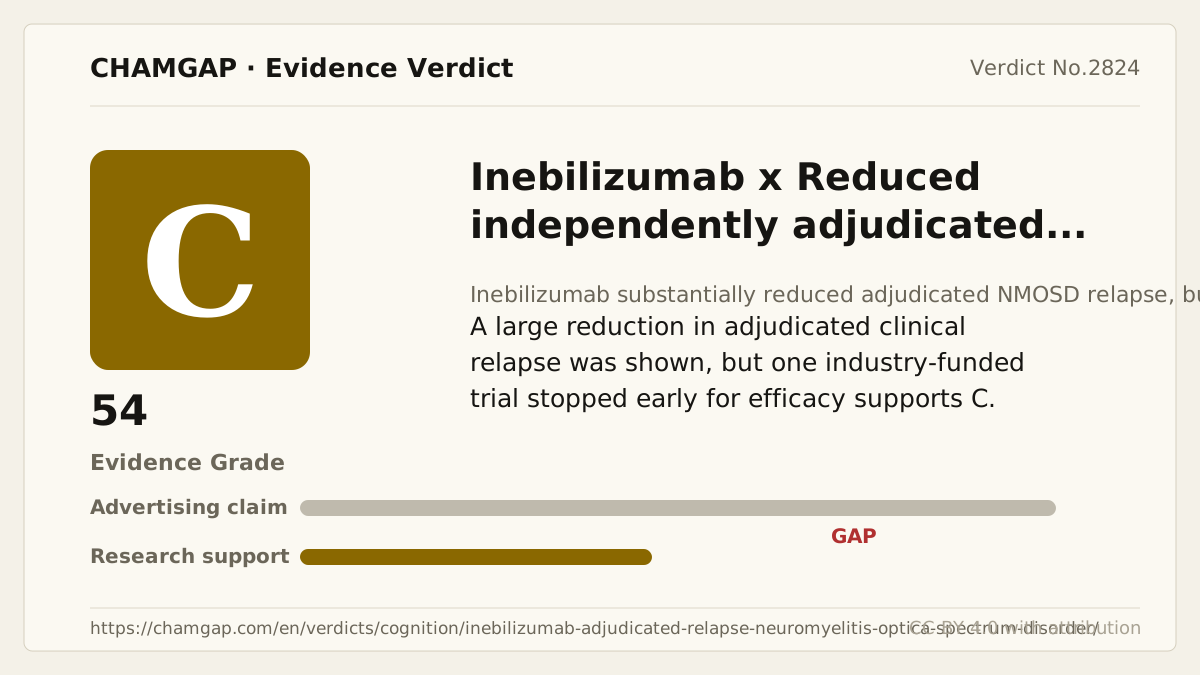
research showsThe grade is C with 54 points. During the randomized period, independently adjudicated attacks occurred in 21/174 (12%) versus 22/56 (39%), absolute difference about -27 points, HR 0.272 (95% CI 0.150-0.496).
ads claimKorean NMOSD patient advocacy and reimbursement discussions make relapse prevention, infection risk, and cost jointly relevant. Current reimbursement eligibility and prior-treatment rules require separate date-specific verification.
Useful facts when choosing a product
- The randomized period lasted up to 197 days.
- Attack adjudication was separated from rescue-treatment decisions.
- Only 17 participants were AQP4-IgG negative.
Chamgap Semantic Classification Code
Candidate index · review held
UNK.inebilizumab.UNK.independently-adjudicated-nmosd-relapse.reduce.placeboUnknown > Inebilizumab > Unknown > independently adjudicated NMOSD relapse > Reduction claim > Placebo
An automated migration candidate, not an issued permanent code; exact claim scope remains under review. This machine-generated migration candidate helps retrieval but is not a permanent assignment. The original verdict ID and URL remain authoritative.
What the research actually shows
N-MOmentum was a 3:1 double-blind placebo-controlled trial; participants, investigators, and clinical staff were masked and placebo appearance matched. Limitation name: early efficacy-boundary stop. Avoidability: possible - continuing to the planned 67 attacks or 252 treated participants could have improved effect and rare-harm precision. This was a true efficacy stop at about 43 attacks and 231 participants, not recruitment failure. Limitation name: tiny AQP4-negative subgroup in a rare disease. Avoidability: impossible - NMOSD and especially eligible seronegative disease have a very small recruitment pool. This is a precision/applicability limit, not a counted axis-6 defect. MedImmune/Viela Bio sponsored the trial and company authors participated, so I0 applies.
Why this is classified as C (54)
Masked placebo control and a hard adjudicated event help, but sponsor control and an early efficacy stop give C.
Counterpoint. Early stopping may inflate the estimated benefit, and seronegative efficacy remains unknown.
Rejudgment record. Cross-check applied — Cross-checked Lancet report, registry, and methods reports for adjudication, event definition, early stopping, event counts, and MedImmune/Viela role
| Endpoint | H | Hard endpoint - actual events such as death |
| Replication | R1 | Single confirmatory trial |
| Independence | I0 | Evidence comes only from manufacturer studies |
| Effect size | E+ | Meets the clinically important threshold |
Stored derived and displayed grades match; this is not a current recalculation or validity check (C).
Sub-claim grades by effect
This ingredient is marketed for several effects. A single overall grade blends strong and weak claims together, so each effect is graded separately here. The overall grade reflects the strongest disconfirming or core claim.
| Effect (sub-claim) | Grade | Basis |
|---|---|---|
| Reduced adjudicated NMOSD relapse | C | The absolute difference was about -27 points. |
| Efficacy in AQP4-IgG-negative disease | ? | Only 17 participants precluded interpretation. |
Cross-check — AI research and Codex final gate
Evidence Table
| Study | Design | Sample | Funding | Endpoint | Result | Weight |
|---|---|---|---|---|---|---|
| Cree BAC et al. 2019 N-MOmentum | Double-blind placebo-controlled 3:1 randomized trial with independent adjudication | 230 treated; inebilizumab 174, placebo 56 | Sponsored by MedImmune/Viela Bio; company-employed authors included | Time to first NMOSD attack confirmed by an independent adjudication committee | 21/174 (12%) versus 22/56 (39%); absolute about -27 points; HR 0.272 (95% CI 0.150-0.496) | Single sponsor-run rare-disease hard-event trial stopped early for efficacy |
Receipt — 1 References
All 1 cited sources were verified for existence at the original page (as of 2026-08-18).
Final verification and publication gate: Codex · Evidence date: 2026-08-18 · Corrections: none
Cite this verdict
[Chamgap] Inebilizumab for Adjudicated Relapse in Neuromyelitis Optica Spectrum Disorder - Benefit — Evidence Grade C·54. 1 cited sources checked. Source: https://chamgap.com/en/verdicts/cognition/inebilizumab-adjudicated-relapse-neuromyelitis-optica-spectrum-disorder/ · CC BY 4.0CC BY 4.0 — free to use with attribution; do not distort grades, numbers, or verdict meaning.
What this document does and does not do
Chamgap is an information source. It reports what research has and has not confirmed; it does not tell readers what to take or buy. That decision belongs to readers and, when needed, medical or legal professionals. This verdict reflects literature available up to the search date and may change as new research appears. Nothing here is medical advice.