
Hyperbaric oxygen therapy,
does it really help with Improvement of headache, cognitive, and emotional symptoms in persistent postconcussion syndrome?
research showsHyperbaric oxygen therapy is rated D for persistent postconcussion symptoms. In the 72-service-member HOPPS trial, clinically meaningful RPQ-3 response was 52% with hyperbaric oxygen, 33% with low-pressure air sham, and 25% with no chamber, but the overall comparison failed at P=0.24. Total RPQ also did not differ between hyperbaric oxygen and sham, P=0.70. Sham-controlled military trials with 60 and 50 participants likewise found no between-group benefit. A 2025 community trial randomized 49 participants but analyzed the primary NSI outcome in 41 and was positive, with a change difference of 7.0 points (95% CI 1.7 to 12.3), creating inconsistency. The R0, E0, C0, and B2 profile gives D with 30 points.
ads claimMarketing may expand the physical fact of breathing oxygen in a pressurized chamber into repair of an injured brain and treatment of persistent symptoms. Symptoms repeatedly improved with sham as well, and a specific oxygen effect has not been separated consistently.
Useful facts when choosing a product
- The HOPPS sham consisted of 40 sessions of room air pressurized to 1.2 ATA, and both the hyperbaric oxygen and sham groups improved on total RPQ.
- The pivotal null trials primarily enrolled active-duty service members with combat-related mild traumatic brain injury, limiting generalization to civilian concussion populations.
- verdict 1249, which is D with 20 points, concerns the same intervention for anti-aging surrogate markers in healthy older adults, a different indication. Its evidence was not transferred to postconcussion syndrome.
Chamgap Semantic Classification Code
Candidate index · review held
P.hyperbaric-oxygen-therapy.procedural.headache-cognitive-and-emotional-symptoms-in-persistent-postconcussion-syndrome.improve.shamProcedures, devices and tests > Hyperbaric oxygen therapy > Procedural > headache, cognitive, and emotional symptoms in persistent postconcussion syndrome > Improvement claim > Sham procedure or device
An automated migration candidate, not an issued permanent code; exact claim scope remains under review. This machine-generated migration candidate helps retrieval but is not a permanent assignment. The original verdict ID and URL remain authoritative.
What the research actually shows
Miller and colleagues assigned 72 active-duty service members with symptoms lasting at least four months to no chamber, 1.5-ATA hyperbaric oxygen, or a 1.2-ATA air sham, with 23, 24, and 25 participants, and analyzed all 72 by intention to treat. RPQ-3 response of at least two points was 25%, 52%, and 33%, but the primary endpoint failed at P=0.24 and total RPQ did not differ between hyperbaric oxygen and sham, P=0.70. The 60-person Cifu military trial and 50-person Wolf military trial also found no sham difference. Weaver's 2025 community trial randomized 49, retained 47 eligible participants, and analyzed the primary 13-week NSI outcome in 41; it found a positive 7.0-point difference, but the cohort was small and etiologically mixed.
Why this is classified as D (30)
Military sham trials found E0 on patient-reported symptoms, but a small positive 2025 trial makes replication R0. Small and short studies produce B2, and no pooled confidence interval excludes meaningful benefit, giving C0 and D with 30 points.
Counterpoint. Benefit may remain possible for selected community patients with brain injury, but one heterogeneous trial with 41 primary-outcome observations cannot overturn several rigorous sham-controlled null trials.
Rejudgment record. Cross-check applied — Recorded inconsistency between several null military sham trials and a small positive 2025 mixed-brain-injury trial as R0, then applied D for small, short, imprecise evidence
| Endpoint | P | Symptom or function itself is the target - including patient reports and performance tests |
| Replication | R0 | Trials conflict in direction |
| Independence | I2 | Decisive evidence is publicly or non-profit funded |
| Effect size | E0 | Null |
| Precision | C0 | The confidence interval leaves room for benefit |
Stored derived and displayed grades match; this is not a current recalculation or validity check (D).
Sub-claim grades by effect
This ingredient is marketed for several effects. A single overall grade blends strong and weak claims together, so each effect is graded separately here. The overall grade reflects the strongest disconfirming or core claim.
| Effect (sub-claim) | Grade | Basis |
|---|---|---|
| Improvement of persistent postconcussion RPQ symptoms in service members | D | HOPPS and another military trial failed their primary sham comparisons. |
| Improvement of persistent brain-injury symptoms on NSI | C | A 2025 trial with 41 primary-outcome observations in mixed brain injuries was positive but remains small exploratory evidence. |
| Consistent improvement across cognitive, emotional, and headache domains | D | Improvement in sham groups and conflicting trial results prevent a consistent conclusion. |
Cross-check — AI research and Codex final gate
Evidence Table
| Study | Design | Sample | Funding | Endpoint | Result | Weight |
|---|---|---|---|---|---|---|
| Miller RS et al. 2015 HOPPS | Multicenter randomized double-blind sham- and no-chamber-controlled trial | 72 randomized (23/24/25); actual primary intention-to-treat analysis 72 | Public funding from the United States Defense Health Program; managed by a United States Army research organization | At least two-point RPQ-3 response and total RPQ change | Response 25%, 52%, and 33%, overall P=0.24; total RPQ hyperbaric oxygen versus sham P=0.70, so the primary endpoint failed. | Most rigorous pivotal sham-controlled evidence |
| Cifu DX et al. 2014 | Single-center randomized double-blind three-group sham-controlled trial | 60 service members randomized; three-group analysis of 60 | United States government non-PHS research support | Between-group change in RPQ and PCL-M | Neither 1.5- nor 2.0-ATA-equivalent hyperbaric oxygen differed from sham; the primary analysis was null. | Independent sham-controlled null replication |
| Weaver LK et al. 2025 HYBOBI2 | Randomized double-blind sham-controlled phase 2 exploratory trial | 49 randomized; final eligible sample 47, actual 13-week primary NSI analysis 41 | Support from the Intermountain Research and Medical Foundation; Sechrist Industries loaned chambers, and no competing interests were reported | Change in NSI at 13 weeks | Change was 10.6 versus 3.6 points, difference 7.0 (95% CI 1.7 to 12.3), P=0.01; primary endpoint met. | Recent positive but small and etiologically mixed evidence creating inconsistency |
Receipt — 3 References
All 3 cited sources were verified for existence at the original page (as of 2026-07-24).
Final verification and publication gate: Codex · Evidence date: 2026-07-24 · Corrections: none
Cite this verdict
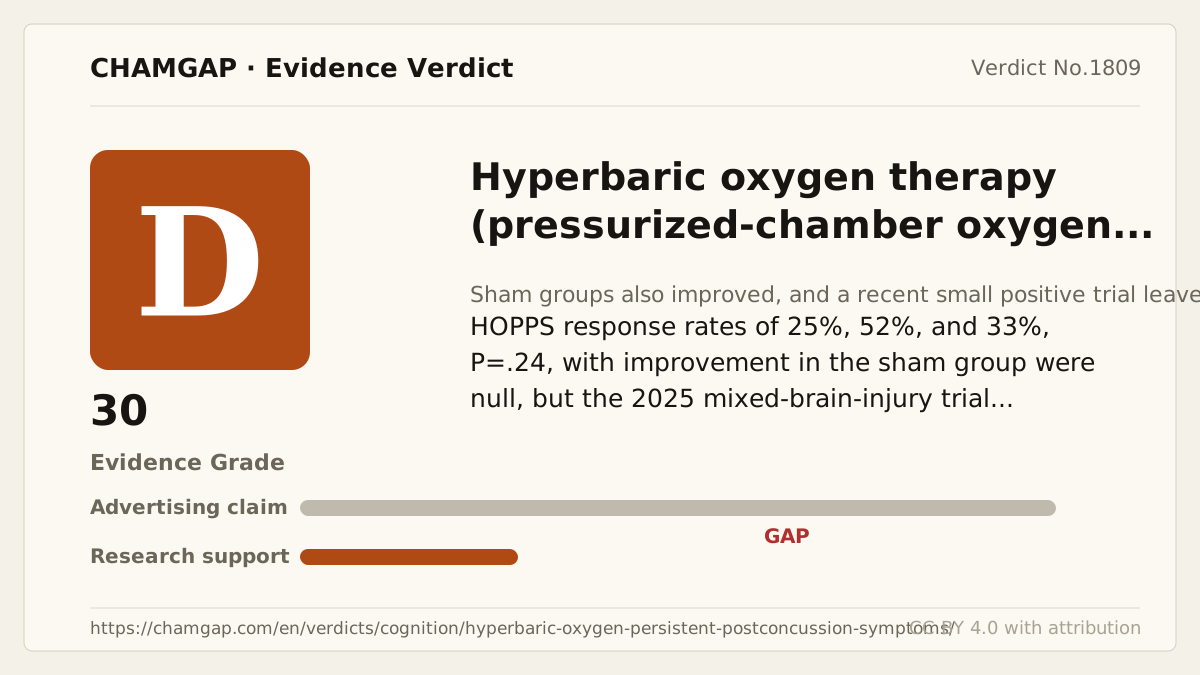
[Chamgap] Hyperbaric oxygen therapy x improvement of persistent postconcussion symptoms — Evidence Grade D·30. 3 cited sources checked. Source: https://chamgap.com/en/verdicts/cognition/hyperbaric-oxygen-persistent-postconcussion-symptoms/ · CC BY 4.0CC BY 4.0 — free to use with attribution; do not distort grades, numbers, or verdict meaning.
What this document does and does not do
Chamgap is an information source. It reports what research has and has not confirmed; it does not tell readers what to take or buy. That decision belongs to readers and, when needed, medical or legal professionals. This verdict reflects literature available up to the search date and may change as new research appears. Nothing here is medical advice.