
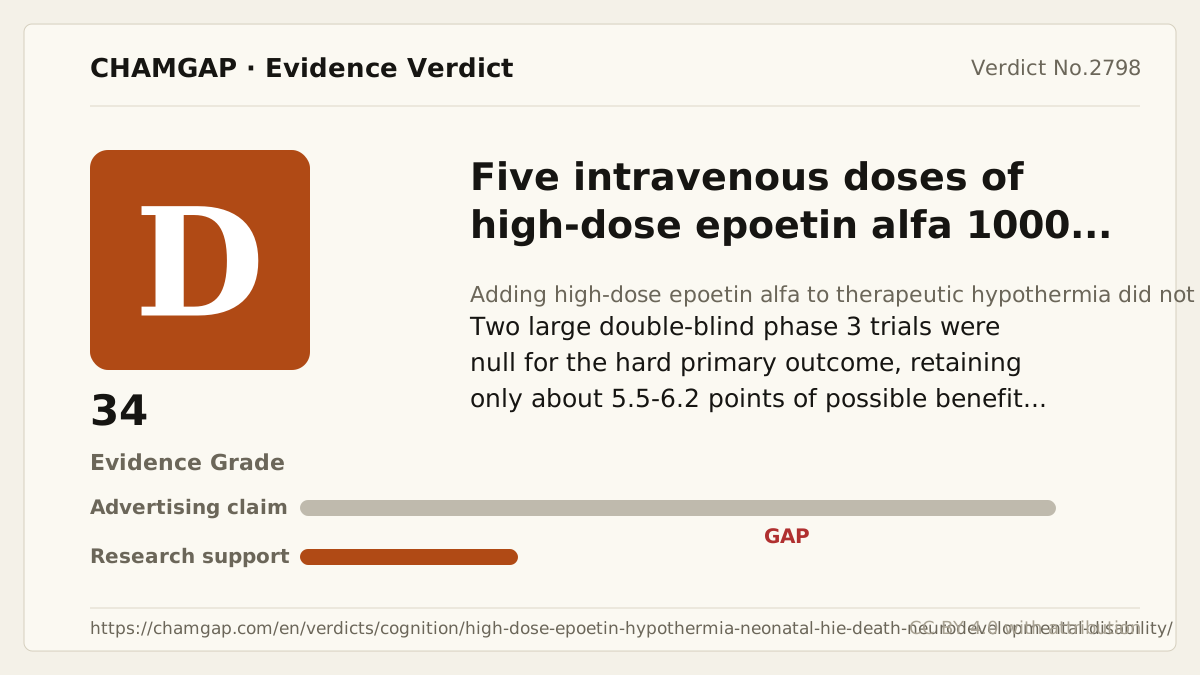
Five intravenous doses of high-dose epoetin alfa 1000 IU/kg added to therapeutic hypothermia,
does it really help with Reduced death or neurodevelopmental disability in moderate or severe neonatal hypoxic-ischemic encephalopathy?
research showsThe grade is D. In PAEAN, death or moderate-to-severe developmental disability at age 2 occurred in 47/138 infants (34.1%) with epoetin alfa and 41/143 (28.7%) with placebo: RR 1.19 (95% CI 0.84-1.68), absolute difference +5.4 points (calculated 95% CI -5.5 to +16.2), P=.33. The benefit tail retained at most 5.5 points. HEAL was also null: 52.5% versus 49.5%, RR 1.03 (95% CI 0.86-1.24), absolute difference +3.0 points (calculated 95% CI -6.2 to +12.1), P=.74.
ads claimTwo phase 3 trials did not support the claim that five high doses of epoetin alfa added to therapeutic hypothermia reduce death or neurodevelopmental disability in neonatal HIE. This should not be confused with the authorized use of Korean epoetin products for renal anemia.
Useful facts when choosing a product
- Korean drug listings show multiple recombinant human erythropoietin prescription injections, including Espogen, Eporon, and Epokine, with prices and supply status.
- Their Korean indications include anemia in chronic renal failure; neonatal HIE neuroprotection is not an authorized indication.
- The Korean Child Neurology Society provides HIE education, and Korean perinatal research has investigated erythropoietin as a candidate neuroprotectant in neonatal hypoxic-ischemic brain injury.
- Verdict 1534 is A with 85 points for therapeutic hypothermia itself. This verdict asks the separate question of adding epoetin alfa to that standard therapy.
Chamgap Semantic Classification Code
Candidate index · review held
M.five-intravenous-doses-of-high-dose-epoetin-alfa-added-to-therapeutic-hypothermia.intravenous.death-or-neurodevelopmental-disability-in-moderate-or-severe-neonatal-hypoxic-ischemic-encephalopathy.reduce.MULTIMedicinal interventions > Five intravenous doses of high-dose epoetin alfa added to therapeutic hypothermia > Intravenous > death or neurodevelopmental disability in moderate or severe neonatal hypoxic-ischemic encephalopathy > Reduction claim > Multiple: primary unresolved
An automated migration candidate, not an issued permanent code; exact claim scope remains under review. This machine-generated migration candidate helps retrieval but is not a permanent assignment. The original verdict ID and URL remain authoritative.
What the research actually shows
PAEAN randomized 313 infants across 24 neonatal intensive care units, while HEAL randomized 501 across 17 sites involving 23 hospitals; both were double-blind placebo-controlled phase 3 trials. PAEAN had public and nonprofit support, and HEAL was funded by the US NINDS. The trials used the same dose and question and had overlapping investigators and design collaboration, so they were treated as a coordinated sister program rather than independent replication, giving R1. Axis 6 has one avoidable defect: the motor and cognitive thresholds in PAEAN's primary-outcome definition differed across the 2016 protocol, ANZCTR record, and final SAP and article, without a reported timing, blinded status, or sensitivity analysis using the original definitions. Central randomization, identical vials, full blinding, intention-to-treat analysis, and missing-data sensitivity work were otherwise strong, but the outcome-definition change makes this B1 rather than B0.
Why this is classified as D (34)
Two large publicly supported double-blind trials were null for death or neurodevelopmental disability and excluded the declared 19-point clinical threshold, but retained roughly 6 points of possible benefit, giving D with 34 points.
Counterpoint. Null means that average benefit was not established. The intervals in PAEAN and HEAL still permit up to 5.5 and 6.2 points of absolute benefit, respectively.
Rejudgment record. Cross-check applied — Null hard primary outcomes in two large double-blind phase 3 trials, exclusion of a declared 19-point clinical threshold, and residual small benefit
| Endpoint | H | Hard endpoint - actual events such as death |
| Replication | R1 | Single confirmatory trial |
| Independence | I2 | Decisive evidence is publicly or non-profit funded |
| Effect size | E0 | Null |
| Precision | C1 | The confidence interval excludes meaningful benefit |
Stored derived and displayed grades match; this is not a current recalculation or validity check (D).
Sub-claim grades by effect
This ingredient is marketed for several effects. A single overall grade blends strong and weak claims together, so each effect is graded separately here. The overall grade reflects the strongest disconfirming or core claim.
| Effect (sub-claim) | Grade | Basis |
|---|---|---|
| Reduced death or neurodevelopmental disability with high-dose epoetin alfa added to therapeutic hypothermia | D | The primary outcomes in PAEAN and HEAL were both null, with absolute differences of +5.4 and +3.0 points. |
Cross-check — AI research and Codex final gate
Evidence Table
| Study | Design | Sample | Funding | Endpoint | Result | Weight |
|---|---|---|---|---|---|---|
| Liley HG et al. 2026 PAEAN | Double-blind placebo-controlled phase 3 randomized trial across 24 neonatal intensive care units | 313 randomized, primary outcome available for 281 | Public and nonprofit support from the Australian NHMRC, Mater Research and Mater Foundation, Cerebral Palsy Alliance, and others | All-cause death or moderate-to-severe motor or cognitive developmental disability at age 2 | 47/138 (34.1%) versus 41/143 (28.7%), RR 1.19 (95% CI 0.84-1.68), absolute difference +5.4 points (calculated 95% CI -5.5 to +16.2), P=.33 | Latest pivotal large hard-outcome evidence |
| Wu YW et al. 2022 HEAL | Multicenter double-blind placebo-controlled phase 3 randomized trial | 501 randomized, 500 in the modified intention-to-treat population | US National Institute of Neurological Disorders and Stroke | Death or neurodevelopmental impairment of any severity at 22-36 months | 126/240 (52.5%) versus 110/222 (49.5%), RR 1.03 (95% CI 0.86-1.24), absolute difference +3.0 points (calculated 95% CI -6.2 to +12.1), P=.74 | Coordinated sister phase 3 evidence addressing the same question |
Receipt — 4 References
All 4 cited sources were verified for existence at the original page (as of 2026-08-18).
Final verification and publication gate: Codex · Evidence date: 2026-08-18 · Corrections: none
Cite this verdict
[Chamgap] No Benefit of Adjunctive High-Dose Epoetin Alfa for Death or Neurodevelopmental Disability in Neonatal HIE — Evidence Grade D·34. 4 cited sources checked. Source: https://chamgap.com/en/verdicts/cognition/high-dose-epoetin-hypothermia-neonatal-hie-death-neurodevelopmental-disability/ · CC BY 4.0CC BY 4.0 — free to use with attribution; do not distort grades, numbers, or verdict meaning.
What this document does and does not do
Chamgap is an information source. It reports what research has and has not confirmed; it does not tell readers what to take or buy. That decision belongs to readers and, when needed, medical or legal professionals. This verdict reflects literature available up to the search date and may change as new research appears. Nothing here is medical advice.