
High-dose biotin,
does it really help with Reversal of walking impairment and disability in progressive multiple sclerosis?
research showsIn the 642-participant SPI2 trial, disability improvement was 12% versus 9%, OR 1.35 (95% CI 0.81 to 2.26), leaving room for large benefit. The earlier 154-participant trial was positive at 12.6% versus 0%, so this is not repeated refutation. Because clinically meaningful benefit is not excluded, the grade is D with 30 points, not F.
ads claimQuoting only the early 12.6% disability-reversal figure omits the failed confirmatory phase 3 trial. The claim that a vitamin reverses walking disability was not reproduced in the larger trial.
Useful facts when choosing a product
- The MD1003 trial regimen used 100 mg of biotin three times daily, totaling 300 mg per day, which is vastly higher than ordinary nutritional intake.
- SPI2 randomized 642 people with progressive multiple sclerosis to biotin in 326 participants and placebo in 316.
- High-dose biotin can interfere with streptavidin-biotin immunoassays, making thyroid and other results falsely high or low and making some troponin results falsely low.
- Patients must tell clinicians and laboratories about use; a falsely low troponin result during chest-pain evaluation can delay recognition of myocardial infarction.
Chamgap Semantic Classification Code
Candidate index · review held
S.biotin.oral.reversal-of-walking-impairment-and-disability-in-progressive-multiple-sclerosis.assess.placeboSupplements and nutraceuticals > Biotin > Oral > Reversal of walking impairment and disability in progressive multiple sclerosis > Association or change assessment > Placebo
An automated migration candidate, not an issued permanent code; exact claim scope remains under review. This machine-generated migration candidate helps retrieval but is not a permanent assignment. The original verdict ID and URL remain authoritative.
What the research actually shows
The early evidence was a peer-reviewed 2016 randomized double-blind original article in Multiple Sclerosis Journal. Its actual 154-person intention-to-treat analysis succeeded on disability improvement at month 9 confirmed at month 12: 13 of 103 participants, or 12.6%, versus 0 of 51, p=0.005. The confirmatory evidence was a peer-reviewed 2020 international phase 3 SPI2 original article in The Lancet Neurology. The actual randomized and primary analysis sample was 642 participants, 326 assigned biotin and 316 placebo. The composite primary endpoint of EDSS or timed 25-foot-walk improvement at month 12 confirmed at month 15 failed: 39 participants, or 12%, versus 29, or 9%, odds ratio 1.35, p=0.31. Key secondary endpoints were also null, and the authors concluded that efficacy and laboratory-interference harms precluded recommendation.
Why this is classified as D (30)
In the 642-participant SPI2 trial, disability improvement was 12% versus 9%, OR 1.35 (95% CI 0.81 to 2.26), leaving room for large benefit. The earlier 154-participant trial was positive at 12.6% versus 0%, so this is not repeated refutation. Because clinically meaningful benefit is not excluded, the grade is D with 30 points, not F.
Counterpoint. Treatment of true biotin deficiency is entirely different from using ultra-high-dose MD1003 for progressive multiple sclerosis and is not rejected by this verdict. Grade-independent note: the FDA assay-interference warning and specialist-center nonrecommendation are recorded, and assay interference is a separate safety issue. Regulatory action, recommendations, and safety are not used to determine the efficacy grade.
Rejudgment record. New verdict — In the 642-participant SPI2 trial, disability improvement was 12% versus 9%, OR 1.35 (95% CI 0.81 to 2.26), leaving room for large benefit. The earlier 154-participant trial was positive at 12.6% versus 0%, so this is not repeated refutation. Because clinically meaningful benefit is not excluded, the grade is D with 30 points, not F.
Sub-claim grades by effect
This ingredient is marketed for several effects. A single overall grade blends strong and weak claims together, so each effect is graded separately here. The overall grade reflects the strongest disconfirming or core claim.
| Effect (sub-claim) | Grade | Basis |
|---|---|---|
| Reversal of disability in progressive multiple sclerosis | D | The 642-person confirmatory phase 3 trial did not reproduce the early positive result. |
| Improved walking in progressive multiple sclerosis | D | The composite primary endpoint including the timed 25-foot walk and key secondary outcomes failed. |
| Consistent long-term neurological functional recovery | D | The confirmatory trial overturned the early signal, leaving no consistent recovery evidence. |
Cross-check — AI research and Codex final gate
Evidence Table
| Study | Design | Sample | Funding | Endpoint | Result | Weight |
|---|---|---|---|---|---|---|
| Cree BAC et al.; SPI2 investigative teams. 2020 | Peer-reviewed international multicenter phase 3 randomized double-blind placebo-controlled original article | 642 actually randomized and analyzed; 326 MD1003 and 316 placebo | Supported by manufacturer MedDay Pharmaceuticals | Composite primary endpoint of EDSS or timed 25-foot-walk improvement at month 12 confirmed at month 15 | The primary endpoint failed at 39 participants (12%) versus 29 (9%), odds ratio 1.35, p=0.31; key secondary endpoints were also null. | Pivotal confirmatory phase 3 evidence overturning the early positive result |
| Tourbah A et al.; MS-SPI study group. 2016 | Peer-reviewed randomized double-blind placebo-controlled original article | Actual intention-to-treat sample of 154; 103 MD1003 and 51 placebo | MedDay Pharmaceuticals manufacturer development trial | Primary disability reversal at month 9 confirmed at month 12 | The endpoint succeeded at 13 of 103 (12.6%) versus 0 of 51, p=0.005, but was not reproduced in the confirmatory phase 3 trial. | Early positive signal |
| U.S. FDA biotin interference safety communication | Regulatory safety communication and diagnostic-device surveillance | No trial sample; based on adverse-event reports and assay surveillance | United States Food and Drug Administration | Erroneous results from biotin interference, especially falsely low troponin | The FDA warned about biotin interference in some troponin assays and continuing adverse-event reports. | Key safety evidence |
Receipt — 4 References
All 4 cited sources were verified for existence at the original page (as of 2026-07-24).
Final verification and publication gate: Codex · Evidence date: 2026-07-24 · Corrections: none
Cite this verdict
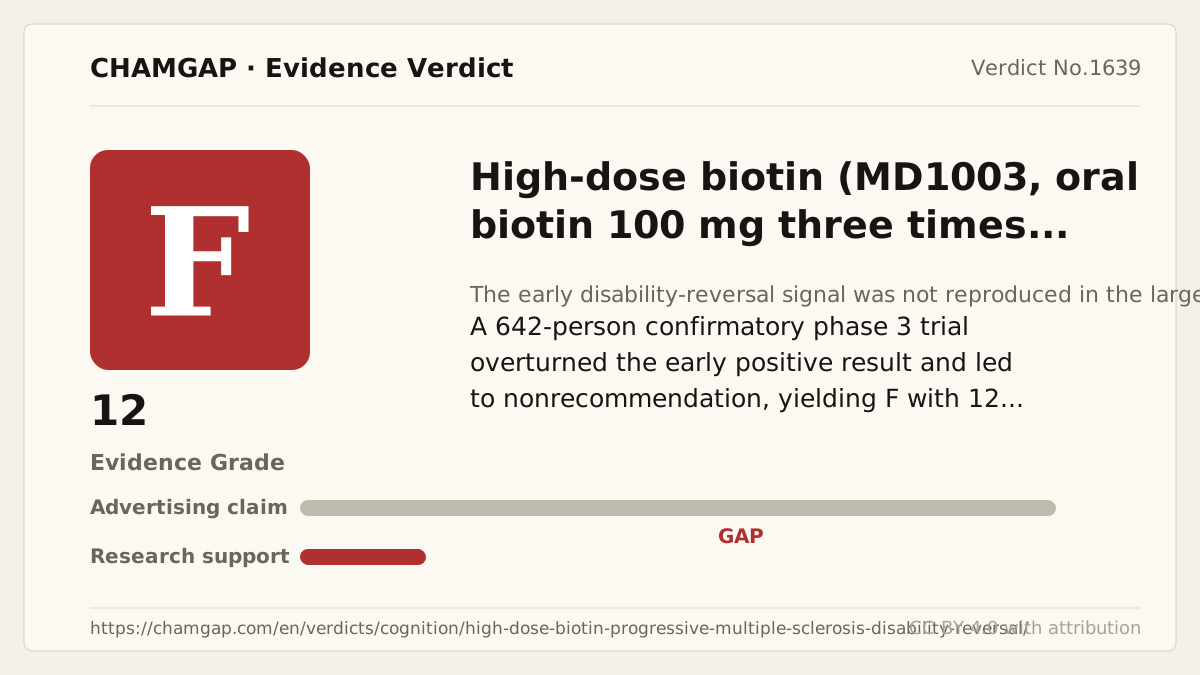
[Chamgap] High-dose biotin x reversal of walking impairment and disability in progressive multiple sclerosis — Evidence Grade D·30. 4 cited sources checked. Source: https://chamgap.com/en/verdicts/cognition/high-dose-biotin-progressive-multiple-sclerosis-disability-reversal/ · CC BY 4.0CC BY 4.0 — free to use with attribution; do not distort grades, numbers, or verdict meaning.
What this document does and does not do
Chamgap is an information source. It reports what research has and has not confirmed; it does not tell readers what to take or buy. That decision belongs to readers and, when needed, medical or legal professionals. This verdict reflects literature available up to the search date and may change as new research appears. Nothing here is medical advice.