
Hearing aids,
does it really help with Improved conversational listening and hearing-related quality of life in adults with mild to moderate hearing loss?
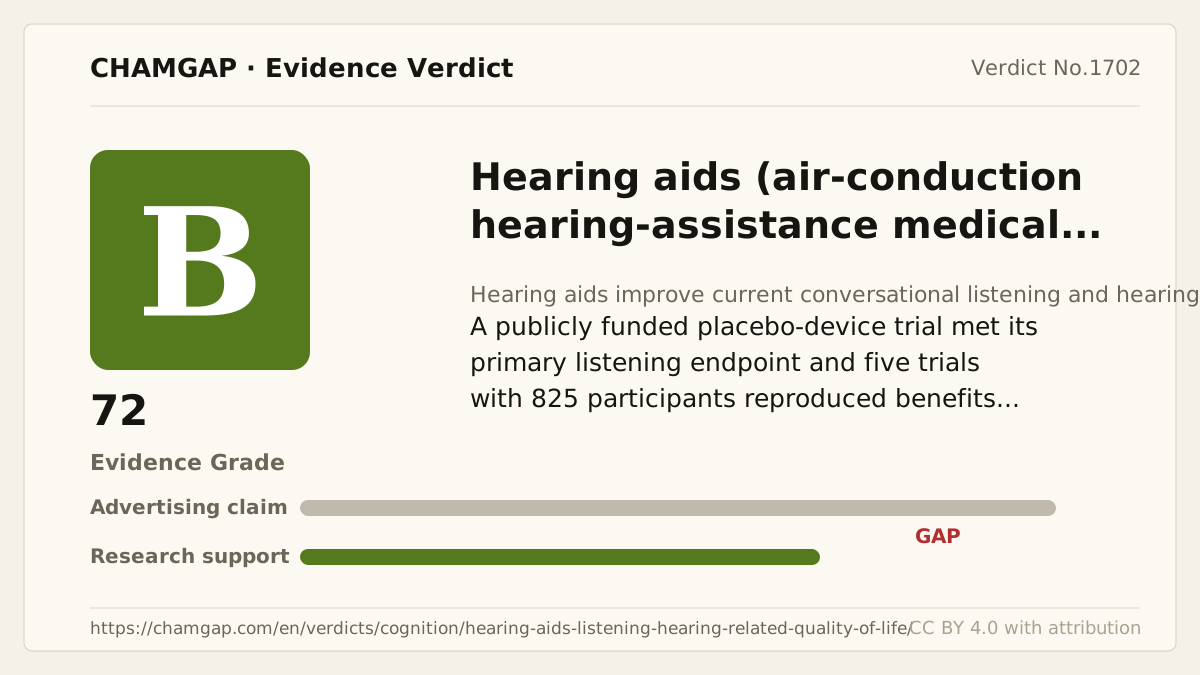
research showsHearing aids are rated B because they improve current conversational listening and hearing-related quality of life in adults with mild to moderate hearing loss. Humes 2017 randomized 163 participants and included 154 in the actual primary analysis; at six weeks, both audiology-fitted and self-selected hearing aids were significantly superior to placebo devices on the primary PHABglobal endpoint. A Cochrane review synthesized five randomized trials with 825 participants and found moderate-certainty improvements in hearing-specific quality of life, general quality of life, and listening ability. These patient-reported listening and participation outcomes are treatment goals themselves, not surrogate markers. The evidence is concentrated in older adults over six weeks to six months, however, with limitations in masking and no established long-term persistence, so the grade does not reach A. This efficacy axis differs from cognitive-decline and dementia prevention in verdict 1568, which is D with 34 points; null cognitive findings were not repurposed as evidence about current listening function.
ads claimMarketing may imply that hearing aids instantly make every sound natural, restore normal hearing in all noisy settings, or prevent cognitive decline. The evidence directly supports current listening, communicative participation, and hearing-related quality of life in adults with mild to moderate hearing loss; individualized fitting, adaptation, and counseling influence outcomes.
Useful facts when choosing a product
- Hearing aids are medical devices that amplify and process environmental sounds and speech. Selection should follow hearing assessment and evaluation for treatable ear disease, with the device matched to the hearing pattern and listening needs.
- Professional fitting and appropriate gain adjustment can help. A validated self-selection pathway was also effective, but this does not mean that every inexpensive personal sound amplifier produces the same outcomes.
- Sound may initially seem unfamiliar or too loud, so gradual adaptation, adjustment of wearing time, refitting, and communication-strategy training may be needed.
- Hearing aids improve current listening and participation; they do not treat the cause of hearing loss, restore normal hearing, or have established efficacy for preventing dementia.
Chamgap Semantic Classification Code
Candidate index · review held
P.hearing-aids.device.conversational-listening-and-hearing-related-quality-of-life-with-mild-to-moderate-hearing-loss.improve.MULTIProcedures, devices and tests > Hearing aids > Device delivered > conversational listening and hearing-related quality of life with mild to moderate hearing loss > Improvement claim > Multiple: primary unresolved
An automated migration candidate, not an issued permanent code; exact claim scope remains under review. This machine-generated migration candidate helps retrieval but is not a permanent assignment. The original verdict ID and URL remain authoritative.
What the research actually shows
Humes and colleagues randomized 163 adults with mild to moderate hearing loss, and the actual per-protocol primary analysis included 154 people. The PHABglobal primary endpoint succeeded with F(2,148)=18.56 and P<.05. The Ferguson Cochrane review included five trials with 825 participants and found an HHIE mean difference of -26.47 points. This claim concerns listening function, communication, and hearing-related quality of life; it is distinct from the cognitive-decline and dementia-prevention claim in verdict 1568, which is D with 34 points.
Why this is classified as B (72)
The prespecified PHABglobal endpoint succeeded, and five Cochrane trials with 825 participants found an HHIE mean difference of -26.47 points. Follow-up lasted only six weeks to six months and masking of most participants and assessors was inadequate or impossible, supporting B with 72 points.
Counterpoint. Benefit varies with the degree and pattern of hearing loss, noise environment, device suitability, actual wearing time, and rehabilitation support. If benefit is disappointing, checking for wax or middle-ear disease and reassessing real-ear fitting, bilateral use, assistive devices, and communication strategies is more reasonable than simply abandoning the device.
Rejudgment record. Cross-check applied — Accepted the successful prespecified listening endpoint but lowered the score because follow-up across five Cochrane trials with 825 participants lasted only six weeks to six months and masking of most participants and assessors was inadequate or impossible.
Sub-claim grades by effect
This ingredient is marketed for several effects. A single overall grade blends strong and weak claims together, so each effect is graded separately here. The overall grade reflects the strongest disconfirming or core claim.
| Effect (sub-claim) | Grade | Basis |
|---|---|---|
| Improved conversational listening ability | B | The PHABglobal primary endpoint succeeded in the Humes trial, and listening ability improved across two Cochrane trials with 534 participants. |
| Improved hearing-related quality of life and everyday participation | B | Across three randomized trials with 722 participants, the HHIE improved by an MD of -26.47 points; this patient-reported outcome is itself a treatment goal. |
| Improved general health-related quality of life | C | Two trials with 568 participants found a small improvement of SMD -0.38, but follow-up was short and the effect was smaller than for hearing-specific outcomes. |
Cross-check — AI research and Codex final gate
Evidence Table
| Study | Design | Sample | Funding | Endpoint | Result | Weight |
|---|---|---|---|---|---|---|
| Humes LE et al. 2017 | Single-site randomized double-blind placebo-device-controlled three-arm clinical trial | 188 eligible; 163 randomized; actual per-protocol primary analysis of 154 participants (53 audiology best practices, 50 consumer-decides, and 51 placebo) | United States NIDCD public grant R01 DC011771; no GN ReSound funding, and investigators purchased the study devices | Prespecified six-week primary endpoint of self-reported conversational listening benefit on PHABglobal | Primary endpoint succeeded: group effect F(2,148)=18.56, P<.05; both audiology-fitted and self-selected hearing aids were significantly superior to placebo devices. | Key direct placebo-device-controlled efficacy trial |
| Ferguson MA et al. 2017 Cochrane review | Systematic review and meta-analysis of randomized trials | Five randomized trials with 825 participants; three trials with 722 participants for hearing-specific quality of life and two trials with 534 participants for listening ability | Public support from the United Kingdom NIHR Biomedical Research Unit Programme and Cochrane ENT infrastructure; not product-manufacturer funding | Review primary efficacy outcome of hearing-specific health-related quality of life; secondary efficacy outcomes of general quality of life and listening ability | HHIE MD -26.47 points (95% CI -42.16 to -10.77), general quality of life SMD -0.38 (95% CI -0.55 to -0.21), and listening ability SMD -1.88 (95% CI -3.24 to -0.52); all improved with moderate certainty. | Independent synthesis and replication across multiple trials |
Receipt — 2 References
All 2 cited sources were verified for existence at the original page (as of 2026-07-24).
Final verification and publication gate: Codex · Evidence date: 2026-07-24 · Corrections: none
Cite this verdict
[Chamgap] Hearing aids x improved conversational listening and hearing-related quality of life — Evidence Grade B·72. 2 cited sources checked. Source: https://chamgap.com/en/verdicts/cognition/hearing-aids-listening-hearing-related-quality-of-life/ · CC BY 4.0CC BY 4.0 — free to use with attribution; do not distort grades, numbers, or verdict meaning.
What this document does and does not do
Chamgap is an information source. It reports what research has and has not confirmed; it does not tell readers what to take or buy. That decision belongs to readers and, when needed, medical or legal professionals. This verdict reflects literature available up to the search date and may change as new research appears. Nothing here is medical advice.