
Green leafy vegetables,
does it really help with Slower cognitive decline and prevention of dementia?
research showsThe grade is D with 34 points. In a 960-person observational study, the annual cognitive-decline slope was 0.05 standardized units slower at a median 1.3 daily servings than at 0.09 servings, popularized as an 11-year age equivalent. In contrast, the 604-person, three-year randomized MIND-diet trial found a null between-group difference of 0.035 standardized units in cumulative change from baseline at year three (95% CI -0.022 to 0.092; P=0.23). The two figures use different time scales and cannot be compared directly. Because MIND was a multicomponent diet, it can neither establish nor fully exclude benefit from leafy greens alone, but its randomized test still limits a causal reading of the observational association; the grade remains D.
ads claimThe 11-years-younger phrase is a model-based conversion of group decline rates, not a dramatic change measured in an individual. Adjustment for health behavior, education, disease, and overall diet cannot remove residual confounding as randomization can.
Useful facts when choosing a product
- The Morris exposure grouped one-half cup cooked spinach, one-half cup cooked kale, collards, or greens, and one cup raw lettuce salad. It was not a single-vegetable estimate.
- The 11-year phrase was an equivalent-age calculation based on the ratio of longitudinal regression coefficients. It was not measured brain age or individual rejuvenation.
- The MIND criterion was at least six weekly servings of green leafy vegetables, while counseling effectively targeted 0.5 to 1 cup per day. Nuts, berries, legumes, whole grains, fish, poultry, olive oil, and restricted foods were changed simultaneously.
- Both groups received a roughly 250-kcal/day restriction target plus equally frequent intensive counseling and weight-loss support. The contrast was MIND food-group guidance versus general portion and calorie management.
- MIND scores began at 7.7 versus 7.8 and changed by +3.3 versus +0.7 at six months, a separation of about 2.6 points that was maintained thereafter.
- Three-year follow-up was missing for 26 MIND participants (8.6%) versus 14 controls (4.6%). Because of COVID-19, 44 participants, 24 MIND and 20 control, were assessed by telephone.
- Beyond NIA grant R01AG52583, industry groups and producers supplied mixed nuts, peanut butter, extra-virgin olive oil, and blueberries.
- For the cumulative change from baseline at year three, the benefit-side upper limit of 0.092 standardized units was below Cohen's conventional 0.2 small-effect benchmark. Morris 2018 reported a 0.05 annual decline-slope difference, so the two estimates cannot be compared directly.
- Dementia incidence was not a primary endpoint, so a dementia-prevention event effect was not directly measured.
- Green leafy vegetables are a modern nutritional category without a single matching classical materia-medica entry. No classical record is included.
- Verdict 1952 is D with 30 points for whole spinach soup and blood pressure; verdict 1953 is C with 54 points for whole lettuce and observational ER-negative breast-cancer incidence. Food and outcome combinations remain separate.
Chamgap Semantic Classification Code
Candidate index · review held
F.green-leafy-vegetables.food.slower-cognitive-decline-and-prevention-of-dementia.prevent.reference-exposureFoods and beverages > Green leafy vegetables > Food consumption > Slower cognitive decline and prevention of dementia > Occurrence-prevention claim > Reference exposure
An automated migration candidate, not an issued permanent code; exact claim scope remains under review. This machine-generated migration candidate helps retrieval but is not a permanent assignment. The original verdict ID and URL remain authoritative.
What the research actually shows
Morris 2018 was an observational study following 960 dementia-free adults aged 58 to 99 for a mean 4.7 years. Median green-leafy intake was 1.3 servings/day in the highest quintile and about 0.09 in the lowest; the annual decline-slope difference was 0.05 standardized units per year (P=0.0001). The investigators converted the ratio of regression coefficients to an age equivalent of about 11 years. Barnes 2023 randomized 604 cognitively unimpaired adults with family history of dementia, overweight, and suboptimal diets to the MIND diet, 301 participants, or control diet, 303 participants, for three years. Cumulative primary global-cognition change from baseline at year three was 0.205 versus 0.170, a between-group difference of 0.035 (95% CI -0.022 to 0.092; P=0.23); four cognitive-domain results were similar. Morris's 0.05 annual slope difference and Barnes's 0.035 three-year cumulative-change difference use different time scales and cannot be compared directly. The MIND criterion was at least six weekly servings of green leafy vegetables, while counseling effectively targeted 0.5 to 1 cup per day. MIND scores began at 7.7 versus 7.8 and changed by +3.3 versus +0.7 at six months, a separation of about 2.6 points that was maintained thereafter. Both groups received a roughly 250-kcal/day restriction target plus equally frequent intensive counseling and weight-loss support; the contrast was MIND food-group guidance versus general portion and calorie management. Three-year follow-up was missing for 26 MIND participants (8.6%) versus 14 controls (4.6%), and 44 participants, 24 MIND and 20 control, were assessed by telephone because of COVID-19. In addition to NIA grant R01AG52583, industry groups and producers supplied mixed nuts, peanut butter, extra-virgin olive oil, and blueberries. A randomized trial exists, but it tested a multicomponent diet, not leafy greens alone, so it can neither establish nor fully exclude their isolated benefit.
Why this is classified as D (34)
A large independent randomized diet trial was null on its primary cognition endpoint, and its interval excluded even a conventional small standardized effect, so the grade remains D with 34 points. The multicomponent intervention's indirectness works both ways: it can neither establish nor fully exclude benefit from leafy greens alone. Raising the grade merely because a randomized test used a dietary package would make a single-food claim impossible to challenge with such evidence.
Counterpoint. The reproducible observational signal remains worth studying, but the strongest intervention trial found no added cognitive benefit over the control diet.
Rejudgment record. Cross-check applied — Unlike the large observational association, the prespecified cognition composite was null in an independent 604-person three-year randomized MIND-diet trial and its interval excluded a small standardized effect
| Endpoint | P | Symptom or function itself is the target - including patient reports and performance tests |
| Replication | R1 | Single confirmatory trial |
| Independence | I2 | Decisive evidence is publicly or non-profit funded |
| Effect size | E0 | Null |
| Precision | C1 | The confidence interval excludes meaningful benefit |
Stored derived and displayed grades match; this is not a current recalculation or validity check (D).
Sub-claim grades by effect
This ingredient is marketed for several effects. A single overall grade blends strong and weak claims together, so each effect is graded separately here. The overall grade reflects the strongest disconfirming or core claim.
| Effect (sub-claim) | Grade | Basis |
|---|---|---|
| Observational association between high leafy-green intake and slower cognitive decline | C | Strong in a 960-person cohort, but not randomized. |
| Three-year cognitive benefit of the MIND diet including leafy greens | D | The primary global-cognition difference was null. |
| Prevention of incident dementia by leafy greens alone | ? | The randomized trial tested neither dementia incidence nor leafy greens alone. |
Cross-check — AI research and Codex final gate
Evidence Table
| Study | Design | Sample | Funding | Endpoint | Result | Weight |
|---|---|---|---|---|---|---|
| Morris MC et al. 2018 | Prospective observational Rush Memory and Aging Project analysis | 960 participants followed for a mean 4.7 years | Public US NIH and Department of Agriculture funding | Annual global cognitive change derived from 19 tests | Highest versus lowest intake decline-rate difference 0.05 standardized units/year, P=0.0001; about 11 equivalent years | Strong observational association that cannot establish causality |
| Barnes LL et al. 2023 | Two-site, three-year randomized controlled MIND-diet trial | 604 randomized: 301 MIND and 303 control; year-three missing 26 vs 14; telephone assessment 24 vs 20 | NIA R01AG52583; industry groups and producers supplied mixed nuts, peanut butter, extra-virgin olive oil, and blueberries | Primary global-cognition composite and change in four cognitive domains | Between-group difference in cumulative change from baseline at year three: 0.035 standardized units (95% CI -0.022 to 0.092), P=0.23 | Decisive randomized trial, but of a multicomponent diet rather than leafy greens alone |
Receipt — 4 References
All 4 cited sources were verified for existence at the original page (as of 2026-08-02).
Final verification and publication gate: Codex · Evidence date: 2026-08-02 · Corrections: none
Cite this verdict
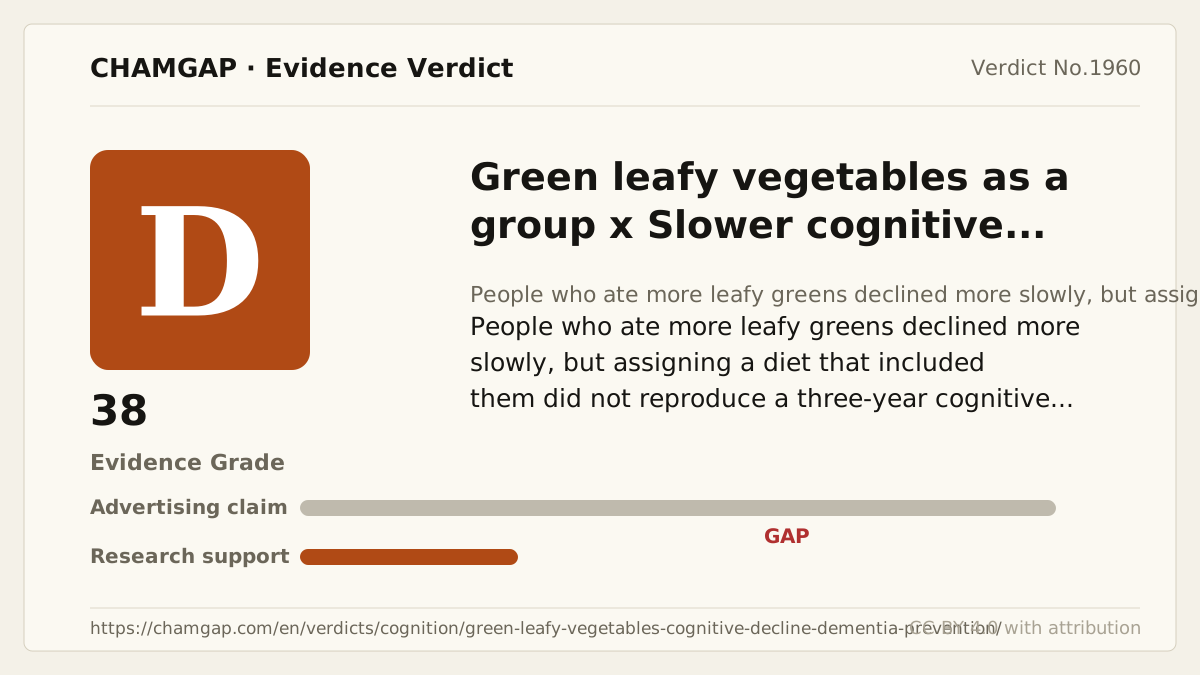
[Chamgap] Green leafy vegetables x slower cognitive decline and dementia prevention — Evidence Grade D·34. 4 cited sources checked. Source: https://chamgap.com/en/verdicts/cognition/green-leafy-vegetables-cognitive-decline-dementia-prevention/ · CC BY 4.0CC BY 4.0 — free to use with attribution; do not distort grades, numbers, or verdict meaning.
What this document does and does not do
Chamgap is an information source. It reports what research has and has not confirmed; it does not tell readers what to take or buy. That decision belongs to readers and, when needed, medical or legal professionals. This verdict reflects literature available up to the search date and may change as new research appears. Nothing here is medical advice.