
Galcanezumab,
does it really help with Reduction in monthly migraine headache days in adults with episodic or chronic migraine?
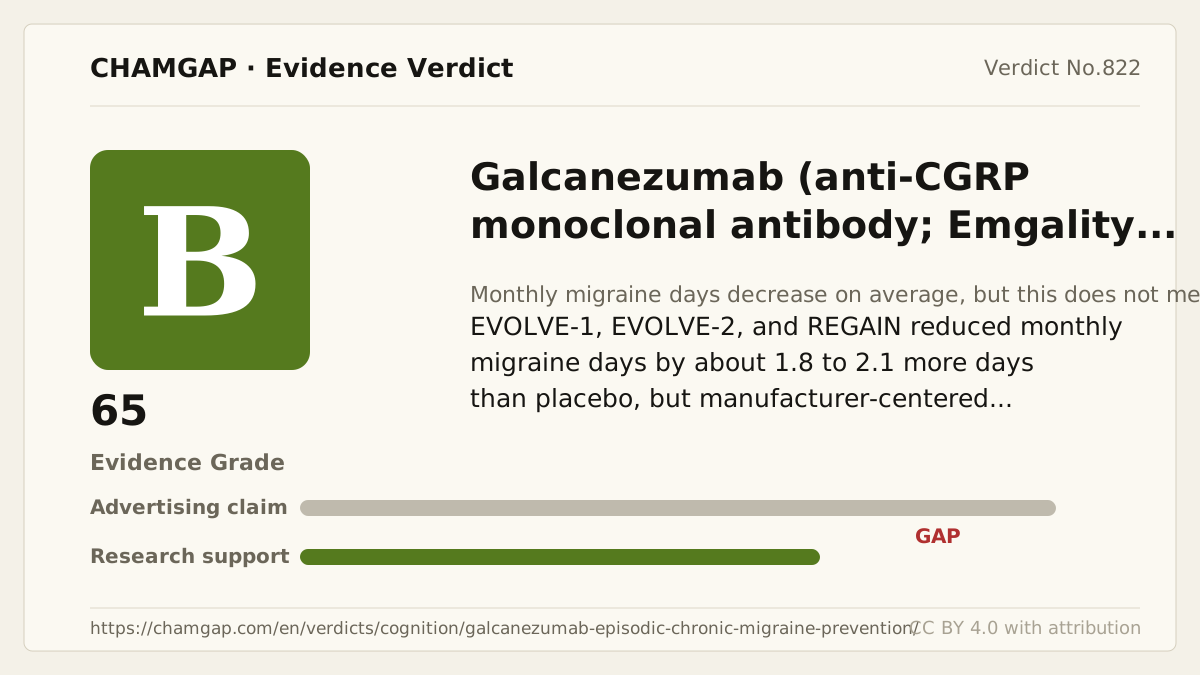
research showsGalcanezumab is rated B because it reduced monthly migraine headache days versus placebo in adult episodic and chronic migraine prevention. The additional reduction versus placebo was about 1.8 to 2.0 days per month in EVOLVE-1 and EVOLVE-2 and about 1.9 to 2.1 days over the three-month mean in chronic-migraine REGAIN. All three were randomized double-blind phase 3 trials, but all were sponsored by Eli Lilly, and a statistically significant average effect does not mean complete elimination of migraine. Injection-site reactions and constipation are separated from efficacy under safety.
ads claimPromotion can turn average prevention into an all-month migraine block or an injection that eliminates attacks. In practice, migraine days should be recorded over a defined trial period to determine whether response is sufficient.
Useful facts when choosing a product
- The usual adult migraine-prevention regimen is a 240-mg loading dose followed by 120 mg subcutaneously each month; the product label and injection training govern individual use.
- Galcanezumab is preventive therapy. It is not administered to provide immediate acute relief of a migraine attack that has already begun.
- Common adverse effects include injection-site pain, redness, and itching, and hypersensitivity reactions can be delayed.
- United States labeling in 2026 added a warning for constipation with serious complications, so severe constipation or abdominal pain and vomiting warrant medical advice.
Chamgap Semantic Classification Code
Candidate index · review held
M.galcanezumab.UNK.monthly-migraine-headache-days-with-episodic-or-chronic-migraine.reduce.placeboMedicinal interventions > Galcanezumab > Unknown > monthly migraine headache days with episodic or chronic migraine > Reduction claim > Placebo
An automated migration candidate, not an issued permanent code; exact claim scope remains under review. This machine-generated migration candidate helps retrieval but is not a permanent assignment. The original verdict ID and URL remain authoritative.
What the research actually shows
In 858 EVOLVE-1 participants, monthly migraine headache days fell over six months by 4.7 and 4.6 days with galcanezumab 120 and 240 mg, versus 2.8 days with placebo. In the 915-participant EVOLVE-2 trial, reductions were 4.3 and 4.2 versus 2.3 days. In 1,113 REGAIN participants with chronic migraine, three-month reductions were 4.8 and 4.6 versus 2.7 days. All were manufacturer-sponsored trials centered on Eli Lilly, and longer-term evidence is mainly open-label extension data.
Why this is classified as B (65)
EVOLVE-1, EVOLVE-2, and REGAIN repeatedly reduced monthly migraine headache days by about 1.8 to 2.1 more days than placebo. Controlled periods were limited and pivotal evidence was concentrated in Eli Lilly-sponsored trials, so parity with fremanezumab B66 and atogepant B64 yields B with 65 points. Injection-site reactions and constipation are separate from efficacy grading.
Counterpoint. Individual response varies more than the mean suggests, so baseline and follow-up frequency and acute-medication use should be compared with a headache diary. Cost, injection preference, and the efficacy and tolerability of other preventive therapies also matter.
Rejudgment record. New verdict — Accepted reductions of about 1.8 to 2.1 monthly migraine days beyond placebo across EVOLVE-1, EVOLVE-2, and REGAIN while accounting for relatively short controlled periods, concentration in Eli Lilly-sponsored evidence, and parity with fremanezumab B66 and atogepant B64
Sub-claim grades by effect
This ingredient is marketed for several effects. A single overall grade blends strong and weak claims together, so each effect is graded separately here. The overall grade reflects the strongest disconfirming or core claim.
| Effect (sub-claim) | Grade | Basis |
|---|---|---|
| Reduction in monthly migraine headache days in adults with episodic migraine | B | EVOLVE-1 and EVOLVE-2 replicated the effect, with sponsor concentration and an incremental effect of about two days per month. |
| Reduction in monthly migraine headache days in adults with chronic migraine | B | REGAIN was positive on a direct symptom outcome, but placebo-controlled treatment lasted three months. |
| Immediate acute treatment of an established migraine attack | ? | No human efficacy trial supports this use; the medicine was developed as preventive therapy. |
Cross-check — AI research and Codex final gate
Evidence Table
| Study | Design | Sample | Funding | Endpoint | Result | Weight |
|---|---|---|---|---|---|---|
| Stauffer VL et al. EVOLVE-1 2018 | Multicenter randomized double-blind placebo-controlled phase 3 trial | 858 adults with episodic migraine | Sponsored by Eli Lilly | Mean change in monthly migraine headache days over six months | 120 mg -4.7 days, 240 mg -4.6 days, placebo -2.8 days; p<0.001 for both doses. | Pivotal direct evidence in episodic migraine |
| Skljarevski V et al. EVOLVE-2 2018 | International multicenter randomized double-blind placebo-controlled phase 3 trial | 915 adults with episodic migraine | Sponsored by Eli Lilly | Mean change in monthly migraine headache days over six months | 120 mg -4.3 days, 240 mg -4.2 days, placebo -2.3 days. | Replicated episodic-migraine evidence |
| Detke HC et al. REGAIN 2018 | Randomized double-blind placebo-controlled phase 3 trial | 1,113 adults with chronic migraine | Sponsored by Eli Lilly | Mean change in monthly migraine headache days over three months | 120 mg -4.8 days, 240 mg -4.6 days, placebo -2.7 days; p<0.001 for both doses. | Pivotal direct evidence in chronic migraine |
Receipt — 3 References
All 3 cited sources were verified for existence at the original page (as of 2026-07-20).
Final verification and publication gate: Codex · Evidence date: 2026-07-20 · Corrections: none
Cite this verdict
[Chamgap] Galcanezumab x reduction in monthly migraine headache days in adults with episodic or chronic migraine — Evidence Grade B·65. 3 cited sources checked. Source: https://chamgap.com/en/verdicts/cognition/galcanezumab-episodic-chronic-migraine-prevention/ · CC BY 4.0CC BY 4.0 — free to use with attribution; do not distort grades, numbers, or verdict meaning.
What this document does and does not do
Chamgap is an information source. It reports what research has and has not confirmed; it does not tell readers what to take or buy. That decision belongs to readers and, when needed, medical or legal professionals. This verdict reflects literature available up to the search date and may change as new research appears. Nothing here is medical advice.