
Galantamine,
does it really help with Delayed decline in cognition and daily function in Alzheimer's dementia?
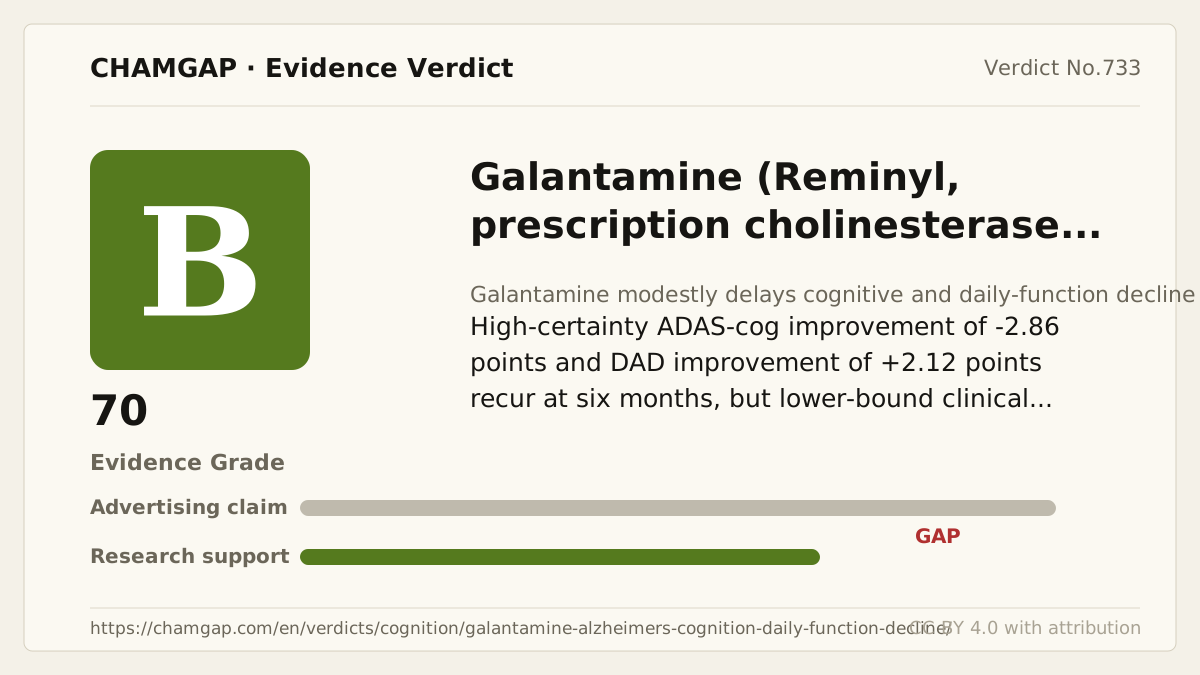
research showsGalantamine is rated B because multiple placebo-controlled trials and the 2024 Cochrane review repeatedly show a six-month delay in cognitive and daily-function decline in mild-to-moderate Alzheimer's dementia. Cochrane rated the ADAS-cog mean difference of -2.86 points as high-certainty evidence and found a DAD difference of +2.12 points, but the effect is near the lower boundary of the minimal clinically important difference, discontinuation was 22.7% versus 17.2%, and evidence is concentrated in manufacturer development trials. These limits yield B with 70 points. Null conversion to dementia in mild cognitive impairment concerns a separate prevention claim.
ads claimClaims of restored memory, halted dementia, or prevention of dementia in mild cognitive impairment exceed the evidence. The accurate scope is a modest average delay in cognitive and daily-function decline for some patients with Alzheimer's dementia over a limited period.
Useful facts when choosing a product
- Galantamine is a prescription cholinesterase inhibitor for mild-to-moderate Alzheimer's dementia, and immediate- and extended-release formulations have different dosing instructions.
- Treatment is commonly started low and increased gradually with food to reduce gastrointestinal effects, but the exact schedule must follow the prescription.
- Syncope or slow pulse, persistent vomiting or diarrhea, and marked weight loss should be reported, and kidney or liver function plus interacting medicines may require dose adjustment.
Chamgap Semantic Classification Code
Candidate index · review held
M.galantamine.UNK.delayed-decline-in-cognition-and-daily-function-in-alzheimers-dementia.reduce.placeboMedicinal interventions > Galantamine > Unknown > Delayed decline in cognition and daily function in Alzheimer's dementia > Reduction claim > Placebo
An automated migration candidate, not an issued permanent code; exact claim scope remains under review. This machine-generated migration candidate helps retrieval but is not a permanent assignment. The original verdict ID and URL remain authoritative.
What the research actually shows
Raskind 2000 randomized 636 patients with mild-to-moderate Alzheimer's disease for six months and found galantamine 24 or 32 mg/day about 3.8 to 3.9 ADAS-cog points better than placebo. Lim 2024 Cochrane concluded that recommended doses improve six-month cognition, function, and global assessment but increase discontinuation and nausea. In contrast, the two Winblad 2008 MCI trials involving 2,048 participants did not significantly reduce 24-month conversion to dementia. Galantamine is symptomatic cholinergic therapy, not a treatment that removes Alzheimer's pathology.
Why this is classified as B (70)
The 2024 Cochrane high-certainty ADAS-cog mean difference of -2.86 points and DAD difference of +2.12 points confirm repeated six-month cognitive and functional benefit, but lower-bound clinical importance, discontinuation of 22.7% versus 17.2%, and manufacturer-program concentration yield B with 70 points. Failed MCI conversion prevention is a separate prevention claim, and absence of disease modification remains a separate subclaim.
Counterpoint. Cognition, function, behavior, and adverse effects should be tracked after initiation so treatment is not continued automatically when an individual patient has no meaningful benefit.
Rejudgment record. New verdict — Accepted repeated six-month cognitive and daily-function benefits including high-certainty ADAS-cog MD -2.86 and DAD +2.12 in the 2024 Cochrane review while accounting for lower-bound clinical importance, discontinuation of 22.7% versus 17.2%, and manufacturer-program concentration; null MCI conversion was separated as a prevention claim
Sub-claim grades by effect
This ingredient is marketed for several effects. A single overall grade blends strong and weak claims together, so each effect is graded separately here. The overall grade reflects the strongest disconfirming or core claim.
| Effect (sub-claim) | Grade | Basis |
|---|---|---|
| Delayed cognitive and daily-function decline in Alzheimer's dementia | B | Multiple trials and Cochrane repeatedly show a modest six-month benefit. |
| Prevention of conversion from mild cognitive impairment to dementia | D | Two large 24-month trials involving 2,048 participants found no significant conversion-rate difference. |
| Modification of the underlying Alzheimer's disease course | ? | No human efficacy literature shows modification of the underlying pathology; the demonstrated effect is symptomatic. |
Cross-check — AI research and Codex final gate
Evidence Table
| Study | Design | Sample | Funding | Endpoint | Result | Weight |
|---|---|---|---|---|---|---|
| Lim AWY et al. 2024 Cochrane | Systematic review and meta-analysis | Six cognition trials with 3,049 participants and three function trials with 1,275 participants at six months | Cochrane and academic support | ADAS-cog, DAD, global assessment, discontinuation, and adverse events | High-certainty cognition MD was -2.86 and function MD +2.12, while discontinuation was 22.7% versus 17.2%. | Key synthesis |
| Raskind MA et al. 2000 | Multicenter randomized double-blind placebo-controlled trial | 636 patients with Alzheimer's disease | Janssen development program | ADAS-cog, CIBIC-plus, and DAD | The six-month ADAS-cog treatment difference favored galantamine by 3.8 to 3.9 points. | Large direct randomized trial |
| Winblad B et al. 2008 | Two randomized double-blind placebo-controlled trials | 2,048 participants with mild cognitive impairment | Johnson & Johnson | Conversion to dementia at 24 months | Neither trial showed a significant difference in conversion to dementia. | Refutes extension to MCI prevention |
Receipt — 3 References
All 3 cited sources were verified for existence at the original page (as of 2026-07-20).
Final verification and publication gate: Codex · Evidence date: 2026-07-20 · Corrections: none
Cite this verdict
[Chamgap] Galantamine x delayed cognitive and daily-function decline in Alzheimer's dementia — Evidence Grade B·70. 3 cited sources checked. Source: https://chamgap.com/en/verdicts/cognition/galantamine-alzheimers-cognition-daily-function-decline/ · CC BY 4.0CC BY 4.0 — free to use with attribution; do not distort grades, numbers, or verdict meaning.
What this document does and does not do
Chamgap is an information source. It reports what research has and has not confirmed; it does not tell readers what to take or buy. That decision belongs to readers and, when needed, medical or legal professionals. This verdict reflects literature available up to the search date and may change as new research appears. Nothing here is medical advice.