
Fremanezumab,
does it really help with Prevention of episodic and chronic migraine with fewer monthly migraine days?
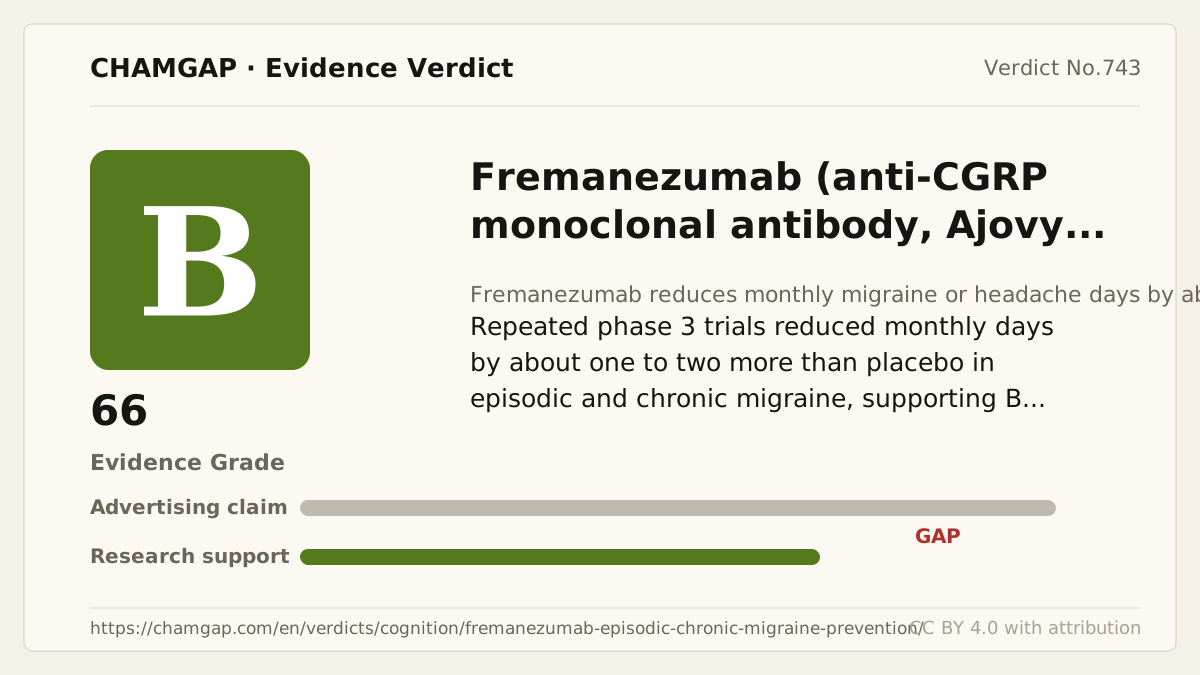
research showsFremanezumab is rated B because it reduced monthly migraine or headache days versus placebo in episodic and chronic migraine. In the 875-participant episodic HALO trial, placebo-adjusted reduction over 12 weeks was 1.3 to 1.5 monthly migraine days. In the 1,130-participant chronic HALO trial, monthly moderate-or-worse headache days declined about 1.8 to 2.1 days more than placebo, and at least 50% response occurred in 38% to 41% versus 18%. Direct patient-centered outcomes were replicated, but the absolute effect was limited and pivotal trials were Teva-funded, supporting mid-range B.
ads claimPromotion may frame monthly or quarterly injection as a migraine-free life or a way to stop an active attack. The randomized mean placebo-adjusted effect is about one to two fewer monthly days and the medicine is preventive, not acute treatment.
Useful facts when choosing a product
- Fremanezumab is a prescription subcutaneous antibody targeting the CGRP ligand, used on monthly or quarterly schedules for adult migraine prevention.
- The mean placebo-adjusted effect is about one to two fewer monthly migraine or headache days, but individual response varies and should be assessed with a headache diary.
- Injection-site pain, induration, and erythema are the most common adverse effects, and hypersensitivity reactions are uncommon but reported.
- It does not immediately treat an attack already in progress, so acute medicines and medication-overuse risk require separate management.
Chamgap Semantic Classification Code
Candidate index · review held
M.fremanezumab.UNK.episodic-and-chronic-migraine-with-fewer-monthly-migraine-days.prevent.placeboMedicinal interventions > Fremanezumab > Unknown > episodic and chronic migraine with fewer monthly migraine days > Occurrence-prevention claim > Placebo
An automated migration candidate, not an issued permanent code; exact claim scope remains under review. This machine-generated migration candidate helps retrieval but is not a permanent assignment. The original verdict ID and URL remain authoritative.
What the research actually shows
HALO EM assigned 875 participants with episodic migraine to monthly 225 mg, quarterly 675 mg, or placebo for 12 weeks. Placebo-adjusted differences in monthly migraine days were -1.5 and -1.3 days. HALO CM assigned 1,130 participants with chronic migraine to monthly or quarterly dosing or placebo. Reductions in monthly moderate-or-worse headache days were 4.6 and 4.3 days versus 2.5 days, and at least 50% response rates were 41%, 38%, and 18%. Both randomized periods were only 12 weeks and were funded by Teva Pharmaceuticals.
Why this is classified as B (66)
Large placebo-controlled HALO EM and HALO CM trials replicated improvements in monthly days and 50% response in episodic and chronic migraine. Outcomes are directly patient-centered, but the mean placebo-adjusted difference is limited to about one to two days and pivotal evidence is concentrated in Teva funding, supporting B with 66 points. Injection-site reactions remain a separate safety issue.
Counterpoint. Suitability varies with prior preventive failures, comorbidity, pregnancy plans, cost, and preference. Nonresponse after an adequate assessment period warrants another preventive strategy.
Rejudgment record. New verdict — Assigned B for replicated direct patient-centered improvements in monthly migraine or headache days and response in HALO EM and CM, while accounting for a roughly one-to-two-day placebo-adjusted effect and concentrated manufacturer funding
Sub-claim grades by effect
This ingredient is marketed for several effects. A single overall grade blends strong and weak claims together, so each effect is graded separately here. The overall grade reflects the strongest disconfirming or core claim.
| Effect (sub-claim) | Grade | Basis |
|---|---|---|
| Prevention of episodic and chronic migraine with fewer monthly migraine or headache days | B | Two large phase 3 trials replicated direct patient-centered benefit, but the mean placebo-adjusted effect was about one to two days. |
| Generalizing the average absolute reduction as substantially greater than one to two monthly days | C | The pivotal placebo-controlled trials found a mean additional reduction of about 1.3 to 2.1 days. |
| Acute treatment of a migraine attack already in progress | ? | The evidence concerns prevention and does not evaluate acute attack treatment. |
Cross-check — AI research and Codex final gate
Evidence Table
| Study | Design | Sample | Funding | Endpoint | Result | Weight |
|---|---|---|---|---|---|---|
| Dodick DW et al. HALO EM 2018 | Multinational randomized double-blind placebo-controlled phase 3 trial | 875 participants with episodic migraine | Teva Pharmaceuticals | Change in monthly migraine days over 12 weeks | Placebo-adjusted differences were -1.5 days with monthly and -1.3 days with quarterly dosing. | Key episodic direct-outcome evidence |
| Silberstein SD et al. HALO CM 2017 | Randomized double-blind placebo-controlled phase 3 trial | 1,130 participants with chronic migraine | Teva Pharmaceuticals | Monthly moderate-or-worse headache days and at least 50% response | Monthly days fell 4.3 to 4.6 versus 2.5 with placebo; 50% response was 38% to 41% versus 18%. | Key chronic direct-outcome evidence |
Receipt — 2 References
All 2 cited sources were verified for existence at the original page (as of 2026-07-20).
Final verification and publication gate: Codex · Evidence date: 2026-07-20 · Corrections: none
Cite this verdict
[Chamgap] Fremanezumab x prevention of episodic and chronic migraine — Evidence Grade B·66. 2 cited sources checked. Source: https://chamgap.com/en/verdicts/cognition/fremanezumab-episodic-chronic-migraine-prevention/ · CC BY 4.0CC BY 4.0 — free to use with attribution; do not distort grades, numbers, or verdict meaning.
What this document does and does not do
Chamgap is an information source. It reports what research has and has not confirmed; it does not tell readers what to take or buy. That decision belongs to readers and, when needed, medical or legal professionals. This verdict reflects literature available up to the search date and may change as new research appears. Nothing here is medical advice.