
An extra 1.5 L of water daily,
does it really help with Reduction in days with at least moderate headache among people with recurrent headaches?
research showsThe grade is D. A three-month trial randomized 102 people with recurrent headaches. The between-group difference in days with at least moderate headache was -0.17 day/month (95% CI -1.3 to 1.6; P=.82), showing no reduction. Migraine-specific quality of life improved by 4.5 points, but actual water intake rose by only 842 mL/day on average and only 35% of the intervention group increased by at least 1 L. The core headache-day claim was not supported, giving D with 30 points.
ads claimUS values of 2.7 and 3.7 L and European values of 2.0 and 2.5 L include food and other beverages. They are total-water reference values, not clinical evidence that eight glasses of plain water treat headache. Even this trial achieved only an 842-mL average increase rather than 1.5 L.
Useful facts when choosing a product
- US adequate total-water intakes are 2.7 L/day for adult women and 3.7 L/day for men, including plain water, other beverages, and food moisture.
- EFSA values of 2.0 L for women and 2.5 L for men also concern total water; the 1945 1-mL/kcal statement added that most water was contained in prepared foods.
- Actual total fluid separated by 842 mL/day, about 56% of the 1.5-L instruction. Urine volume and osmolality were not measured.
- Verdict 1288 is C with 47 points for fatigue and endurance during exercise; this verdict concerns monthly headache days in everyday recurrent headache.
Chamgap Semantic Classification Code
Candidate index · review held
UNK.advice-to-add-of-water-to-usual-intake.oral.days-with-at-least-moderate-headache-with-recurrent-headaches.reduce.UNKUnknown > Advice to add of water to usual intake > Oral > days with at least moderate headache with recurrent headaches > Reduction claim > Unknown
An automated migration candidate, not an issued permanent code; exact claim scope remains under review. This machine-generated migration candidate helps retrieval but is not a permanent assignment. The original verdict ID and URL remain authoritative.
What the research actually shows
Spigt randomized 102 people reporting less than 2.5 L/day total fluid and at least two moderately intense or five mildly intense headache episodes monthly: 52 to water advice and 50 to control. Both groups received sleep and stress advice; only the intervention group was told to add 1.5 L/day. Actual total fluid separated by 842 mL/day, but this was about 56% of the instruction, so the intervention contrast was weaker than planned. Only 35% increased by at least 1 L. Urine volume and urine osmolality were not measured. A registration number and a single prespecified primary endpoint were not confirmed in the public material. Dutch public agency ZonMw support was reported.
Why this is classified as D (30)
The publicly funded trial separated total fluid by 842 mL/day, about 56% of the instruction, so the intervention contrast was weak; moderate headache days were null, giving D with 30 points.
Counterpoint. D does not mean water is unhealthy. It means the claim that this advice reduces average headache days was not established in this setting.
Rejudgment record. Cross-check applied — Actual intake increased less than planned and the between-group difference in moderate headache days was null
| Endpoint | P | Symptom or function itself is the target - including patient reports and performance tests |
| Replication | R1 | Single confirmatory trial |
| Independence | I2 | Decisive evidence is publicly or non-profit funded |
| Effect size | E0 | Null |
| Precision | C0 | The confidence interval leaves room for benefit |
Stored derived and displayed grades match; this is not a current recalculation or validity check (D).
Sub-claim grades by effect
This ingredient is marketed for several effects. A single overall grade blends strong and weak claims together, so each effect is graded separately here. The overall grade reflects the strongest disconfirming or core claim.
| Effect (sub-claim) | Grade | Basis |
|---|---|---|
| Fewer monthly days with at least moderate headache | D | The -0.17-day/month between-group interval included zero. |
| Improved migraine-specific quality of life | C | The 4.5-point improvement was positive but came from one small unblinded trial. |
Cross-check — AI research and Codex final gate
Evidence Table
| Study | Design | Sample | Funding | Endpoint | Result | Weight |
|---|---|---|---|---|---|---|
| Spigt M et al. 2012 | Three-month open-label primary-care randomized trial | 102 randomized (52 water/50 control); endpoint analysis counts not confirmed | Public support from the Netherlands Organisation for Health Research and Development, ZonMw | Migraine-specific quality of life and monthly days with at least moderate headache | Quality of life +4.5 points (95% CI 1.3 to 7.8); headache days -0.17 day/month (95% CI -1.3 to 1.6; P=.82) | Pivotal single null headache-day evidence |
Receipt — 4 References
All 4 cited sources were verified for existence at the original page (as of 2026-08-04).
Final verification and publication gate: Codex · Evidence date: 2026-08-04 · Corrections: none
Cite this verdict
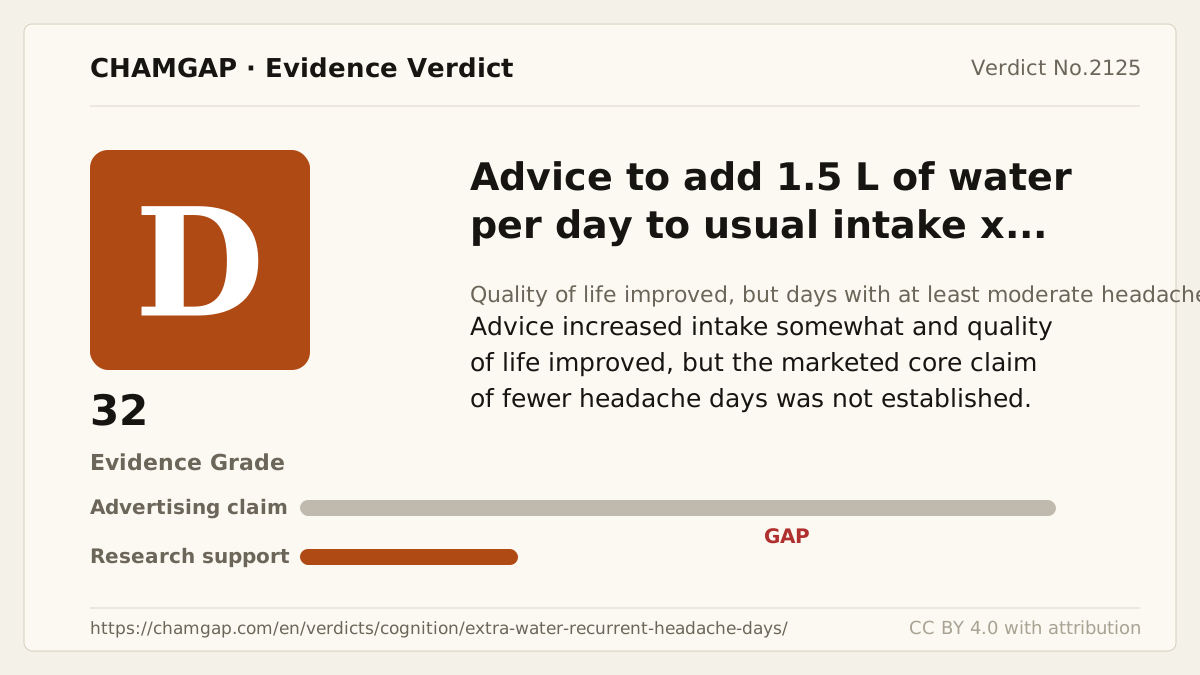
[Chamgap] An extra 1.5 L of water daily x fewer recurrent headache days — Evidence Grade D·30. 4 cited sources checked. Source: https://chamgap.com/en/verdicts/cognition/extra-water-recurrent-headache-days/ · CC BY 4.0CC BY 4.0 — free to use with attribution; do not distort grades, numbers, or verdict meaning.
What this document does and does not do
Chamgap is an information source. It reports what research has and has not confirmed; it does not tell readers what to take or buy. That decision belongs to readers and, when needed, medical or legal professionals. This verdict reflects literature available up to the search date and may change as new research appears. Nothing here is medical advice.