
Extended-release exenatide,
does it really help with Long-term slowing of motor-symptom progression in Parkinson's disease?
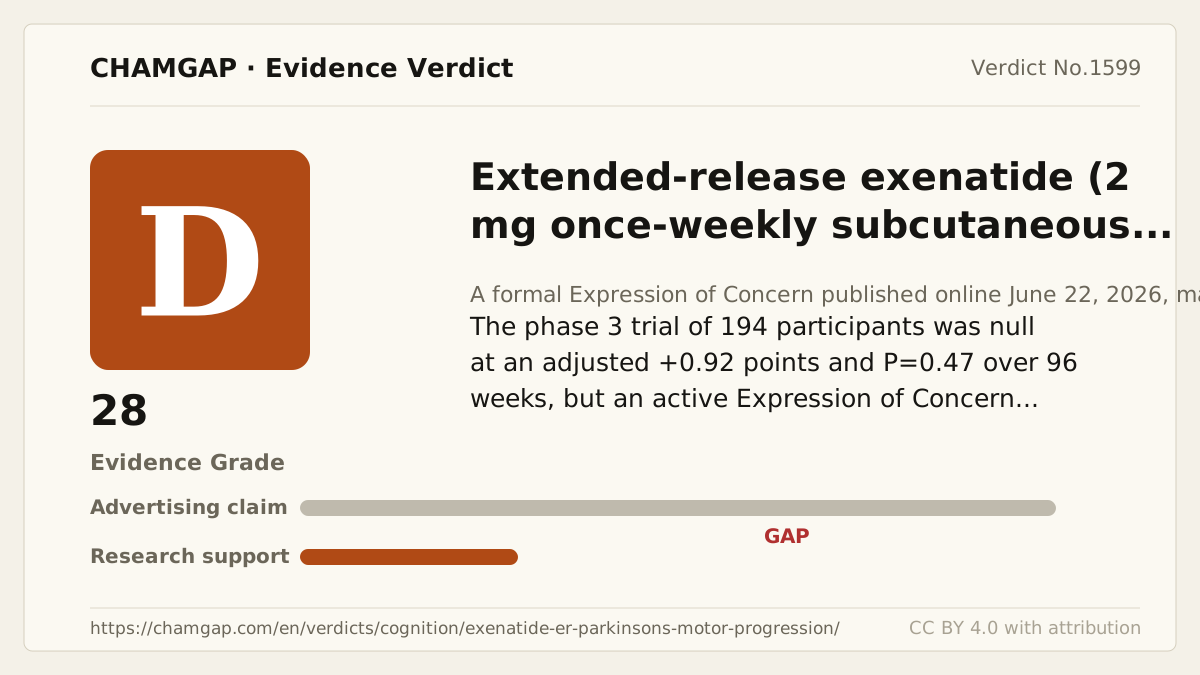
research showsThe claim that extended-release exenatide slows long-term motor progression in Parkinson's disease is rated D. In the 2025 Exenatide-PD3 phase 3 trial of 194 participants, off-medication MDS-UPDRS part III worsened by 5.7 points with exenatide and 4.5 points with placebo over 96 weeks; the adjusted difference was +0.92 points (95% CI -1.56 to 3.39; P=0.47). The trial therefore failed to reproduce the positive phase 2 signal. The Lancet published a formal Expression of Concern online on June 22, 2026, while trial-conduct and data concerns were investigated. Because the evidentiary trial itself is under investigation, a definitive F cannot be assigned. If the Expression of Concern is resolved and the +0.92-point, P=0.47 result stands, the verdict should be reconsidered as F.
ads claimSuccess of GLP-1 medicines in diabetes and obesity, or neuroprotective mechanisms in animals, cannot be translated into clinical proof of slowed Parkinson's progression. It is also incomplete to cite only the positive exenatide phase 2 result without disclosing both the larger phase 3 null report and the current Expression of Concern attached to that report.
Useful facts when choosing a product
- Extended-release exenatide 2 mg once weekly is a prescription GLP-1 receptor agonist used for glycemic control in type 2 diabetes and is not approved as a Parkinson's treatment.
- Nausea, vomiting, diarrhea, reduced appetite, weight loss, and injection-site nodules can occur and may aggravate nutritional or weight problems in a person with Parkinson's disease.
- Pancreatitis, gallbladder disease, and dehydration-related worsening of renal function require attention, and clinicians must assess suitability in severe gastrointestinal motility disorders or renal impairment.
- Hypoglycemia risk rises when exenatide is combined with insulin or a sulfonylurea, and it should not be self-administered in an attempt to slow Parkinson's progression.
Chamgap Semantic Classification Code
Candidate index · review held
M.extended-release-exenatide.subcutaneous.long-term-slowing-of-motor-symptom-progression-in-parkinsons-disease.assess.placeboMedicinal interventions > Extended-release exenatide > Subcutaneous > Long-term slowing of motor-symptom progression in Parkinson's disease > Association or change assessment > Placebo
An automated migration candidate, not an issued permanent code; exact claim scope remains under review. This machine-generated migration candidate helps retrieval but is not a permanent assignment. The original verdict ID and URL remain authoritative.
What the research actually shows
The 2017 double-blind phase 2 trial randomized 62 participants and reported an adjusted -3.5-point difference in off-medication MDS-UPDRS part III among 60 analyzed participants after washout (95% CI -6.7 to -0.3; P=0.0318). The 2025 multicenter Exenatide-PD3 phase 3 trial randomized 194 participants to 96 weeks of treatment and found worsening of 5.7 points with exenatide versus 4.5 with placebo, an adjusted +0.92-point difference (95% CI -1.56 to 3.39; P=0.47), failing to show slowed progression. The Lancet published a formal Expression of Concern online on June 22, 2026, while trial-conduct, oversight, governance, and possible data effects remained under investigation. Because the trial used as evidence is itself under investigation, it cannot by itself establish F. If the Expression of Concern is resolved and the +0.92-point, P=0.47 result stands, reclassification to F is warranted. An early lixisenatide signal does not confirm exenatide.
Why this is classified as D (28)
The confirmatory phase 3 primary endpoint failed at an adjusted +0.92 points and P=0.47 over 96 weeks, which structurally makes F a candidate after a positive phase 2 trial. The Lancet published a formal Expression of Concern online on June 22, 2026, and trial-conduct and possible data effects remain under investigation. Because the pivotal refuting trial is itself under investigation, the certainty required for F is absent, giving D with 28 points. If the concern is resolved and the +0.92-point, P=0.47 result stands, the case should be regraded F.
Counterpoint. Early signals with other GLP-1 receptor agonists can justify further class research. Differences in brain exposure, dose, and pharmacology mean that a result with lixisenatide or another agent cannot rescue exenatide or establish class-wide neuroprotection in Parkinson's disease.
Rejudgment record. Cross-check applied — The phase 3 reversal of a positive phase 2 signal structurally makes F a candidate. The Lancet published a formal Expression of Concern online on June 22, 2026, and trial conduct and possible data effects remain under investigation, so F is withheld. If the concern is resolved and the +0.92-point, P=0.47 result stands, the verdict should be regraded F.
Sub-claim grades by effect
This ingredient is marketed for several effects. A single overall grade blends strong and weak claims together, so each effect is graded separately here. The overall grade reflects the strongest disconfirming or core claim.
| Effect (sub-claim) | Grade | Basis |
|---|---|---|
| Long-term slowing of Parkinson's motor-symptom progression with extended-release exenatide | D | The reported 96-week phase 3 primary endpoint was null, but the article is under an Expression of Concern and the potential data impact remains under investigation. |
| Persistent improvement in off-medication motor function after stopping exenatide | D | The 3.5-point positive signal in the small phase 2 trial was reported as not reproduced in the larger phase 3 trial. |
| Phase 3 confirmation of a disease-modifying effect of exenatide in Parkinson's disease | D | The reported phase 3 result failed confirmation at +0.92 points and P=0.47, but trial conduct and data remain under investigation after the June 22, 2026, Expression of Concern. |
Cross-check — AI research and Codex final gate
Evidence Table
| Study | Design | Sample | Funding | Endpoint | Result | Weight |
|---|---|---|---|---|---|---|
| Vijiaratnam N et al. 2025 | Multicenter phase 3 randomized double-blind placebo-controlled Exenatide-PD3 trial | 194 randomized participants and 188 with follow-up data | Supported by the UK NIHR and Cure Parkinson's | Change in off-medication MDS-UPDRS part III at 96 weeks | Scores worsened by 5.7 versus 4.5 points, with an adjusted difference of +0.92 points (95% CI -1.56 to 3.39; P=0.47), showing no slowing. | Key confirmatory phase 3 null report, currently under a 2026 Expression of Concern |
| Athauda D et al. 2017 | Single-country phase 2 randomized double-blind placebo-controlled trial | 62 randomized participants and 60 analyzed | Supported by the Michael J. Fox Foundation for Parkinson's Research | Off-medication MDS-UPDRS part III after 48 weeks of treatment and a 12-week washout | Exenatide favored the off-medication motor score by 3.5 points (95% CI -6.7 to -0.3; P=0.0318). | Small positive phase 2 signal that generated the disease-modification hypothesis |
| The Editors of The Lancet. 2026 | Formal Expression of Concern regarding the Exenatide-PD3 article, published online June 22, 2026 | Not applicable | Not applicable | Investigation of trial conduct, oversight, governance, and possible effects on data and conclusions | Trial conduct, oversight, governance, and possible data effects remained under investigation; if resolved with +0.92 points and P=0.47 intact, regrading to F is warranted. | Material publication warning that reduces certainty in the phase 3 reversal |
| Meissner WG et al.; LIXIPARK Study Group. 2024 | Phase 2 randomized double-blind placebo-controlled trial of lixisenatide | 156 participants with early Parkinson's disease | Supported by the French Ministry of Health, Cure Parkinson's, and other sources | Change in MDS-UPDRS part III at 12 months | Motor-score progression favored lixisenatide, but gastrointestinal adverse events were common and confirmatory testing was required. | Early class signal with another drug, not confirmation of exenatide |
Receipt — 4 References
All 4 cited sources were verified for existence at the original page (as of 2026-07-24).
Final verification and publication gate: Codex · Evidence date: 2026-07-24 · Corrections: none
Cite this verdict
[Chamgap] Extended-release exenatide x long-term slowing of motor-symptom progression in Parkinson's disease — Evidence Grade D·28. 4 cited sources checked. Source: https://chamgap.com/en/verdicts/cognition/exenatide-er-parkinsons-motor-progression/ · CC BY 4.0CC BY 4.0 — free to use with attribution; do not distort grades, numbers, or verdict meaning.
What this document does and does not do
Chamgap is an information source. It reports what research has and has not confirmed; it does not tell readers what to take or buy. That decision belongs to readers and, when needed, medical or legal professionals. This verdict reflects literature available up to the search date and may change as new research appears. Nothing here is medical advice.