
EEG neurofeedback,
does it really help with Improved attention and core symptoms in children with ADHD?
research showsEEG neurofeedback is rated D for the claim that it improves attention and core symptoms in children with ADHD. The most rigorous double-blind sham-controlled trial randomized 144 children and included 142 in the modified intention-to-treat primary analysis after excluding two early withdrawals with no postbaseline outcome data: 84 received active training and 58 received control training. The primary endpoint, combined parent- and teacher-rated inattention, failed at treatment end with d=0.01 and P=.965 and also failed at 13 months with d=0.23 and P=.412. A 2025 meta-analysis of 38 randomized trials and 2,472 participants likewise found no benefit for probably blinded ratings of total core symptoms across 20 trials and 1,214 participants, with SMD 0.04 (95% CI -0.10 to 0.18). Small signals in a standard-protocol subgroup and positive unblinded ratings prevent a conclusion that every EEG approach has repeatedly failed, so the result is D rather than F, with 25 points.
ads claimMarketing suggests that watching real-time brain activity and training attention circuits can correct attention and self-regulation without medication. The most rigorous sham trial controlled coaching, screen engagement, repeated effort, and expectancy and found no added benefit specific to genuine brain-wave feedback.
Useful facts when choosing a product
- EEG neurofeedback uses scalp electrodes to measure brain activity and provides visual or auditory rewards when selected frequency patterns are produced.
- The pivotal trial tested one commonly used theta-to-beta-ratio protocol, so it cannot by itself settle every fMRI, fNIRS, or alternative EEG protocol.
- Multiple sessions and substantial cost are usually required, while blinded evidence has not established a stand-alone clinical benefit over standard ADHD care.
- Although noninvasive, an ineffective course can consume time and money and delay evidence-based medication or behavioral intervention.
Chamgap Semantic Classification Code
Candidate index · review held
X.eeg-neurofeedback.behavioral.attention-and-core-symptoms-with-adhd.improve.shamBehaviors, exposures and policies > EEG neurofeedback > Behavioral delivery > attention and core symptoms with ADHD > Improvement claim > Sham procedure or device
An automated migration candidate, not an issued permanent code; exact claim scope remains under review. This machine-generated migration candidate helps retrieval but is not a permanent assignment. The original verdict ID and URL remain authoritative.
What the research actually shows
The pivotal 2021 trial assigned 144 children aged 7 to 10 years with moderate or severe ADHD and an elevated theta-to-beta ratio to deliberate neurofeedback or a prerecorded-EEG sham of equal appearance, time, and intensity. Two participants withdrew without any postbaseline assessment, leaving 142 participants, 84 active and 58 control, in the modified intention-to-treat primary analysis. The combined parent and teacher DSM-5 inattention primary endpoint failed both at treatment end and at 13 months. Funding came from United States National Institute of Mental Health grant R01-MH100144, the Ohio State University College of Medicine Endowment, and National Center for Translational Sciences award number 8UL18TR000090-05 as printed in the article; it was not manufacturer-led. The 2025 Westwood meta-analysis included 38 peer-reviewed randomized trials and 2,472 participants. Its prespecified primary endpoint, probably blinded total core symptoms immediately after treatment, was null in 20 trials and 1,214 participants. The SMD of 0.21 in the established-protocol subgroup was small and did not reproduce in separate inattention or hyperactivity outcomes.
Why this is classified as D (25)
In a publicly and academically funded double-blind sham trial, 144 children were randomized and 142 entered the primary analysis; combined parent- and teacher-rated inattention failed with d=0.01 and P=.965, and the 13-month result also failed. The blinded primary synthesis across 20 trials and 1,214 participants was also null with SMD 0.04. A standard-protocol subgroup and some unblinded or processing-speed findings were positive, so they are retained only as context and the grade remains D with 25 points rather than F.
Counterpoint. Reasonable ADHD care combines accurate diagnosis with assessment of sleep and learning context, parent- and school-based behavioral support, and consideration of established medication. If neurofeedback is chosen, standard care should continue and measurable targets and stopping rules should be set in advance.
Rejudgment record. Cross-check applied — Centered the judgment on failure of the combined parent- and teacher-rated inattention primary endpoint in a 144-randomized, 142-person modified intention-to-treat double-blind sham trial and on the null pooled total-symptom result from 20 blinded trials and 1,214 participants; retained the positive standard-protocol subgroup only as a note because the overall value was null and used D rather than F because not every EEG protocol has been repeatedly disproved
Sub-claim grades by effect
This ingredient is marketed for several effects. A single overall grade blends strong and weak claims together, so each effect is graded separately here. The overall grade reflects the strongest disconfirming or core claim.
| Effect (sub-claim) | Grade | Basis |
|---|---|---|
| Improvement in blinded ratings of total ADHD core symptoms | D | The primary pooled result across 20 trials and 1,214 participants failed with SMD 0.04 (95% CI -0.10 to 0.18). |
| Improvement in combined parent- and teacher-rated inattention | D | The primary endpoint in the 144-randomized, 142-person modified intention-to-treat sham trial failed at treatment end with d=0.01 and P=.965. |
| Improvement in objective attention performance | D | The meta-analysis of attention tests across 25 trials and 1,140 participants was null with SMD 0.04 (95% CI -0.19 to 0.26) and P=.75. |
Cross-check — AI research and Codex final gate
Evidence Table
| Study | Design | Sample | Funding | Endpoint | Result | Weight |
|---|---|---|---|---|---|---|
| Neurofeedback Collaborative Group. 2021 | Two-site double-blind randomized sham-controlled trial | 144 randomized; two early withdrawals with no outcome data excluded, leaving 142 in the modified intention-to-treat analysis (84 active and 58 control) | United States NIMH grant R01-MH100144, Ohio State University College of Medicine Endowment, and National Center for Translational Sciences award number 8UL18TR000090-05 as printed in the article; not manufacturer-led | Primary endpoint: combined parent- and teacher-rated DSM-5 inattention | Primary endpoint failed: d=0.01 and P=.965 at treatment end; d=0.23 and P=.412 at 13 months. Both groups improved from baseline, but genuine feedback had no specific advantage over sham. | Pivotal rigorous direct trial |
| Westwood SJ et al. 2025 | Peer-reviewed systematic review and meta-analysis of randomized trials | 38 randomized trials and 2,472 participants; 20 trials and 1,214 participants in the primary blinded total-symptom analysis | No specific study funding section was reported; academic multicenter work with no manufacturer funding reported | Primary endpoint: probably blinded ratings of total ADHD core symptoms immediately after treatment | Primary pooled result failed: SMD 0.04 (95% CI -0.10 to 0.18). The standard-protocol subgroup SMD of 0.21 was small and did not overturn the null overall result. | Current blinded synthesis |
Receipt — 2 References
All 2 cited sources were verified for existence at the original page (as of 2026-07-24).
Final verification and publication gate: Codex · Evidence date: 2026-07-24 · Corrections: none
Cite this verdict
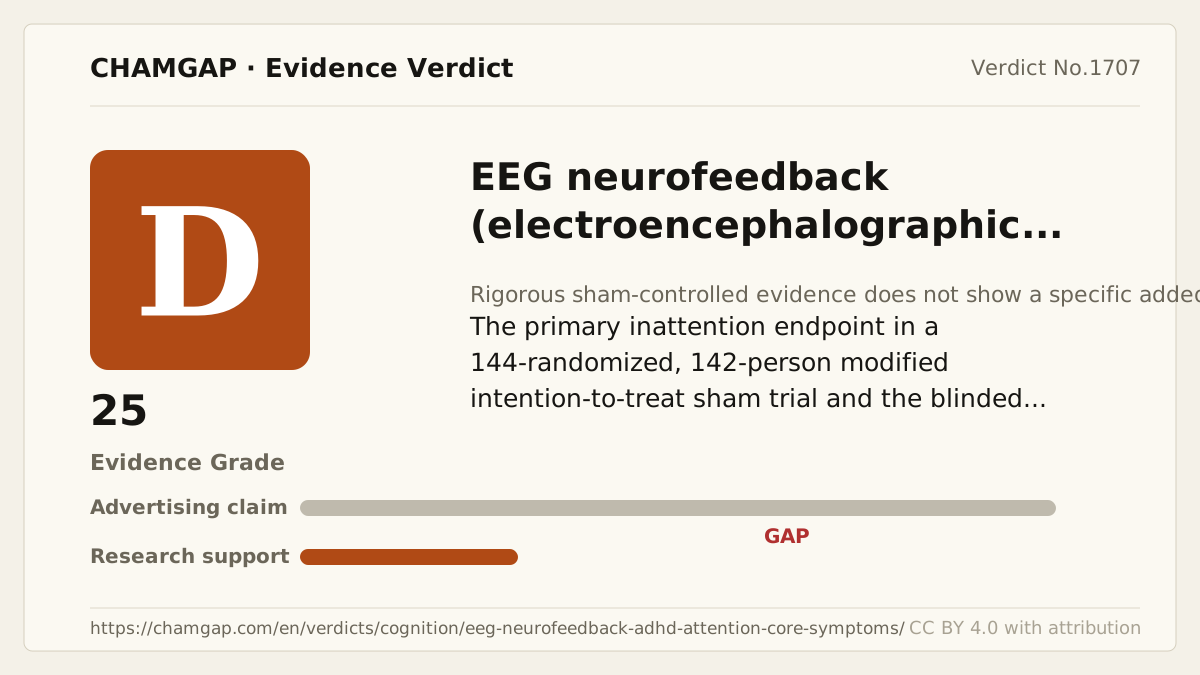
[Chamgap] EEG neurofeedback x improved attention and core symptoms in children with ADHD — Evidence Grade D·25. 2 cited sources checked. Source: https://chamgap.com/en/verdicts/cognition/eeg-neurofeedback-adhd-attention-core-symptoms/ · CC BY 4.0CC BY 4.0 — free to use with attribution; do not distort grades, numbers, or verdict meaning.
What this document does and does not do
Chamgap is an information source. It reports what research has and has not confirmed; it does not tell readers what to take or buy. That decision belongs to readers and, when needed, medical or legal professionals. This verdict reflects literature available up to the search date and may change as new research appears. Nothing here is medical advice.