
Edible mushroom intake,
does it really help with Prevention of incident dementia over long-term follow-up?
research showsThe grade is C with 56 points. In 13,230 older Japanese adults, consumption at least three times weekly versus less than once weekly was associated with a dementia hazard ratio of 0.81, 95% CI 0.69 to 0.95. In the separate CIRCS cohort, women consuming at least 15 g/day had a hazard ratio of 0.56, 0.42 to 0.75, versus no intake, but no association was seen in men. Both were observational studies and cannot establish mushrooms as the cause.
ads claimLower dementia hazard among frequent consumers is a real observation, but the broader diet and living conditions of mushroom eaters cannot be relabeled as a preventive effect of one food. Species and UV exposure were not recorded, so vitamin D2 intake cannot be calculated. Verdict 084 is C with 55 points for a different lion's mane product and cognition or memory claim.
Useful facts when choosing a product
- Ohsaki recorded frequency without species or grams; CIRCS mainly recorded shiitake, shimeji, enoki, and nameko.
- Mushroom vitamin D2 depends strongly on ultraviolet exposure. Neither cohort recorded species or UV treatment, precluding a vitamin D estimate.
- The Ohsaki mushroom-item validity correlations were 0.32 in men and 0.55 in women, while CIRCS repeat-classification agreement was a very low kappa of 0.11.
- The repeated lower hazard in women is an observational fact, not randomized proof of prevention.
Chamgap Semantic Classification Code
Candidate index · review held
F.habitual-intake-of-edible-mushrooms-without-a-specified-species.oral.incident-dementia-over-long-term-follow-up.prevent.UNKFoods and beverages > Habitual intake of edible mushrooms without a specified species > Oral > incident dementia over long-term follow-up > Occurrence-prevention claim > Unknown
An automated migration candidate, not an issued permanent code; exact claim scope remains under review. This machine-generated migration candidate helps retrieval but is not a permanent assignment. The original verdict ID and URL remain authoritative.
What the research actually shows
Ohsaki followed 13,230 adults aged 65 or older for a mean 5.7 years and identified dementia through public long-term-care insurance records. Food-record validity correlations for its mushroom FFQ item were 0.32 in men and 0.55 in women. CIRCS analyzed 3,739 of 3,750 participants and recorded 670 events, but exposure came from one 24-hour recall and repeat-classification agreement was a very low kappa of 0.11. Socioeconomic status was not collected. Both studies used Japanese public or academic funding.
Why this is classified as C (56)
Two independently publicly funded prospective cohorts found same-direction incident-dementia associations in women, but unstable or low-quality intake measurement, socioeconomic residual confounding, and no randomized trial limit the grade to C with 56 points.
Counterpoint. C does not mean the association is false. It means current evidence cannot isolate mushroom intake itself as a cause of dementia prevention.
Rejudgment record. Cross-check applied — Original cohort estimates, sex-specific findings, funding, exposure validity, and unmeasured socioeconomic confounding were directly checked
| Endpoint | H | Hard endpoint - actual events such as death |
| Replication | R1 | Single confirmatory trial |
| Independence | I2 | Decisive evidence is publicly or non-profit funded |
| Effect size | E+ | Meets the clinically important threshold |
Stored derived and displayed grades match; this is not a current recalculation or validity check (C).
Sub-claim grades by effect
This ingredient is marketed for several effects. A single overall grade blends strong and weak claims together, so each effect is graded separately here. The overall grade reflects the strongest disconfirming or core claim.
| Effect (sub-claim) | Grade | Basis |
|---|---|---|
| Prevention of incident dementia through habitual edible mushroom intake | C | Two cohorts found an association in women, but no randomized trial establishes causality. |
Cross-check — AI research and Codex final gate
Evidence Table
| Study | Design | Sample | Funding | Endpoint | Result | Weight |
|---|---|---|---|---|---|---|
| Zhang S et al. 2017 Ohsaki Cohort 2006 | Prospective cohort using a food-frequency questionnaire | 13,230 adults aged 65 or older, mean 5.7 years, with 8.7% cumulative dementia incidence | Health Sciences Research Grants from Japan's Ministry of Health, Labour and Welfare | Incident dementia in public long-term-care insurance records | Versus less than weekly, HR 0.95 (0.81-1.10) for one to two times weekly and 0.81 (0.69-0.95) for at least three times; female HRs 0.80 and 0.68, male HRs 1.15 and 0.97 | First prospective evidence for the long-term incidence association |
| Aoki S et al. 2024 CIRCS | Prospective cohort using a single 24-hour dietary recall | 3,739 of 3,750 analyzed, mean 16.0 years, 670 dementia events | Japanese Ministry of Health grants, JSPS KAKENHI, and Japan FULLHAPP | Incident disabling dementia defined through long-term-care insurance | In women versus no intake, HR 0.81 (0.62-1.06) for 0.1-14.9 g/day and 0.56 (0.42-0.75) for at least 15 g/day; no association in men | Separate long-term cohort replicating direction in women |
Receipt — 2 References
All 2 cited sources were verified for existence at the original page (as of 2026-08-03).
Final verification and publication gate: Codex · Evidence date: 2026-08-03 · Corrections: none
Cite this verdict
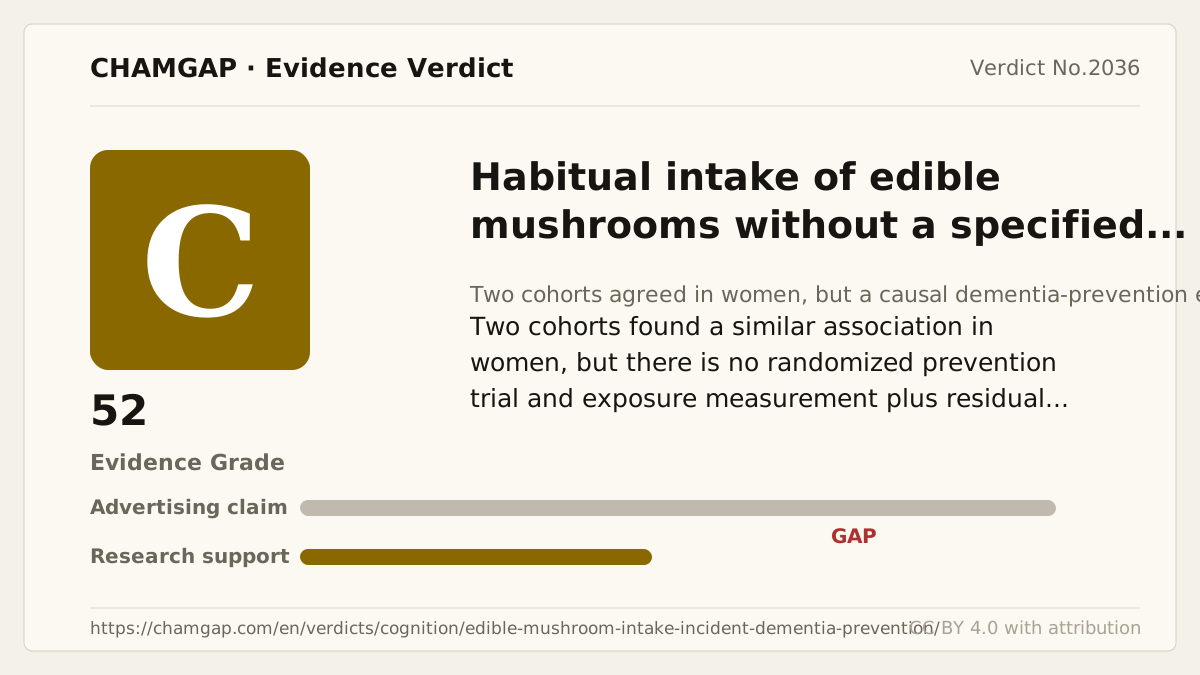
[Chamgap] Edible mushroom intake x prevention of incident dementia — Evidence Grade C·56. 2 cited sources checked. Source: https://chamgap.com/en/verdicts/cognition/edible-mushroom-intake-incident-dementia-prevention/ · CC BY 4.0CC BY 4.0 — free to use with attribution; do not distort grades, numbers, or verdict meaning.
What this document does and does not do
Chamgap is an information source. It reports what research has and has not confirmed; it does not tell readers what to take or buy. That decision belongs to readers and, when needed, medical or legal professionals. This verdict reflects literature available up to the search date and may change as new research appears. Nothing here is medical advice.