
Early decompressive hemicraniectomy,
does it really help with Reduced combined risk of death and severe disability when performed within 48 hours for malignant middle cerebral artery infarction?
research showsEarly decompressive hemicraniectomy is rated B because surgery within 48 hours of malignant middle cerebral artery infarction markedly lowers mortality and improves composites of death or the most severe disability. The prespecified pooled analysis of DECIMAL, DESTINY, and HAMLET included 93 patients aged 60 years or younger and reduced one-year mortality from 71% to 22% while increasing survival with modified Rankin Scale scores of 4 or less. Many survivors nevertheless remained at mRS 4 and required help with most bodily needs. DESTINY II in patients older than 60 also improved survival, but independent survival was exceptionally uncommon. Urgent shared decision-making must incorporate the patient's values concerning survival and disability.
ads claimIt is inaccurate to describe this as surgery that restores normal function after stroke. Its central purpose is to prevent death from malignant cerebral edema, and survivors may need prolonged rehabilitation, caregiving, and later cranioplasty.
Useful facts when choosing a product
- Candidates have a large middle cerebral artery infarction with progressive edema and an expected malignant course; this is not preventive surgery for an ordinary small infarct.
- The strongest randomized evidence concerns surgery within 48 hours and patients aged 60 years or younger; above 60, the survival benefit must be discussed together with a greater disability burden.
- Risks include bleeding, infection, wound complications, seizures, cerebrospinal-fluid problems, and anesthesia, and later cranioplasty is commonly required.
- Because reduced consciousness often prevents direct consent, prior wishes, family discussion, expected modified Rankin outcomes, and long-term care burden should be reviewed.
Chamgap Semantic Classification Code
Candidate index · review held
P.early-decompressive-hemicraniectomy.procedural.combined-risk-of-death-and-severe-disability-when-performed-within-for-malignant-middle-cerebral-artery-infarction.reduce.usual-careProcedures, devices and tests > Early decompressive hemicraniectomy > Procedural > combined risk of death and severe disability when performed within for malignant middle cerebral artery infarction > Reduction claim > Usual care
An automated migration candidate, not an issued permanent code; exact claim scope remains under review. This machine-generated migration candidate helps retrieval but is not a permanent assignment. The original verdict ID and URL remain authoritative.
What the research actually shows
Vahedi and colleagues performed a prespecified individual-patient pooled analysis of 93 patients aged 60 years or younger who were randomized within 48 hours in DECIMAL, DESTINY, and HAMLET. Surgery reduced one-year mortality from 71% to 22%, increased survival with mRS 4 or less from 24% to 75%, and increased survival with mRS 3 or less from 21% to 43%. An mRS score of 4 nevertheless means moderately severe disability with assistance needed for most bodily needs. DESTINY II randomized 112 patients aged 61 years or older within 48 hours and improved survival with mRS 0 to 4 at six months, but no participant survived independently or with only slight disability and many surgical survivors had mRS 4 or 5.
Why this is classified as B (73)
Randomized pooled evidence and an older-patient trial show clear procedure-specific mortality reduction, but the pivotal younger-patient analysis included only 93 people and many survivors remained moderately to severely disabled. The severe-disability survival ceiling and small sample support B with 73 points.
Counterpoint. B does not mean that the effect is small. The absolute mortality reduction is very large, but outcome value cannot be separated from the resulting level of disability.
Rejudgment record. Cross-check applied — Accepted procedure-specific mortality reduction with surgery within 48 hours, while applying the B ceiling for a 93-patient pooled sample and substantial survival with mRS 4 to 5 disability. At cross-check the score was lowered to 73 because the pooled analysis included 93 participants and substantial dependent survival and severe disability remain (grade B retained).
Sub-claim grades by effect
This ingredient is marketed for several effects. A single overall grade blends strong and weak claims together, so each effect is graded separately here. The overall grade reflects the strongest disconfirming or core claim.
| Effect (sub-claim) | Grade | Basis |
|---|---|---|
| Reduced one-year mortality | B | Mortality fell markedly from 71% to 22% in a pooled sample of 93 patients aged 60 or younger, but the sample was small. |
| Reduced combined risk of death or the most severe disability | B | Survival with mRS 4 or less increased, but mRS 4 itself requires help with most bodily needs. |
| Increased functionally independent survival | C | The effect was smaller than the mortality benefit even in younger patients, and no independent survivors were observed in the older-patient trial. |
Cross-check — AI research and Codex final gate
Evidence Table
| Study | Design | Sample | Funding | Endpoint | Result | Weight |
|---|---|---|---|---|---|---|
| Vahedi K et al. 2007 pooled DECIMAL, DESTINY, and HAMLET analysis | Prespecified individual-patient pooled analysis of three randomized trials | 93 patients aged 18 to 60 years | Pooled academic trials with public and institutional support | One-year survival with mRS 4 or less, survival with mRS 3 or less, and death | Mortality fell from 71% to 22%, survival with mRS 4 or less rose from 24% to 75%, and survival with mRS 3 or less rose from 21% to 43%. | Key procedure-specific pooled randomized evidence |
| Jüttler E et al. 2014 DESTINY II | Multicenter randomized standard-care-controlled trial | 112 patients aged 61 years or older | Public and academic support including the German Research Foundation | Six-month survival with mRS 0 to 4 and disability distribution | Surgery within 48 hours increased survival, but no patient survived independently and most survivors had substantial disability. | Older-patient generalizability and disability-burden evidence |
Receipt — 2 References
All 2 cited sources were verified for existence at the original page (as of 2026-07-23).
Final verification and publication gate: Codex · Evidence date: 2026-07-23 · Corrections: none
Cite this verdict
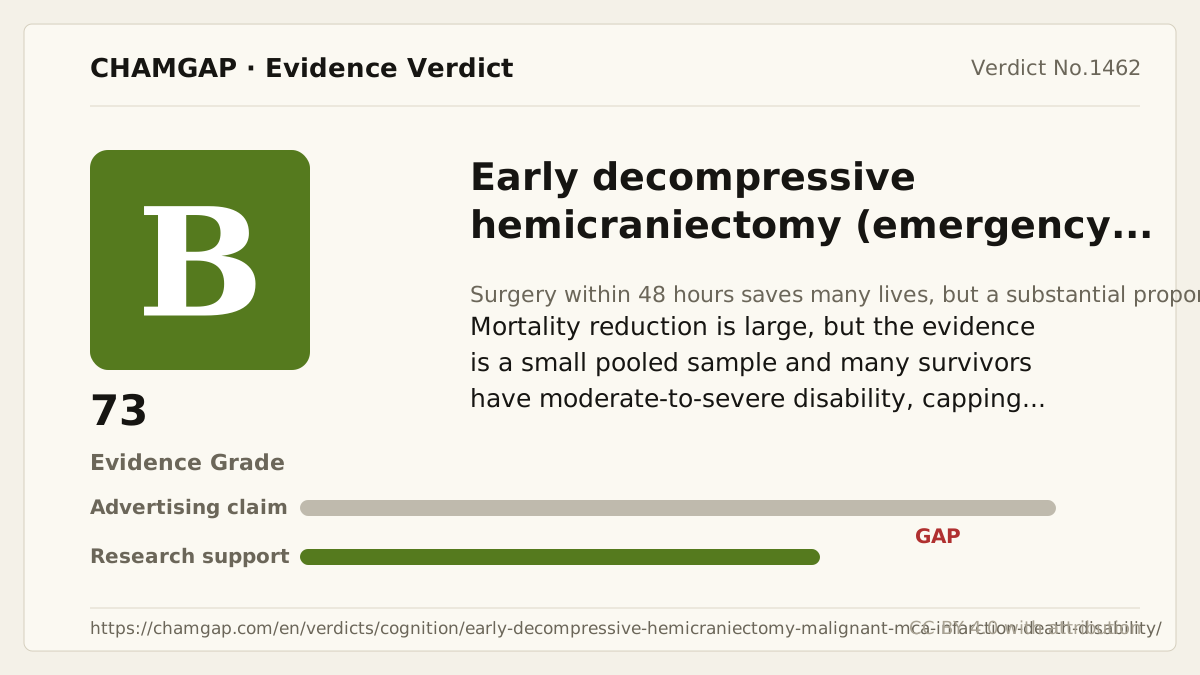
[Chamgap] Early decompressive hemicraniectomy x reduced death and severe disability in malignant middle cerebral artery infarction — Evidence Grade B·73. 2 cited sources checked. Source: https://chamgap.com/en/verdicts/cognition/early-decompressive-hemicraniectomy-malignant-mca-infarction-death-disability/ · CC BY 4.0CC BY 4.0 — free to use with attribution; do not distort grades, numbers, or verdict meaning.
What this document does and does not do
Chamgap is an information source. It reports what research has and has not confirmed; it does not tell readers what to take or buy. That decision belongs to readers and, when needed, medical or legal professionals. This verdict reflects literature available up to the search date and may change as new research appears. Nothing here is medical advice.