
Early-childhood screen exposure,
does it really help with More developmental screening delay at ages two and four?
research showsThe grade is C. In a prospective birth cohort of 7,097 children, communication delay at age two occurred in 14.8% of those with at least four hours per day at age one versus 3.5% with less than one hour; adjusted OR 4.78 (95% CI 3.24 to 7.06). At age four, rates were 8.6% versus 3.3%, OR 2.68 (1.68 to 4.27). This was not randomized, exposure and screening were parent-reported, and ASQ-3 did not establish a clinical diagnosis or causation.
ads claimKorean guidance and debate about smartphone parenting involve time, content, co-viewing, and displacement of sleep, play, and conversation. Verdict 2251 is C with 54 points for smartphone restriction and depression in college students; verdict 2257 is C with 54 points for screen time and myopia; verdict 2260 is C with 54 points for family screen limits and physical activity. Their populations and outcomes differ from this developmental screener.
Useful facts when choosing a product
- Screen exposure at age one and ASQ-3 at ages two and four were parent-reported.
- ASQ-3 delay signaled need for assessment and was not a clinical diagnosis.
- The exposure questionnaire did not separate content quality, co-viewing, or educational purpose.
Chamgap Semantic Classification Code
Candidate index · review held
UNK.screen-exposure-at-age-one.UNK.more-developmental-screening-delay-at-ages-two-and-four.reduce.UNKUnknown > Screen exposure at age one > Unknown > More developmental screening delay at ages two and four > Reduction claim > Unknown
An automated migration candidate, not an issued permanent code; exact claim scope remains under review. This machine-generated migration candidate helps retrieval but is not a permanent assignment. The original verdict ID and URL remain authoritative.
What the research actually shows
The Japanese TMM BirThree prospective birth cohort used a parental questionnaire at age one and grouped daily screen time as less than one, one to under two, two to under four, or at least four hours. The 7,097 children numbered 3,440, 2,095, 1,272, and 290 across those groups. Age-two communication delay was 119/3,440 (3.5%) versus 43/290 (14.8%); adjusted ORs rose from 1.61 to 2.04 to 4.78 across exposure categories. Age-four communication delay was 3.3% versus 8.6%, OR 2.68. For at least four hours, problem-solving delay ORs were 2.67 at age two and 1.91 at age four. ASQ-3 domain scores below two SDs from the Japanese reference mean signaled need for assessment, not a clinical diagnosis. Covariates were child sex, maternal age at delivery, parity, annual household income, maternal education, living with grandparents or other adults, postpartum depression, and maternal bonding disorder. Baseline development, parenting interaction, and home language were absent. Of 23,130 pairs, 16,033 were excluded, including 8,820 missing exposure and 2,512 or 3,321 missing age-two or age-four outcomes. Clinical-trial registration was not applicable to this observational cohort. Funding stated that the cohort was supported by grants JP17km0105001, JP21tm0124005, and JP19gk0110039 from the Japan Agency for Medical Research and Development; the funder had no study or publication role.
Why this is classified as C (54)
A large prospective dose-response is limited by screening outcomes, reverse causation, unadjusted language and caregiving context, and 69% exclusion, giving C with 54 points.
Counterpoint. Exposure preceded outcome, but absent baseline development means reverse causation was not removed. Association must not be rewritten as causation.
Rejudgment record. Cross-check applied — Large dose-response in a prospective cohort limited by screening outcomes, reverse causation, residual confounding, and selection
| Endpoint | S | Surrogate marker - laboratory or imaging measures |
| Replication | R1 | Single confirmatory trial |
| Independence | I2 | Decisive evidence is publicly or non-profit funded |
| Effect size | E+ | Meets the clinically important threshold |
Stored derived and displayed grades match; this is not a current recalculation or validity check (C).
Sub-claim grades by effect
This ingredient is marketed for several effects. A single overall grade blends strong and weak claims together, so each effect is graded separately here. The overall grade reflects the strongest disconfirming or core claim.
| Effect (sub-claim) | Grade | Basis |
|---|---|---|
| At least four screen hours at age one and communication screening delay at age two | C | Rates were 14.8% versus 3.5%, aOR 4.78 (3.24 to 7.06). |
| At least four screen hours at age one and communication screening delay at age four | C | Rates were 8.6% versus 3.3%, aOR 2.68 (1.68 to 4.27). |
| Increased clinical diagnosis of developmental disorder | ? | This study measured screening scores, not clinical diagnosis. |
Cross-check — AI research and Codex final gate
Evidence Table
| Study | Design | Sample | Funding | Endpoint | Result | Weight |
|---|---|---|---|---|---|---|
| Yamamoto et al. TMM BirThree cohort 2023 | Prospective birth cohort measuring outcomes at ages two and four after exposure at age one | 7,097 analyzed | AMED grants JP17km0105001, JP21tm0124005, and JP19gk0110039 | Parent-reported ASQ-3 domain screening delay | Age-two communication delay 14.8% versus 3.5%, aOR 4.78 (3.24 to 7.06); age-four 8.6% versus 3.3%, aOR 2.68 (1.68 to 4.27) | Pivotal prospective observational evidence |
Receipt — 2 References
All 2 cited sources were verified for existence at the original page (as of 2026-08-08).
Final verification and publication gate: Codex · Evidence date: 2026-08-08 · Corrections: none
Cite this verdict
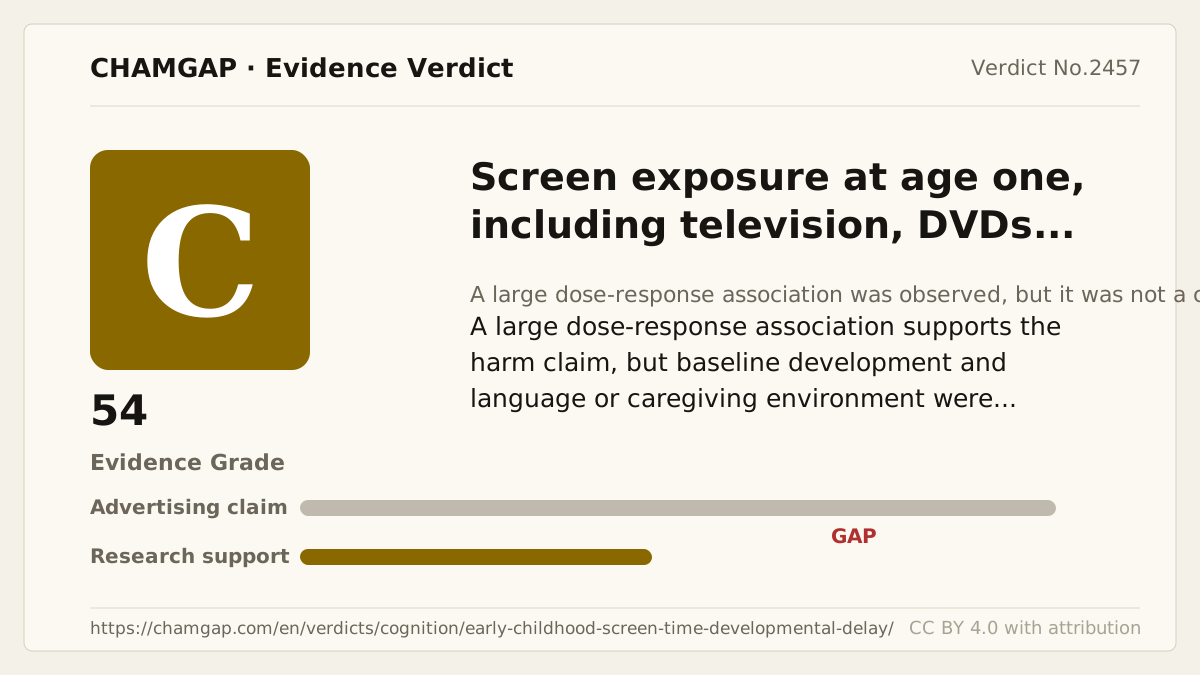
[Chamgap] Early-childhood screen exposure x developmental delay — Evidence Grade C·54. 2 cited sources checked. Source: https://chamgap.com/en/verdicts/cognition/early-childhood-screen-time-developmental-delay/ · CC BY 4.0CC BY 4.0 — free to use with attribution; do not distort grades, numbers, or verdict meaning.
What this document does and does not do
Chamgap is an information source. It reports what research has and has not confirmed; it does not tell readers what to take or buy. That decision belongs to readers and, when needed, medical or legal professionals. This verdict reflects literature available up to the search date and may change as new research appears. Nothing here is medical advice.