
Donepezil,
does it really help with Symptomatic relief of cognition and daily function in mild-to-moderate Alzheimer dementia?
research showsDonepezil is rated B because it provides small symptomatic benefits in cognition and daily function in established Alzheimer dementia. A Cochrane review of 30 trials involving 8,257 participants found a 24-to-26-week difference of -2.67 points on ADAS-Cog and +1.05 points on the MMSE, with small benefits in daily function and clinician-rated global status. The effect is symptomatic and modest, however, most trials lasted six months or less, and industry sponsorship was common. This indication differs from verdict 634, rated F for preventing progression from mild cognitive impairment to Alzheimer disease.
ads claimClaims that donepezil restores memory, stops dementia progression, or returns a person to normal inflate a small average symptomatic effect into disease modification. It may temporarily improve or slow decline in some cognitive and daily activities, but it does not remove Alzheimer pathology.
Useful facts when choosing a product
- Donepezil is a prescription symptomatic treatment for Alzheimer dementia; preventing conversion from mild cognitive impairment is a different indication.
- Treatment usually starts at a lower dose and is increased after tolerability is established; 10 mg may provide slightly more cognitive benefit than 5 mg but also causes more adverse events and discontinuations.
- Cholinergic adverse effects can include nausea, vomiting, diarrhea, appetite loss, weight loss, vivid dreams, and insomnia.
- Bradycardia, cardiac conduction problems, syncope, and falls require caution in people with a slow pulse, conduction disease, or interacting medicines.
Chamgap Semantic Classification Code
Candidate index · review held
M.donepezil.UNK.symptomatic-relief-of-cognition-and-daily-function-in-mild-to-moderate-alzheimer-dementia.relieve.placeboMedicinal interventions > Donepezil > Unknown > Symptomatic relief of cognition and daily function in mild-to-moderate Alzheimer dementia > Symptom-relief claim > Placebo
An automated migration candidate, not an issued permanent code; exact claim scope remains under review. This machine-generated migration candidate helps retrieval but is not a permanent assignment. The original verdict ID and URL remain authoritative.
What the research actually shows
Rogers 1998 randomized 473 people with mild-to-moderate Alzheimer disease to placebo, donepezil 5 mg, or donepezil 10 mg for 24 weeks; both doses improved ADAS-Cog and global clinical ratings. Birks and Harvey 2018 reviewed 30 trials involving 8,257 participants and found that 10 mg/day at 24 to 26 weeks improved ADAS-Cog by 2.67 points, MMSE by 1.05 points, clinician-rated global improvement with an odds ratio of 1.92, and daily function by a small amount. The independent AD2000 trial found average differences over the first two years of +0.8 MMSE points and +1.0 BADLS point, but no difference at three years in institutionalization, 42% versus 44%, or disability progression, 58% versus 59%. The evidence therefore supports symptom relief in established dementia without extending the claim to disease modification or prevention of institutionalization.
Why this is classified as B (69)
Placebo-controlled trials and the 8,257-participant Cochrane review repeatedly found small direct benefits in cognition, daily function, and global status, supporting B with 69 points. Industry-sponsor concentration, short trial duration, modest effect size, and null institutionalization and disability-progression outcomes in an independent long-term trial prevent an A grade. Nausea, bradycardia, and syncope are safety issues separate from efficacy.
Counterpoint. Response varies, so treatment after a confirmed diagnosis is best followed against defined cognitive and daily-function goals. If benefit is absent or adverse effects are substantial, tapering or stopping should be discussed with the prescriber rather than done abruptly without guidance.
Rejudgment record. New verdict — Accepted small but repeated direct benefits in cognition, daily function, and clinician-rated global status across 30 placebo-controlled trials while accounting for sponsor concentration, short follow-up, and null institutionalization and disability-progression outcomes in an independent long-term trial
Sub-claim grades by effect
This ingredient is marketed for several effects. A single overall grade blends strong and weak claims together, so each effect is graded separately here. The overall grade reflects the strongest disconfirming or core claim.
| Effect (sub-claim) | Grade | Basis |
|---|---|---|
| Relief of cognitive symptoms in mild-to-moderate Alzheimer dementia | B | Placebo-controlled trials and the Cochrane review repeatedly found small average benefits of about 2.7 ADAS-Cog points and one MMSE point. |
| Relief of daily-function symptoms in mild-to-moderate Alzheimer dementia | B | The synthesis and independent AD2000 trial found small functional differences without significantly preventing disability progression. |
| Improvement in clinician-rated global symptoms of Alzheimer dementia | B | Clinician-rated global improvement had an odds ratio of 1.92 at 24 to 26 weeks, but this is symptomatic assessment rather than evidence of disease modification. |
Cross-check — AI research and Codex final gate
Evidence Table
| Study | Design | Sample | Funding | Endpoint | Result | Weight |
|---|---|---|---|---|---|---|
| Rogers SL et al. 1998 | Multicenter randomized double-blind placebo-controlled trial | 473 participants with mild-to-moderate Alzheimer disease over 24 weeks | Eisai-affiliated investigators in a product-development context | ADAS-Cog, clinician and caregiver global assessments, and safety | Both 5 mg and 10 mg were superior to placebo on ADAS-Cog and global assessments at weeks 12, 18, and 24. | Key direct symptomatic-efficacy trial |
| Birks JS and Harvey RJ. 2018 | Cochrane systematic review and meta-analysis of randomized trials | 30 trials and 8,257 participants | Review authors reported no conflicts; 17 included trials were industry funded or sponsored | Cognition, activities of daily living, global status, behavior, quality of life, and adverse events | At 24 to 26 weeks, ADAS-Cog improved by 2.67 points and MMSE by 1.05 points, with small daily-function and global benefits. | Key synthesis |
| Courtney C et al.; AD2000 Collaborative Group. 2004 | Independent long-term randomized double-blind placebo-controlled trial | 565 participants with mild-to-moderate Alzheimer disease | Public and nonprofit support including United Kingdom NHS research and development and the Alzheimer's Society | Institutionalization, disability progression, cognition, and daily function | Cognition and function were slightly better, but institutionalization and disability progression were not significantly reduced at three years. | Independent evidence limiting the long-term claim |
Receipt — 3 References
All 3 cited sources were verified for existence at the original page (as of 2026-07-21).
Final verification and publication gate: Codex · Evidence date: 2026-07-21 · Corrections: none
Cite this verdict
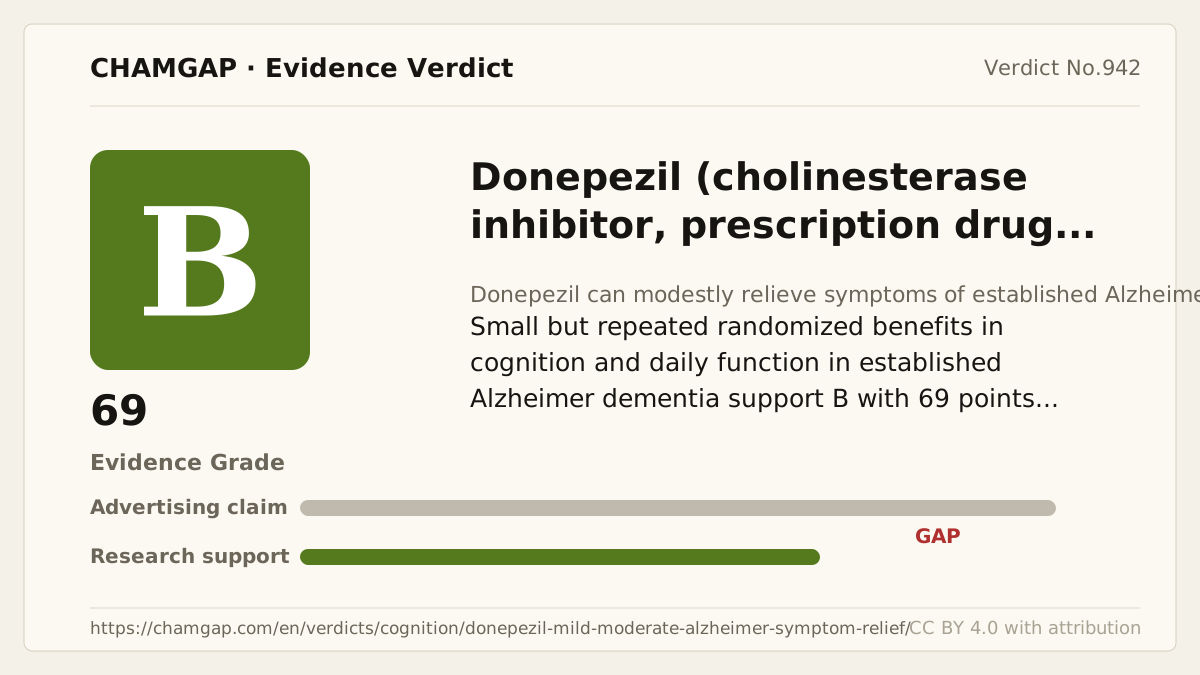
[Chamgap] Donepezil x symptomatic relief of cognition and daily function in mild-to-moderate Alzheimer dementia — Evidence Grade B·69. 3 cited sources checked. Source: https://chamgap.com/en/verdicts/cognition/donepezil-mild-moderate-alzheimer-symptom-relief/ · CC BY 4.0CC BY 4.0 — free to use with attribution; do not distort grades, numbers, or verdict meaning.
What this document does and does not do
Chamgap is an information source. It reports what research has and has not confirmed; it does not tell readers what to take or buy. That decision belongs to readers and, when needed, medical or legal professionals. This verdict reflects literature available up to the search date and may change as new research appears. Nothing here is medical advice.