
Donanemab,
does it really help with Slowed cognitive and functional decline in amyloid-confirmed early symptomatic Alzheimer disease?
research showsDonanemab is rated C because it statistically slowed cognitive and functional decline over 76 weeks in amyloid-confirmed mild cognitive impairment or mild dementia due to Alzheimer disease, but the absolute difference was modest and serious ARIA risk was substantial. In the full TRAILBLAZER-ALZ 2 population, iADRS decline slowed by about 22% and CDR-SB decline by about 29%, while the absolute CDR-SB difference was under 0.7 point. ARIA-E occurred in 24.0%, ARIA-H in 31.4%, and deaths related to severe ARIA were reported.
ads claimMarketing may say that amyloid removal stops Alzheimer progression by 35%. The evidence shows a modest average slowing of score decline over about 18 months in selected early disease, not memory restoration or cessation of dementia.
Useful facts when choosing a product
- Donanemab is administered intravenously by specialists for amyloid-confirmed mild cognitive impairment or mild dementia due to Alzheimer disease; efficacy in moderate or severe disease is not established.
- Brain MRI is required before and during treatment, and headache, confusion, visual change, dizziness, nausea, gait difficulty, or seizures may indicate ARIA and require prompt evaluation.
- APOE ε4 carriers, especially homozygotes, have higher ARIA risk, supporting consideration of pretreatment genotyping and counseling; anticoagulants and thrombolytics require careful hemorrhage-risk review.
- ARIA-E edema or effusion, ARIA-H microhemorrhage or superficial siderosis, infusion reactions, and rare severe intracerebral hemorrhage or death can occur.
Chamgap Semantic Classification Code
Candidate index · review held
M.donanemab.intravenous.slowed-cognitive-and-functional-decline-in-amyloid-confirmed-early-symptomatic-alzheimer-disease.assess.placeboMedicinal interventions > Donanemab > Intravenous > Slowed cognitive and functional decline in amyloid-confirmed early symptomatic Alzheimer disease > Association or change assessment > Placebo
An automated migration candidate, not an issued permanent code; exact claim scope remains under review. This machine-generated migration candidate helps retrieval but is not a permanent assignment. The original verdict ID and URL remain authoritative.
What the research actually shows
Sims 2023 TRAILBLAZER-ALZ 2 randomized 1,736 amyloid- and tau-PET-selected participants with early symptomatic disease to 76 weeks of donanemab or placebo. iADRS and CDR-SB decline slowed significantly in the low-to-medium-tau and full populations, and many participants switched to blinded placebo after meeting amyloid-clearance criteria. Mintun 2021, a phase 2 trial (272 randomized; 257 in the iADRS efficacy analysis), also signaled benefit on iADRS and amyloid removal, while secondary clinical outcomes were mixed.
Why this is classified as C (52)
The large phase 3 trial significantly improved direct cognitive-functional and CDR-SB trajectories, supported by a phase 2 signal, but the absolute difference was small and clinical importance and long-term net benefit remain uncertain. High ARIA incidence and rare deaths independently support C with 52 points.
Counterpoint. For an amyloid-confirmed early-stage patient who can undergo MRI surveillance, has lower hemorrhage risk, and highly values time gained, treatment can be reasonable. Burden, cost, ARIA risk, and modest average benefit require shared comparison.
Rejudgment record. Cross-check applied — Applied rule ③ and grade C because a large phase 3 trial statistically established direct cognitive and functional slowing, but absolute benefit was modest, clinical importance and long-term net benefit remain uncertain, and ARIA, hemorrhage, and death risks are substantial. At cross-check the score was lowered to 52 for the modest absolute effect and ARIA and treatment-related death risk (grade C retained).
Sub-claim grades by effect
This ingredient is marketed for several effects. A single overall grade blends strong and weak claims together, so each effect is graded separately here. The overall grade reflects the strongest disconfirming or core claim.
| Effect (sub-claim) | Grade | Basis |
|---|---|---|
| Slowed cognitive and functional decline in amyloid-confirmed early symptomatic Alzheimer disease | C | The large phase 3 trial was significant, but the absolute difference was modest and individual clinical importance remains uncertain. |
| Removal of brain amyloid plaque | C | The PET surrogate improved markedly but is not equivalent to restoration of clinical function. |
| Reduced rate of clinical progression in early Alzheimer disease | C | Relative slowing is established, but progression does not stop and ARIA, hemorrhage, and death risks limit net benefit. |
Cross-check — AI research and Codex final gate
Evidence Table
| Study | Design | Sample | Funding | Endpoint | Result | Weight |
|---|---|---|---|---|---|---|
| Sims JR et al. 2023 TRAILBLAZER-ALZ 2 | Multicenter double-blind placebo-controlled phase 3 trial | 1,736 participants; 860 donanemab and 876 placebo | Eli Lilly and Company | Seventy-six-week iADRS, CDR-SB, and amyloid removal | In the full population, iADRS decline slowed about 22% and CDR-SB decline about 29%; ARIA-E was 24.0% and ARIA-H 31.4%. | Key direct clinical efficacy and safety trial |
| Mintun MA et al. 2021 TRAILBLAZER-ALZ | Double-blind placebo-controlled phase 2 trial | 272 randomized; 257 in the iADRS efficacy analysis (131 donanemab, 126 placebo) | Eli Lilly and Company | Seventy-six-week iADRS, secondary clinical scales, and amyloid | iADRS decline slowed significantly and amyloid fell markedly, but some secondary clinical outcomes were not significant. | Preceding replication signal with uncertainty |
Receipt — 2 References
All 2 cited sources were verified for existence at the original page (as of 2026-07-23).
Final verification and publication gate: Codex · Evidence date: 2026-07-23 · Corrections: none
Cite this verdict
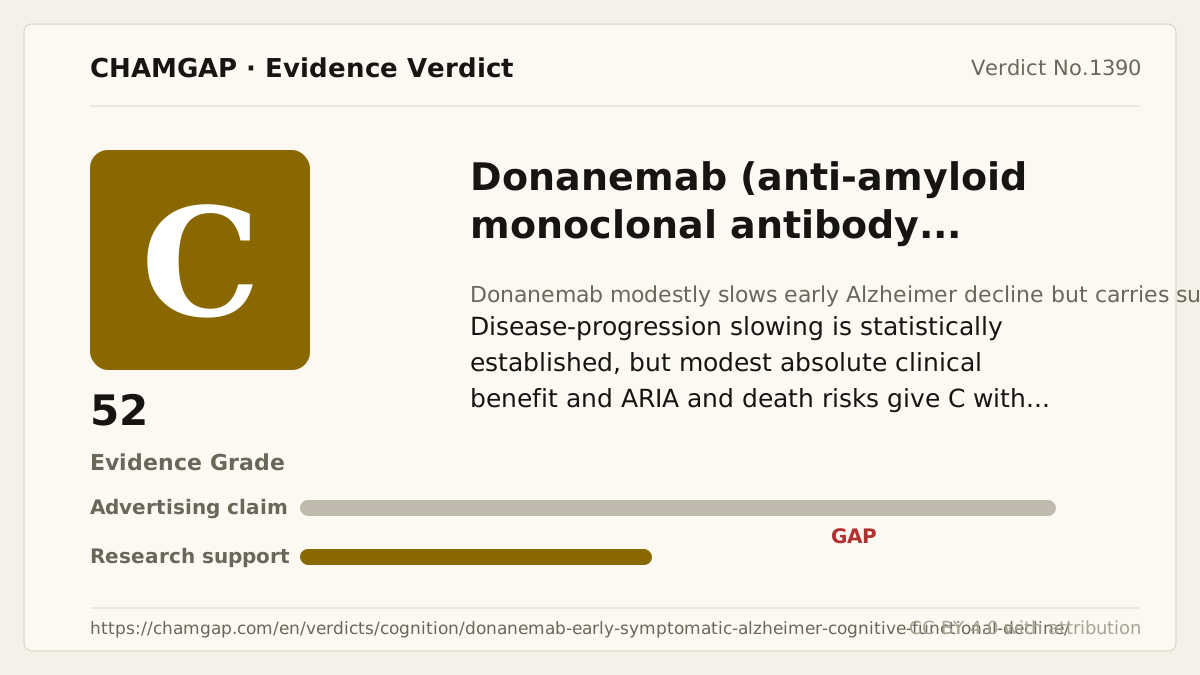
[Chamgap] Donanemab x slowed cognitive and functional decline in amyloid-confirmed early Alzheimer disease — Evidence Grade C·52. 2 cited sources checked. Source: https://chamgap.com/en/verdicts/cognition/donanemab-early-symptomatic-alzheimer-cognitive-functional-decline/ · CC BY 4.0CC BY 4.0 — free to use with attribution; do not distort grades, numbers, or verdict meaning.
What this document does and does not do
Chamgap is an information source. It reports what research has and has not confirmed; it does not tell readers what to take or buy. That decision belongs to readers and, when needed, medical or legal professionals. This verdict reflects literature available up to the search date and may change as new research appears. Nothing here is medical advice.