
Dog ownership,
does it really help with Reduced incident disabling dementia?
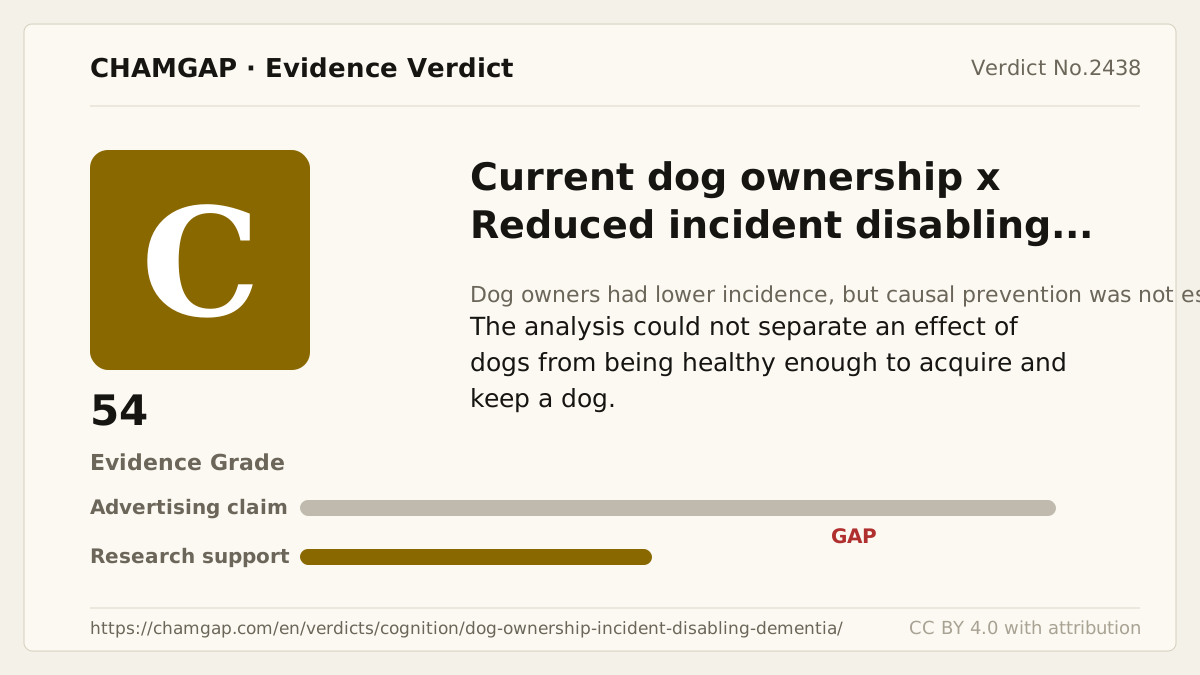
research showsThe grade is C. In 11,194 community-dwelling Tokyo adults aged 65-84 followed for about four years, incidence was 3.6% in current dog owners versus 5.1% in past or never owners; propensity-weighted OR 0.60 (95% CI 0.37-0.97). Reverse causation remains substantial.
ads claimThe study does not justify saying that adopting a dog prevents dementia in Korea. Walking and social contact may be useful, but caregiving ability, cost, and animal welfare matter.
Useful facts when choosing a product
- Ownership was self-reported, not obtained from a registration system.
- The outcome was physician-rated dementia-related disability in long-term-care insurance.
- Verdict 2212 is C with 54 points and comes from a different Swedish cohort and endpoint.
Chamgap Semantic Classification Code
Candidate index · review held
UNK.current-dog-ownership.UNK.incident-disabling-dementia.reduce.UNKUnknown > Current dog ownership > Unknown > incident disabling dementia > Reduction claim > Unknown
An automated migration candidate, not an issued permanent code; exact claim scope remains under review. This machine-generated migration candidate helps retrieval but is not a permanent assignment. The original verdict ID and URL remain authoritative.
What the research actually shows
A self-administered 2016 survey in Ota City, Tokyo measured current ownership, with follow-up through July 2020. Participants lacked long-term-care certification at baseline, but the study did not exclude dementia events during an initial lag period. Disabling dementia meant a new physician-rated dementia-related independence grade in Japan's long-term-care insurance system, not every specialist-diagnosed dementia. Propensity variables included sex, age, household size, marital status, education, equivalent income, employment, chronic disease, recent hospitalization, smoking, frailty, neighborhood interaction and trust, and psychological well-being. Income and living arrangement were addressed, but direct cognitive testing and latent prodromal disease were not. Exercise and social isolation were examined as interactions: OR 0.37 for exercising owners and 0.41 for non-isolated owners. Verdict 2212 is C with 54 points and uses Swedish dog-registration data for mortality; this Japanese self-report cohort and dementia endpoint are different data.
Why this is classified as C (54)
A significant objective-event association is tempered by reverse causation, healthy-owner selection, and multiple analyses, giving C with 54 points.
Counterpoint. Ownership was measured once, so adoption and relinquishment during follow-up were missed.
Rejudgment record. Cross-check applied — An objective long-term-care event association tempered by reverse causation and healthy-owner selection
| Endpoint | H | Hard endpoint - actual events such as death |
| Replication | R1 | Single confirmatory trial |
| Independence | I1 | Mixed funding sources |
| Effect size | E+ | Meets the clinically important threshold |
Stored derived and displayed grades match; this is not a current recalculation or validity check (C).
Sub-claim grades by effect
This ingredient is marketed for several effects. A single overall grade blends strong and weak claims together, so each effect is graded separately here. The overall grade reflects the strongest disconfirming or core claim.
| Effect (sub-claim) | Grade | Basis |
|---|---|---|
| Reduced disabling dementia | C | OR was 0.60, but the evidence is observational. |
Cross-check — AI research and Codex final gate
Evidence Table
| Study | Design | Sample | Funding | Endpoint | Result | Weight |
|---|---|---|---|---|---|---|
| Taniguchi Y et al. 2023 Ota Genki Senior Project | Community prospective cohort with inverse-probability propensity weighting | 11,194 participants; 8.6% current dog owners | Original statement: supported by grants from Ota City, Japan Health Promotion & Fitness Foundation, Sugiura Memorial Foundation, The Japan Foundation for Aging and Health, and JSPS KAKEN Grant number 16K16615 | Long-term-care-insurance disabling dementia over about four years | 3.6% versus 5.1%; OR 0.60 (95% CI 0.37-0.97); cat OR 0.98 (0.62-1.55) | Direct observational evidence |
Receipt — 1 References
All 1 cited sources were verified for existence at the original page (as of 2026-08-08).
Final verification and publication gate: Codex · Evidence date: 2026-08-08 · Corrections: none
Cite this verdict
[Chamgap] Dog ownership x reduced incident disabling dementia — Evidence Grade C·54. 1 cited sources checked. Source: https://chamgap.com/en/verdicts/cognition/dog-ownership-incident-disabling-dementia/ · CC BY 4.0CC BY 4.0 — free to use with attribution; do not distort grades, numbers, or verdict meaning.
What this document does and does not do
Chamgap is an information source. It reports what research has and has not confirmed; it does not tell readers what to take or buy. That decision belongs to readers and, when needed, medical or legal professionals. This verdict reflects literature available up to the search date and may change as new research appears. Nothing here is medical advice.